

The MacGyver General: The Missing Piece in Every Leader’s Strategy
By Atip Muangsuwan
“The missing piece in every leader’s strategy is the MacGyverisms piece.”
Atip Muangsuwan
CEO Coach and Coach Supervisor
John had a plan.
Actually, John had several plans. As a rising executive in the vertical transportation business, he had already collected a small arsenal of frameworks. He had the CA-BAC Winning Team Framework. He had the V-VIP Fast-Track-To-Promotion Framework.
He was climbing fast. But he wanted to climb even faster. He wanted the corner office with the “CEO of APAC Business Units” on the door — and he wanted to know how to see the future before it arrived.
So, when I asked him what topic he wanted for our session, he didn’t hesitate. “Leader As Strategist.”
It made sense. John defined a leader as strategist as a person who understands markets, connects with top management, drives innovation. All true. But all incomplete.
Because here is the uncomfortable truth about strategy: everyone has a plan until they get punched in the face.
The question isn’t whether you can build a beautiful plan. The question is whether you can win when the plan catches fire.
That’s when I introduced John to a framework I’ve refined over years of coaching leaders across the globe — and to a new addition that changes everything.
First, the Foundation: ADU
Whenever I think of the greatest strategist who ever lived, I think of Sun Tzu. His Art of War isn’t a book about war. It’s a book about winning before the fighting starts. And this book can be applied in business as well as in life.
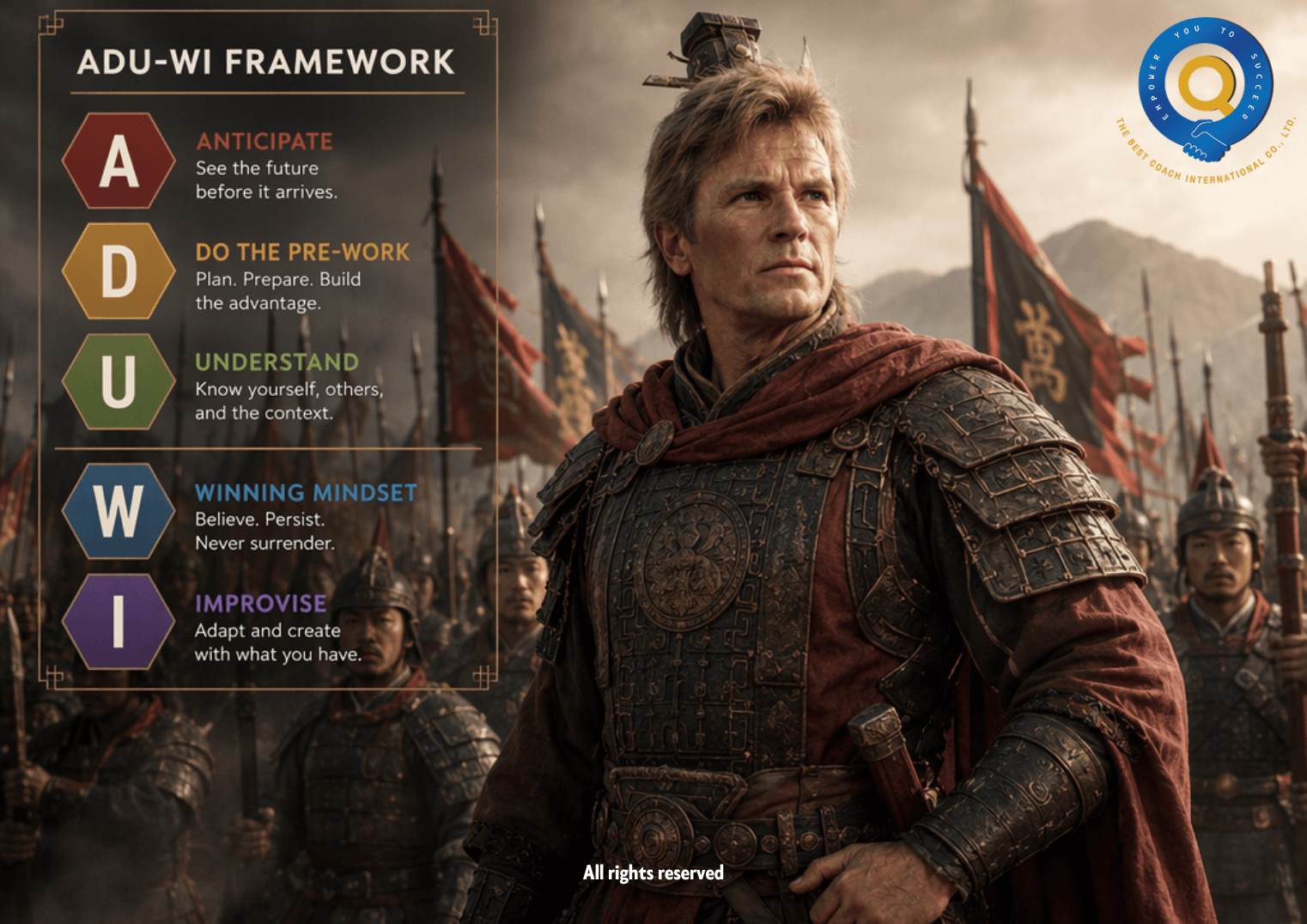
From his teachings, I built the ADU Strategic Thinking Framework:
A — Anticipate the future.
Trends. Changes. Disruptions. Incidents. The heart and soul of strategy is seeing what’s coming before it arrives.
D — Do the pre-work.
Planning, preparation, research, development. Sun Tzu said it best: “Victorious warriors win first and then go to war, while defeated warriors go to war first and then seek to win.”
U — Understand oneself, others, and contexts.
“If you know the enemy and know yourself, you need not fear the result of a hundred battles. If you know Heaven and know Earth, you may make your victory complete.” Know yourself and your team. Know your competitors or rivals. Know the terrain — the market, the environment, the circumstance, the situation, the moment.
John nodded along. This made sense to him. But he was still thinking like a manager. ADU is the blueprint. It’s not the whole building.
The Two Letters That Change Everything: WI
Here’s what separates a good strategist from a legendary one. It isn’t intelligence. It isn’t even preparation.
It’s what happens after the preparation.
W — Winning Mindset.
You must believe, with absolute conviction, that you will win no matter what. Not “hope to win.” Not “try to win.” Win. Never surrender. Never give up, no matter how badly the situation deteriorates. Avoid the battle if you can. But if you cannot avoid it, the only acceptable outcome is victory. The winning mindset also includes your resilience, persistence, determination, concentration, focus, perseverance and grit. You’ll never stop until you succeed just like Abraham Lincoln, the 16th president of the United States.
I — Improvise.
This is the piece most leaders miss. You will do your best anticipation. Your best pre-work. Your best understanding. And then reality will hand you something you never saw coming — a currency crisis, a competitor’s surprise launch, a pandemic, a supply chain collapse, or even a war.
At that moment, you must become MacGyver (a fictional secret agent and the main character of the hit action-television franchise of the same name. He is best known for his resourceful “MacGyverisms”—solving complex, life-threatening problems and disarming weapons by engineering makeshift devices out of ordinary, everyday objects (like duct tape, a Swiss Army knife, paperclips, and chewing gum). Unlike traditional action heroes, MacGyver prefers non-violent resolutions and rarely uses a gun.)
You must improvise with what you have, in that situation, at that timing, in that exact moment. A plan is a starting point, not a script.
Sun Tzu planned meticulously. He also won battles by adapting on the ground. That’s the paradox of strategy: prepare like a chess grandmaster, then improvise like a jazz musician.
Putting ADU-WI to Work
John didn’t just learn a framework that day. He left with a mission.
His industry is a long-cycle business. You can’t think in quarters. You must think in decades. So, we applied ADU-WI to build his 5-to-10-year vision.
Anticipate: We looked at the future of transportation. Moving parts. Logistics. Urbanization. Where will the demand be in 2035? John even used AI to map global trends and identify future markets — a smart move for any modern strategist.
Do the pre-work: Once you see the future, you start building for it now. Research and development. New products. New capabilities.
Understand: Know your competitors. Really know them. John left with homework to study his strongest competitors in the market — their strategies, their products, their innovations, their business models, their customers — and to figure out how to win those customers over.
Winning Mindset + Improvise: And then act. John spotted something no one else in his company was looking at. His business unit in China had ample manufacturing capacity. The Japan and Korea business units were struggling with capacity constraints.
He didn’t wait for permission. He drafted a plan: manufacture in China, export to Japan and Korea. Then, he asked to lead this initiative project himself.
That’s not a task. That’s a strategy. That’s how you get noticed by the people who decide who becomes CEO of APAC.
The Real Lesson
At the end of our session, I asked John what he’d learned about himself.
His answer was quietly profound: “I need to think beyond my current boundary.”
His one-word summary of the session? “Future.”
Mine? “ADU-WI.”
Because here’s the truth I want you to sit with:
Most leaders are firefighters. They wait for the blaze, then run toward it with a hose. They’re heroic. They’re exhausted. And they’re replaceable.
Strategists are architects. They see the fire before it starts — and often, they make sure it never starts at all. And when it does start anyway? They improvise. They adapt. They win.
Sun Tzu put it simply: “If you know neither the enemy nor yourself, you will succumb in every battle.”
So, Which One Are You?
Are you reacting, or are you anticipating?
Are you following a plan, or are you building a future?
When the unexpected hits — and it will — will you freeze, or will you improvise?
The ADU-WI Leader as Strategist Framework isn’t theory. It’s a discipline. And like any discipline, it’s built one deliberate rep at a time — sometimes with a coach who’s walked the path before.
John’s session summary ended with one word: “Great.” But the real work started the moment he walked out the door.
Yours can start today.
Ready to become a leader as strategist your organization can’t afford to lose? Let’s build your ADU-WI together. Let’s connect!
About Atip Muangsuwan: Atip is an executive leadership coach who specializes in helping high-achieving leaders overcome internal barriers to unlock their full potential and drive organizational success. Through a blend of strategic frameworks and profound personal insights, he empowers leaders in transforming their mindsets, emotional states, and behaviors for lasting impact.
SHARE :
Facebook
LinkedIn
Twitter
RECOMMENDED ARTICLES :