

Why Your Engaged Team Isn’t Performing (And How to Fix It)
By Atip Muangsuwan
“Performance management isn’t about control. It’s about clarity. It’s about accountability. It’s about understanding and working with people’s psychology. It’s about creating an environment where people feel motivated to take ownership and accountability by themselves. That’s performance management!”
Atip Muangsuwan
CEO Coach and Coach Supervisor
He was drowning in his own success.
The promotion had come with a corner office, a global team, and a mandate to drive results across three continents. From the outside, George had everything a senior executive could want—title, influence, a track record of delivering billion-dollar brands to market.
But inside? He was exhausted.
“I can’t delegate,” he confessed during one of our coaching sessions. His voice carried the weight of someone who had been carrying too much for too long. “The engagement scores are through the roof. But when I hand over a project, it comes back half-baked. I end up redoing it myself.”
George was the senior executive vice president of operations for a global beverage company—a name you’d recognize from any supermarket shelf. He led thousands of employees across multiple time zones. And yet, he couldn’t free himself from the day-to-day.
“I’ve let my people’s performances slide for two to three years now,” he admitted, shaking his head. “I shouldn’t have let this happen.”
Sound familiar?
Here’s the paradox George was living: his team was engaged but not accountable. They showed up, participated in meetings, and scored well on the annual engagement survey. But when it came to taking ownership, stepping up, and delivering without hand-holding? They fell short.
George had assumed engagement and motivation were the same thing.
They’re not.
The Real Problem: Engagement vs. Motivation
Let me be clear: engagement is about connection. Motivation is about action.
George’s team felt connected to the company. They liked their jobs. They enjoyed their colleagues. But they weren’t driven to excel. They weren’t motivated to take ownership. And without ownership, accountability is impossible.
“I need to check in with them. But should they be the ones checking in with me instead?” George asked.
That question changed everything.
Because the answer is yes—if you’ve set the right expectations. If you’ve built the right systems. If you’ve given them the tools to succeed.
And that’s exactly what we set out to build.
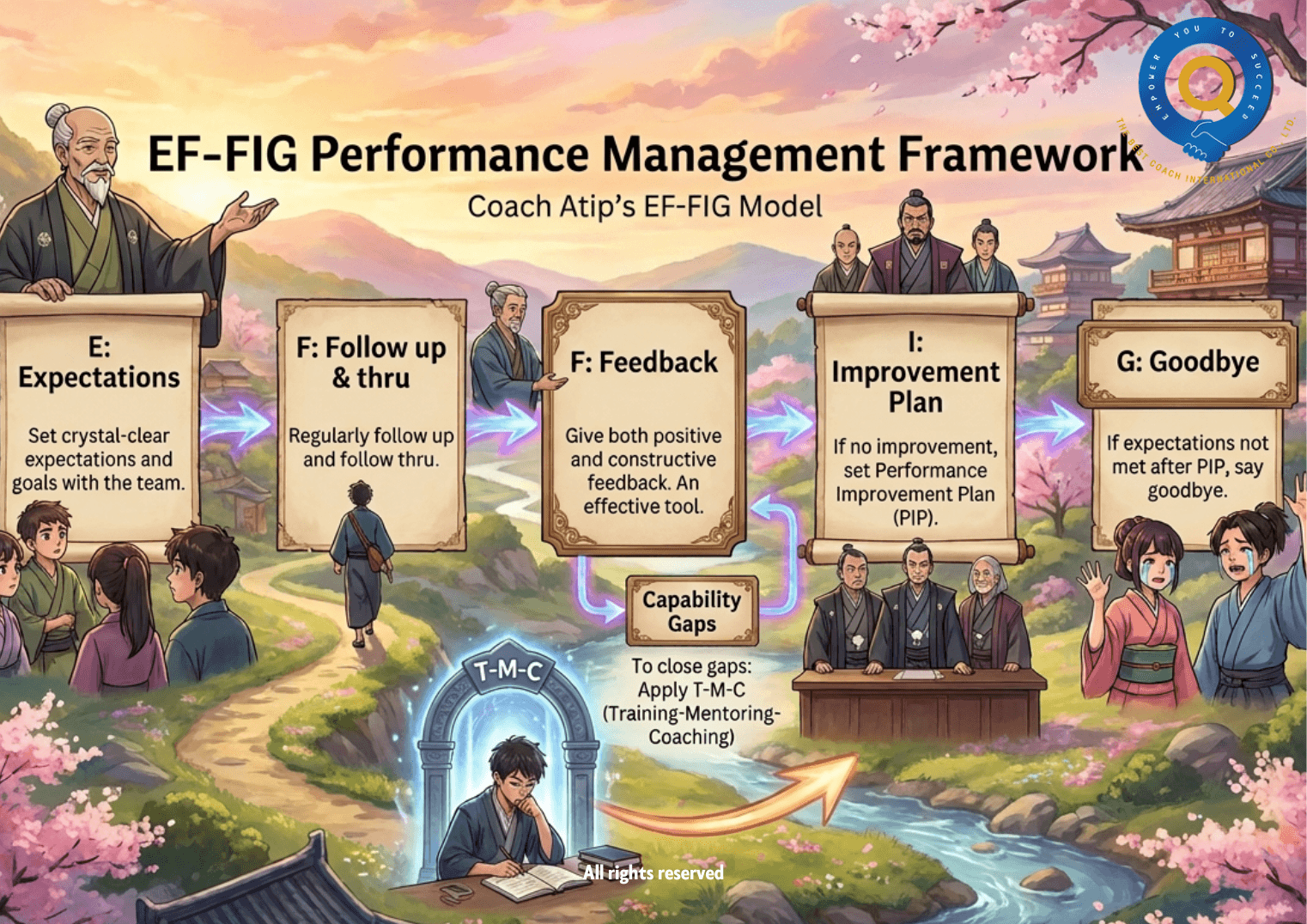
The EF-FIG Framework: A Simple System for Performance Management
Over the years of coaching executives across industries, I’ve developed a simple, repeatable framework for managing performance that actually works. I call it EF-FIG.
It’s not complicated. But it’s disciplined. And discipline is what separates high-performing teams from the rest.
E — Expectations
“Effective leaders set crystal-clear expectations and goals with their team,” I told George. “If your people don’t know exactly what success looks like, how can you expect them to deliver it?”
George realized he’d been vague. He’d assumed his team understood what he wanted. They didn’t.
The fix: Write it down. Make it specific. Make it measurable. Make it unforgettable.
F — Follow Up & Follow Through
“Who should follow up—me or them?” George asked.
My answer: “You set the rules. If you want them to check in with you, then set that expectation clearly. But whatever you decide, you must follow through.”
Regular check-ins aren’t micromanagement. They’re accountability. They’re the difference between hoping something gets done and knowing it gets done.
F — Feedback: Both Positive and Constructive
Feedback is one of the most underutilized tools in leadership. We’re quick to criticize but slow to provide the right feedback. We avoid difficult conversations because they’re uncomfortable.
But feedback—done well—is fuel.
“Give your people both positive and constructive feedback,” I told George. “And do it regularly. Don’t wait for annual reviews. Make feedback a conversation, not a verdict.”
I — Improvement Plan
When performance still falls short, it’s time for a Performance Improvement Plan (PIP). This isn’t punishment—it’s clarity. It tells your employee exactly what needs to change, by when, and how you’ll support them.
“Set the plan,” I told George. “Give them a pathway back to success.”
G — Goodbye
If the improvement plan doesn’t work—if they still can’t meet expectations—it’s time to say goodbye.
“Two or three years of underperformance is too long,” I reminded George. “You’re not doing them any favors by keeping them in a role they can’t succeed in. And you’re certainly not doing your team any favors.”
But Here’s the Secret: Performance Management Starts with People
EF-FIG gives you the system. But systems don’t work if you don’t understand the people inside them.
That’s where two additional frameworks come in nicely.
The EE-FI Leadership Model: Understanding Their Psychology
E — Engage: Connect with your people regularly and frequently. Not just when there’s a problem. Make engagement a habit.
E — Empathize: Seek to understand their psychology; i.e. thoughts, feelings, core values, belief system, expectations, needs, motivations, and so on. What drives them? What scares them? What makes them feel valued?
F — Fulfill: Every human being has psychological needs—pride, self-esteem, self-fulfillment, belonging, significance. When you fulfill these needs, you unlock motivation. When people feel recognized, they contribute more.
I — Influence: When you’ve done the first three steps regularly, influence comes naturally. You don’t have to demand loyalty—you’ve earned it.
The LAR-SE Effective Communication Framework: Building Mutual Understanding
L — Listen: Listen actively and deeply. Listen to understand, not to respond.
A — Ask: Ask questions to understand their psychology. What do they think? What do they feel? What do they need?
R — Reflect: Reflect back what you’ve heard. Clarify. Make sure you truly understand them, their thoughts, feelings and psychology.
S — Share: Share your own thoughts, feelings and psychology, too. Make it a two-way street. When they understand you, empathy flows both ways.
E — Empower: Encourage and empower them. Leave every conversation with them by making them feel optimistic, hopeful, motivated, and clear on what’s next.
The Results: George’s Transformation
When we met for our final session, George was a different person.
“I’ve reflected on all three frameworks,” he told me. “And I’ve personalized my approach to each individual on my team. Some need more empathy. Some need clearer expectations. Some need more frequent feedback.”
He’d started delegating more clearly. He’d started checking in more intentionally. And most importantly—he’d started holding his people accountable.
“The tools always work if you work the tools,” I reminded him.
He smiled proudly. “I’ve been working them.”
Your Turn: The Accountability Challenge
If you’re reading this and recognizing yourself in George’s story, here’s my challenge to you:
- Reflect on your expectations. Are they crystal clear? Could your team recite them back to you?
- Audit your follow-through. Are you checking in consistently? Or are you hoping for the best?
- Examine your feedback. Are you giving both positive and constructive feedback regularly?
- Understand your people’s psychology. Do you truly know what motivates each person on your team?
- Communicate with intention. Are you listening, asking, reflecting, sharing, and empowering?
Performance management isn’t about control. It’s about clarity. It’s about accountability. It’s about understanding and working with people’s psychology. It’s about creating an environment where people feel motivated to take ownership and accountability by themselves. That’s performance management!
On a side note, principles, frameworks, tools and strategies always work. But only if you work them. Agree?
If you want to learn and apply the leadership principles, frameworks, tools and strategies to your own contexts and circumstances, let’s connect!
About Atip Muangsuwan: Atip is an executive leadership coach who specializes in helping high-achieving leaders overcome internal barriers to unlock their full potential and drive organizational success. Through a blend of strategic frameworks and profound personal insights, he empowers leaders in transforming their mindsets, emotional states, and behaviors for lasting impact.
SHARE :
Facebook
LinkedIn
Twitter