

The Empathy Paradox: Why Your Team Doesn’t Trust You (And How to Fix It)
By Atip Muangsuwan
“True empowerment isn’t just about you having empathy for your team. It is about creating an environment where empathy flows toward you as well. Empathy is a two-way street.”
Atip Muangsuwan
CEO Coach and Coach Supervisor
She sat across from me, the late afternoon sun casting long shadows across the polished table. Let’s call her Rachel. On paper, she was the archetype of the modern executive—a high-flyer at a global technology company, navigating a sea of relentless transformation.
But the woman in front of me wasn’t a job title. She was exhausted.
“I give them everything,” she said, her voice a mixture of frustration and genuine heartbreak. “I listen to their anxieties about the restructuring. I absorb the pressure of the high workload. I try to be the shock absorber for the team. But when I ask them to trust the process, or to understand the pressure I am under from the board… they just look at me with blank stares.”
She paused, searching for the right words. “It’s like they demand my empathy, but they have none for me. Isn’t empathy supposed to be a two-way street?”
Rachel had just articulated the silent killer of modern leadership: The Empathy Gap.
She had come to the session to learn how to “empower her people” and boost their morale. But as we peeled back the layers, we found the real wound. She was trying to pour energy into a team that didn’t understand her, and in turn, she was beginning to resent them.
The Flaw in the “Servant” Model
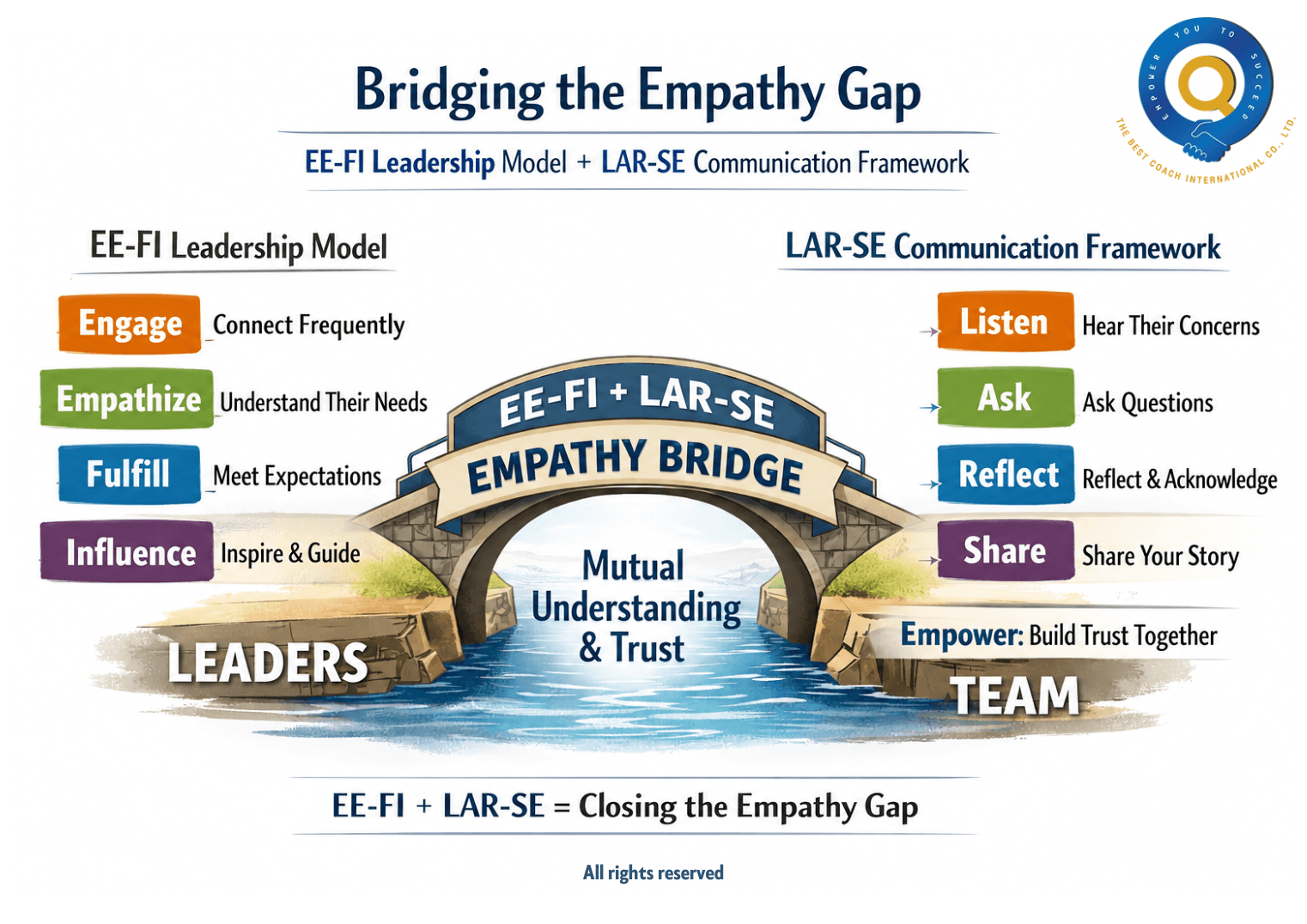
Many leadership models tell us to serve, to be of service to others, to engage, and to empathize. And they are right. That is the foundation of influence. I introduced Rachel to what I call the EE-FI Leadership Model.
It’s a sequential logic:
- E – Engage: Connect frequently and regularly, not just transactionally.
- E – Empathize: Step into their shoes. Understand their psychology.
- F – Fulfill: Meet their psychological needs.
- I – Influence: This is the by-product. It comes naturally once the first three are mastered.
Rachel was a master of the first three. She was engaging, she was empathetic, she was fulfilling. But she wasn’t getting the influence she deserved. Why?
Because the model was one-directional. She was a pipeline of empathy that ended in a dry well. She was being a great leader, but she was invisible as a human being.
The Missing Ingredient: The LAR-SE Bridge
“Rachel,” I asked, “when was the last time you told your team you were scared?”
She looked at me as if I had suggested she jump off a cliff.
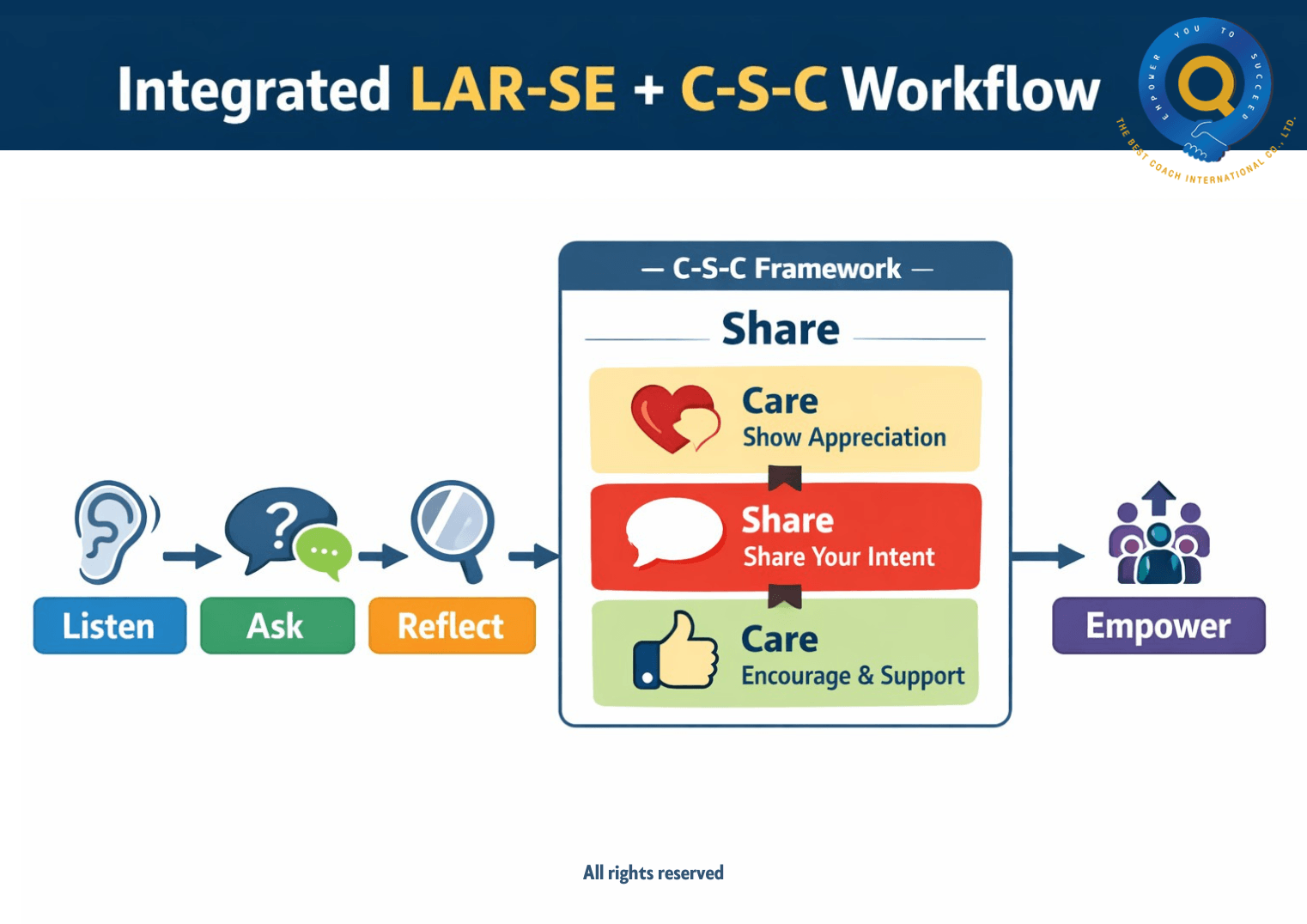
This is where we introduced the LAR-SE Communication Framework. While EE-FI handles the “what” (Leadership), LAR-SE handles the “how” (Communication). Specifically, we focused on the “S.”
LAR-SE stands for Listen, Ask, Reflect, Share, Empower.
We often nail the “L,” “A,” and “R.” We are great listeners, we ask probing questions, we reflect their words back to them. But we skip the “S.” The Share.
I told Rachel, “You cannot expect your team to have empathy for you if you present yourself as an impenetrable fortress. You are hiding your vulnerability behind a wall of authority. You need to share your context, your pressures, and your constraints.”
By sharing your story, you give your team permission to see the system through your eyes. You stop being the ‘boss’ who imposes change and become the ‘human’ who is navigating that change alongside them.
The Turning Point
We redefined Rachel’s strategy. She didn’t just need to be a coach to her team; she needed to let her team coach her, too! That’s called, “Reversed Coaching”.
Her homework was radical:
- Co-Create the Future: Instead of dictating goals to boost morale, she would schedule a team meeting to brainstorm the “short-term and long-term wins” with them, giving them ownership.
- Be Vulnerable: She committed to sharing the reality of the business stress—not to burden them, but to invite them into the solution.
- Look for Gold: We decided she would spend less time fixing weaknesses and more time mining the unique strengths of her people.
By the end of our time together, the tension had left her shoulders. She summarized her new insight perfectly: “Build deeper connections and trust with my team by being vulnerable with them.”
But the real shift was in her feeling. She said she felt “Empowered.”
The Art of Mutual Empathy
The lesson of Rachel’s story is universal. We have romanticized the idea of the “servant leader” to the point of burnout. We have taught leaders to be bottomless wells of support, but we forgot to teach their teams to look back and see the person holding the rope as well.
True empowerment isn’t just about you having empathy for your team. It is about creating an environment where empathy flows toward you as well.
If you are a leader facing a transformation, don’t just ask how you can serve your people. Ask if they truly understand who they are serving alongside.
It is only when we bridge the gap between authority and vulnerability—when we balance the EE-FI model with the LAR-SE framework—that we move from being managers to being truly trusted leaders.
As a global executive and leadership coach, I work with leaders like Rachel to navigate the complex intersection of business performance and human emotion. If you are ready to move beyond transactional leadership and create a culture of mutual trust, I invite you to explore the science and art of influence with me.
About Atip Muangsuwan: Atip is an executive leadership coach who specializes in helping high-achieving leaders overcome internal barriers to unlock their full potential and drive organizational success. Through a blend of strategic frameworks and profound personal insights, he empowers leaders in transforming their mindsets, emotional states, and behaviors for lasting impact.
SHARE :
Facebook
LinkedIn
Twitter
RECOMMENDED ARTICLES :