


The Firefighter and the Futurist: A CEO’s Blueprint for Strategic Leadership
By Atip Muangsuwan
“Effective leaders need to become more than just firefighters! They need to become strategic thinkers and innovation leaders.”
Atip Muangsuwan
CEO Coach and Coach Supervisor
The scent of ozone and burnt wiring filled the executive suite. Paul, a senior leader of a global electrical conglomerate, wasn’t in the server room, but the feeling of a four-alarm fire was his constant companion. His days were a blur of crisis management: a supply chain snarl in one country, a regulatory surprise in another, his fellow senior executives’ sudden resignations. He was brilliant at it. He was the best firefighter in the company.
And that was the problem.
Paul was a master of the present. He could solve any problem thrown at him today. But when he looked to the horizon, he didn’t see a vision; he saw a fog. He was so consumed with putting out the fires of the moment that he had no time to check the weather report. He was leading a global titan, but he was thinking like a local fire chief.
Paul’s story isn’t unique. It’s the silent struggle of countless successful leaders. They’ve climbed the ladder on the strength of their execution, only to find that at the top, execution isn’t enough. The view from the summit requires a different set of eyes. Paul felt this deeply. He came to me not for a quick fix, but for a fundamental rewiring. He wanted to become a strategic leader, a man of principles who could not only fight fires but prevent them from starting in the first place.
His goal was simple, yet profound: “I want to learn how to build long-term strategic leadership habits more effectively.”
The Anatomy of a Firefighter
In our first sessions, we diagnosed the root cause. Paul was missing two critical components of modern leadership: external awareness and a structured path from idea to innovation.
Like many executives, he was deeply self-aware. He knew his strengths and his weaknesses. But his vision was turned inward. His world was his company. He wasn’t up to date with the global news, tracking technological disruptions, or studying shifting geopolitical trends. He was a brilliant musician playing beautifully, but he couldn’t hear the rest of the orchestra. His strategic vision, the very thing he craved, was starved of the raw material it needed to grow: the world itself.
He was also missing a repeatable process. He saw creativity and innovation as mysterious, lightning-strike events, not a disciplined practice. He needed a playbook.
The “Easy” Playbook for a Strategic Mind
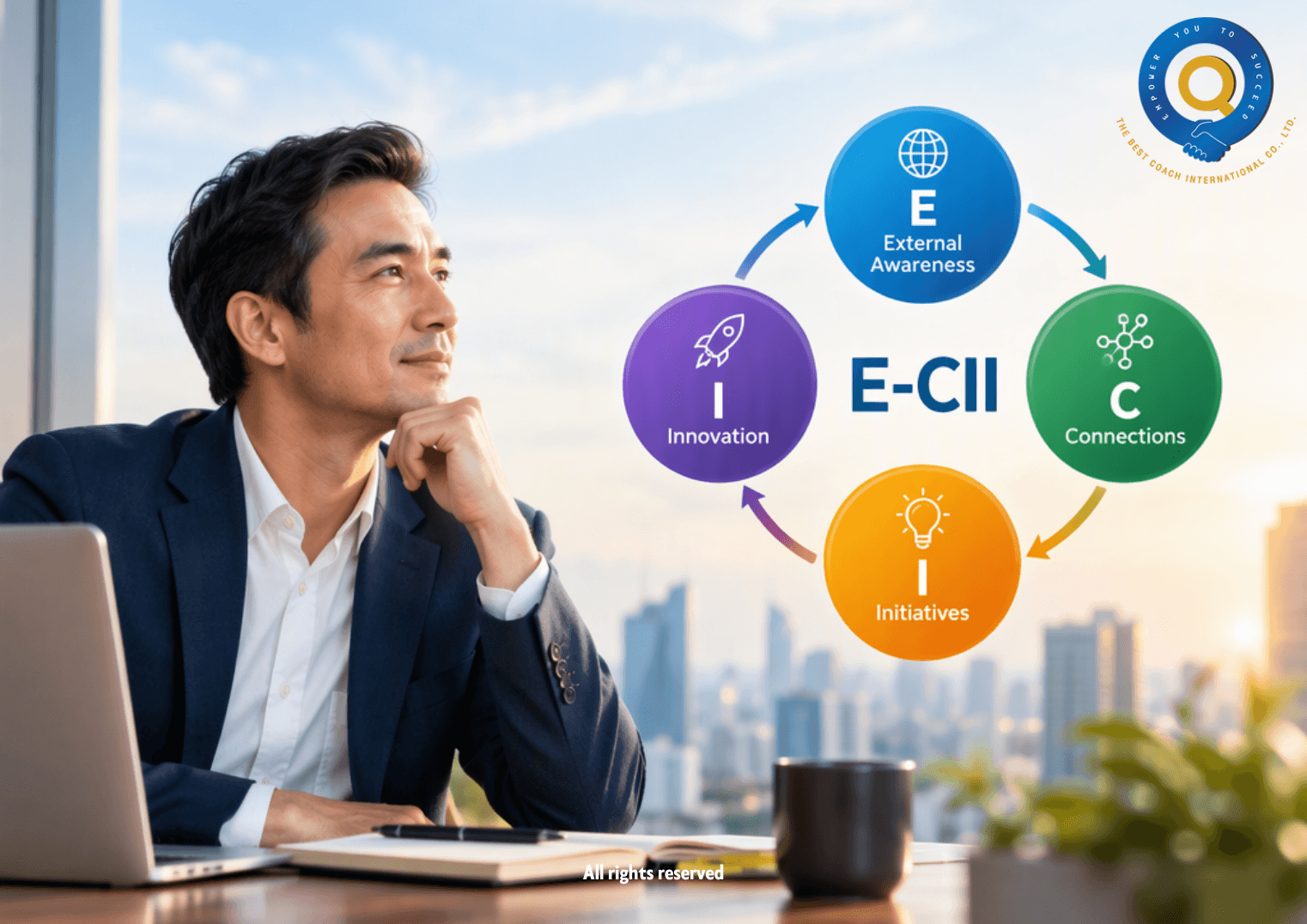
Together, we designed a deceptively simple, yet profoundly powerful framework that I call the E-CII (pronounced “Easy”) Leadership Model. It’s not about adding more to your plate; it’s about changing how you see the plate. It’s a four-step habit loop that transforms a reactive firefighter into a proactive futurist.
Here is the blueprint we created for Paul:
E — External Awareness. This is the foundational step. You cannot be strategic in a vacuum. We made a pact: 30 minutes a day, no exceptions, to consume global and local news, industry reports, and future trend analyses. This isn’t about doomscrolling; it’s about purposefully scanning the horizon for signals of change, disruption, and opportunity. As I explained to Paul, this external awareness is the fertile soil in which a strategic vision takes root.
C — Connections. This is the magic. It’s where you connect the dots. You take the new information you’ve gathered from the outside world and connect it with your existing knowledge, experiences, and wisdom. This is where true creativity is born.
I shared a classic story with Paul: the invention of Liquid Paper. It wasn’t created by a chemist in a lab; it was created by a secretary, Bette Nesmith Graham, who connected her artistic knowledge of painting over mistakes to the problem of typewriter errors. An innovation born from a simple connection.
Paul and I applied this to his world. We connected the trend of global sustainability (External Awareness) with one of his company’s products—transformers. The connection? A new generation of environmentally friendly oil for their transformers, a major market differentiator born not from a lab, but from a connection.
I — Initiatives. An idea in your head is just a daydream. An idea with a deadline is an initiative. To make this a habit, we agreed Paul would set a KPI: create and execute at least one initiative project per month. This could be a new process, a small experiment, a pilot program. The goal isn’t size; it’s frequency. It’s about building the muscle of turning ideas into action.
I — Innovation. This is where you scale. After a year of launching a number of initiatives, patterns emerge. You can pick and choose a few high-potential projects to leverage and upgrade into major innovation projects with a dedicated KPI: execute at least one major innovation project per year. This is how you build a sustainable engine for growth, turning a series of small sparks into a blazing beacon of market leadership.
Lighting the Torch
The change in Paul was palpable. He was no longer just the man in the arena, covered in soot. He was the architect on the hill, designing the arena for the future. The fog had lifted.
His action plan was bold and decisive. He wasn’t going to keep this playbook to himself. He was going to cascade it down to his line managers, turning the E-CII model into a shared language for innovation. He would challenge each department to create their own initiative projects, then select a few of the best to elevate as organization-wide innovation projects. He was going to turn a culture of firefighting into a culture of innovation.
His one-word summary for our journey was “Innovation.”
My one-word summary for him was “E-CII.”
For Paul, the firefighter had finally become the strategist. He learned that the greatest innovation isn’t a product or a service; it’s the culture you build. A culture where every leader is empowered to lift their eyes from the daily inferno and see the future waiting to be built.
And it all starts with a simple, “E-CII” (Easy) habit.
As a global executive and leadership coach, I help leaders like Paul shift from reactive execution to visionary strategy. If you’re ready to move from putting out fires to lighting the path ahead, my E-CII Leadership Model might just be your new playbook.
Want to discover how to build your own strategic leadership habits, let’s connect!
About Atip Muangsuwan: Atip is an executive leadership coach who specializes in helping high-achieving leaders overcome internal barriers to unlock their full potential and drive organizational success. Through a blend of strategic frameworks and profound personal insights, he empowers leaders in transforming their mindsets, emotional states, and behaviors for lasting impact.
SHARE :
Facebook
LinkedIn
Twitter
RECOMMENDED ARTICLES :