

Leading Through Uncertainty: How One Executive Mastered the Art of Change
By Atip Muangsuwan
“To manage change, lead change, or lead through change—it all starts with your mindset, then moves into action.”
Atip Muangsuwan
CEO Coach and Coach Supervisor
Change has a way of finding us when we least expect it.
For Peter, a senior executive at a global electronics company, it arrived in the form of a sweeping organizational restructuring. Entire teams were being reshuffled. Reporting lines were redrawn. Roles that had existed for decades were suddenly obsolete.
And Peter was the one responsible for making it all work.
“I want to help my organization achieve our vision and missions,” he told me during one of our coaching sessions. “I want my people to be happy, working with enjoyment. I want fewer repeated mistakes caused by human errors. And honestly? I want to make myself proud of myself and my team.”
These weren’t just corporate talking points. This was a leader who genuinely cared—about results, about his people, and about his own legacy.
But caring isn’t enough when you’re leading an organization through choppy waters. You need a map. You need a framework. You need something more than good intentions.
The Problem with Traditional Change Management
Peter defined change management the way most executives do: “How we bring the organization from point A to point B by using systematic thinking, good preparation and planning, and effective communication.”
It’s a solid definition. It’s also incomplete.
Because here’s what Peter discovered—and what I’ve seen in coaching hundreds of executives across the globe: Change management isn’t just about systems and processes. It’s about mindsets.
You can have the most brilliant plan in the world. But if your people are resistant, fearful, or disengaged? That plan is dead in the water.
And if you—the leader—are approaching change with anxiety rather than intentionality? Your team will feel it. They’ll mirror it. And the entire organization will suffer.
Two Frameworks That Changed Everything
During our session, I introduced Peter to two proprietary frameworks I’ve developed over the years of coaching global executives. They’re designed to work together—one for coping with change, and one for leading it.
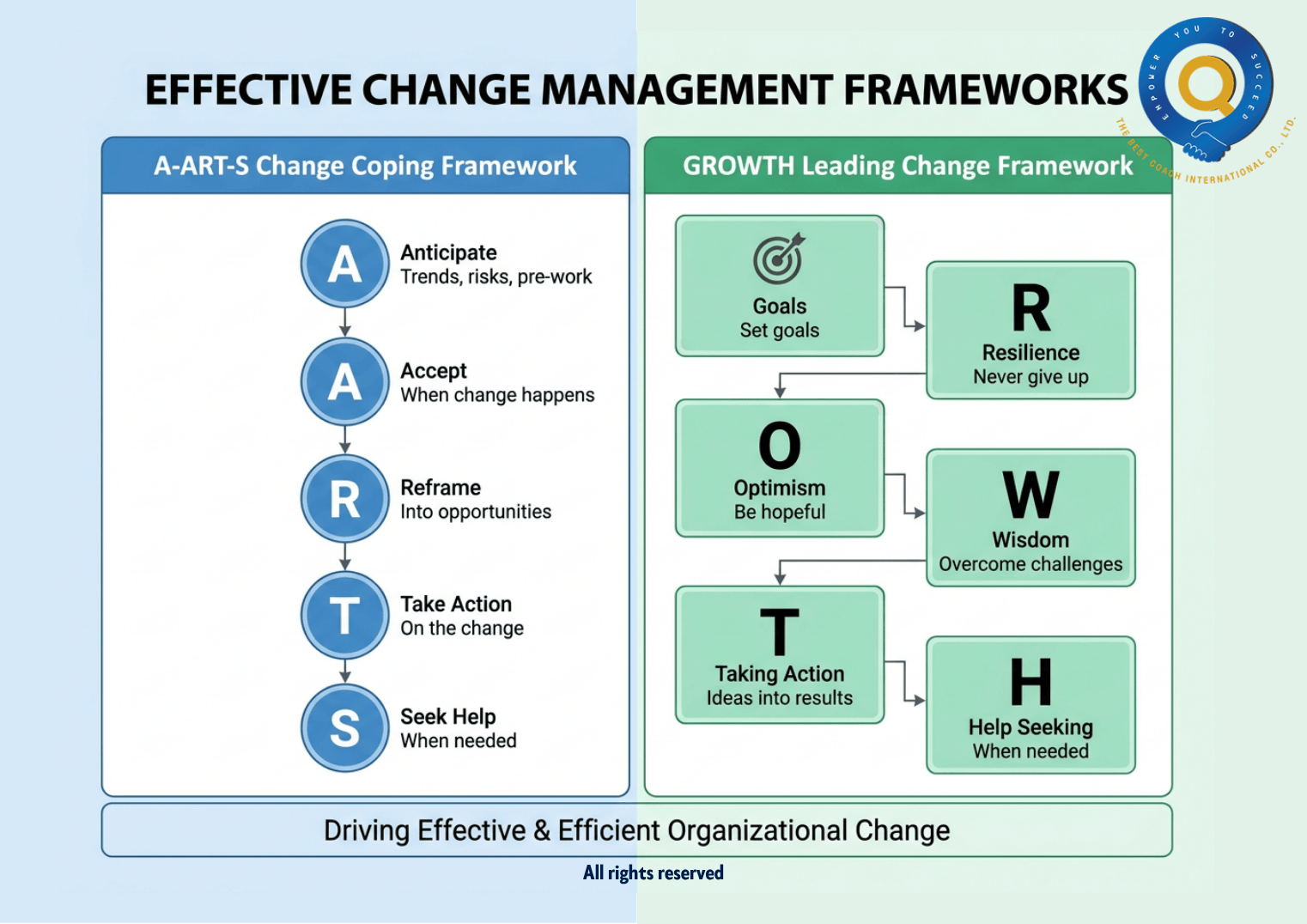
Framework One: The A-ART-S Change-Coping Framework
Change is inevitable. Suffering through it? That’s optional.
The A-ART-S framework gives you a step-by-step approach to not just surviving change, but thriving through it:
A — Anticipate: Most executives live reactively. They wait for change to hit, then scramble to respond. But the leaders who thrive are the ones who’ve already done the mental and strategic pre-work. They’ve asked themselves: What changes could be coming? What new skills might I need? What relationships should I be building right now?
A — Accept: When change actually arrives—when it’s standing in your doorway, impossible to ignore—your first instinct will be to deny, escape, or run. Don’t. Acceptance isn’t surrender. It’s the first step toward taking control.
R — Reframe: What if this change isn’t a punishment—but an opportunity you haven’t yet claimed? That single question has transformed more careers than any business strategy I know.
T — Take Action: Action is power. Action turns intangible ideas into tangible results. Without action, even the best frameworks are just words on paper.
S — Seek Support: When you can’t handle the change alone, ask for help. Not because you’re weak. Because you’re smart enough to know that great leaders don’t go it alone.
Framework Two: The GROWTH Leading Change Framework
Once you’ve learned to cope with change, it’s time to lead it. That’s where GROWTH comes in:
G — Goals: Set clear goals for what you want to change. What does success look like? What’s the five-year vision? Compelling futures diminish present stumbles.
R — Resilience: Never ever give up until you’ve achieved your goals. Fall forward. Give yourself permission to panic for five seconds—then bounce back. Conserve your energy for recovery, not failure avoidance.
O — Optimism: Be hopeful. When you have hope, you’ll be resilient. Replace fear with curiosity. Instead of saying “I don’t know,” try asking “How curious—I wonder how this works?”
W — Wisdom: Use your wisdom to overcome challenges and tackle problems. Distinguish between personal wisdom and collective wisdom. Ask your team: “Who here has done this before?”
T — Taking Action: Reframe action as an experiment. An experiment can’t fail—it can only produce a result. This mindset stops overthinking and starts momentum.
H — Help-Seeking: Seeking help isn’t weakness—it’s resource allocation. It’s efficient problem-solving. It gets you answers in hours, not weeks.
What Peter Discovered About Himself
Here’s the thing about frameworks: they don’t just change your organization. They change you.
As we worked through these concepts, Peter had a moment of clarity that I’ll never forget.
“I’ve learned that I’m an optimistic and resilient leader,” he said, “because I’ll never give up in the face of challenges, problems, and obstacles.”
That self-awareness is priceless. Because when you understand your own strengths, you can leverage them. When you recognize your own patterns, you can break the ones that don’t serve you.
Peter left our session feeling something he hadn’t felt in weeks: enlightened.
Putting It into Action
Knowledge without action is just trivia. So, Peter committed to three specific steps:
First, he’d start applying the frameworks within his direct team. Test them. Refine them. Learn what works in his specific organizational context.
Second, he’d share the frameworks with his broader team and deploy them across the organization.
Third, he’d document the success stories that emerged and share them with senior leadership—not to brag, but to demonstrate what’s possible when you lead change with intention and heart.
The One Sentence That Changed Everything
At the end of our session, I asked Peter to summarize what he’d learned in a single sentence.
He said: “Resilience is a key success factor for change management.”
I added: “To manage change, lead change, or lead through change—it all starts with your mindset, then moves into action.”
And then I asked him for one word. Just one word that captured the entire experience.
Peter said: “Action.”
I said: “Mindset.”
We were both right. Because change doesn’t happen in your spreadsheets or your project plans. It happens first in your mind—and then, and only then, in the world.
Ready to Lead through Change or Lead Change?
If Peter’s story resonates with you—if you’re facing organizational change and wondering how to lead your team through it with grace and effectiveness—I’d love to help. Let’s connect!
Here’s the truth: change isn’t going away. The only question is whether you’ll lead through it, lead it —or be led by it.
The choice, as always, is yours.
About Atip Muangsuwan: Atip is an executive leadership coach who specializes in helping high-achieving leaders overcome internal barriers to unlock their full potential and drive organizational success. Through a blend of strategic frameworks and profound personal insights, he empowers leaders in transforming their mindsets, emotional states, and behaviors for lasting impact.
SHARE :
Facebook
LinkedIn
Twitter
RECOMMENDED ARTICLES :