

Fear of the Unknown? See How the GROWTH Framework Helps You Tackle It
By Atip Muangsuwan
“Be a visionary leader. Not because you see the whole path, but because you are willing to walk it without a map.”
Atip Muangsuwan
CEO Coach and Coach Supervisor
There is a specific, silent kind of terror that lives in the corner office of a global technology company. It is not the fear of bankruptcy or a hostile takeover. It is more insidious than that.
It is the fear of the unknown.
I recently sat down with a leader I’ll call Steve. On paper, Steve has already won the game of modern business. He leads thousands of engineers. He predicts market trends three years out. He is a master of the known universe of his industry.
But Steve had a secret: Every time he was forced to navigate a situation where he had no data, no precedent, and no expertise, he froze. Not literally—he could still give orders. But internally, he was drowning.
“I can’t afford to be incompetent,” Steve told me. “I have a time pressure. I have a reputation. If I fail here, people will think I’ve lost my credibility. So, I delay. I seek certainty. I chase perfection until the window of opportunity slams shut.”
Steve’s problem wasn’t his intelligence. It was his Identity. He had built his career on knowing the answers. Now, to grow his organization (and himself), he had to become comfortable with not knowing.
He needed a new operating system for his brain. He needed to stop leading from fear and start leading from passion.
The Framework: Moving Beyond “Fixed” Mindset
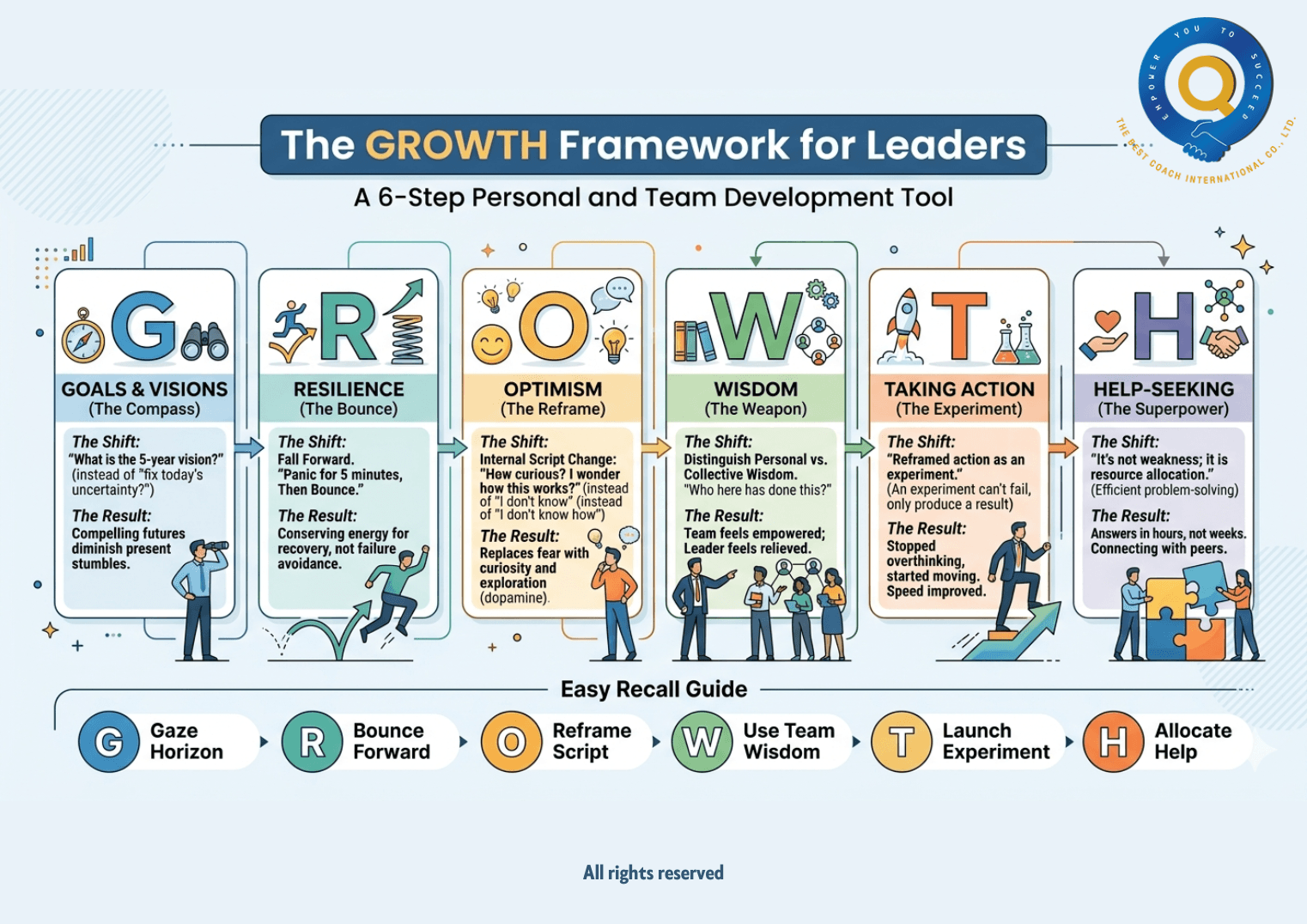
To help Steve, we didn’t just talk about positive thinking. We installed a structural framework. I call it the GROWTH Framework—a proprietary method I developed to help high-performers turn uncertainty into fuel.
Here is how Steve applied the GROWTH acronym to save his leadership and accelerate his entire organization.
G: Goals & Visions (The Compass)
Steve’s fear came from the pressure of the present. We shifted his gaze to the horizon.
- The Shift: We stopped asking, “How do I fix today’s uncertainties?” and started asking, “What is the 5-year vision for this organization?”
- The Result: When you have a compelling future, the stumbles of the present lose their power to humiliate you.
R: Resilience (The Bounce)
Steve admitted he viewed failure as a stain on his resume. We rebranded failure as a data point.
- The Shift: Resilience doesn’t mean you don’t fall. It means you fall forward. We created a rule: “You are allowed to panic for 5 minutes. Then, you bounce.”
- The Result: Steve stopped wasting energy avoiding failure and started using energy to recover from it.
When Steve faced an unfamiliar assignment, his internal dialogue was, “Oh no, I don’t know how to do this.”
- The Shift: We changed the internal script to, “How curious? I wonder how this works?”
- The Result: He replaced the biology of fear (stress) with the biology of exploration (dopamine). Curiosity is the enemy of anxiety.
W: Wisdom (The Weapon)
Steve felt he had to have all the answers. That is a lonely, heavy burden.
- The Shift: He learned to distinguish between personal wisdom (what he knows) and collective wisdom (what his people knows). He started asking, “Who here has done this before?” instead of pretending he had.
- The Result: His people felt empowered. Steve felt relieved.
T: Taking Action (The Experiment)
Perfectionists wait for the perfect plan. Growth-minded leaders take the first step.
- The Shift: We reframed every action as an “experiment.” An experiment cannot “fail”; it can only produce a result you didn’t expect.
- The Result: Steve stopped overthinking. He started moving. Speed improved immediately because he stopped waiting for certainty.
H: Help-Seeking (The Superpower)
For a global tech leader, asking for help feels like admitting defeat.
- The Shift: Steve learned that “Help-seeking” is not weakness; it is resource allocation. It is the most efficient way to solve a problem you haven’t seen before.
- The Result: Instead of suffering in silence, Steve now calls three peers before starting a new initiative. He gets answers in hours, not weeks.
The Homework That Changed the Organization
Steve didn’t just want insights; he wanted transformation. So, he took the GROWTH framework off the whiteboard and into the boardroom.
His homework was audacious: “Use the GROWTH framework to write a 5-year business plan for your organization.”
Normally, a 5-year plan is a document of fear—full of safe bets and conservative estimates. But with the GROWTH lens, Steve turned it into a document of curiosity.
- He used Optimism to assume opportunity was abundant.
- He used Wisdom to poll his junior staff for fresh ideas.
- He used Resilience to project potential market crashes as “learning cycles.”
When he shared the final plan with me via email two weeks later, he didn’t just send a document. He sent a confession.
“I used to think growth mindset was a soft skill. It’s not. It’s the hardware for courage. I worked without passion for three years because I was afraid of looking stupid. Today, I’m terrified of the unknown, but I’m moving anyway. I am a continuous, persistent development project.”
The Bottom Line
Steve learned that self-confidence doesn’t come before the challenge. It comes during the struggle, when you apply a system.
If you are leading in a volatile world—if you are afraid of the new, the strange, or the difficult—stop trying to “feel” confident. Start doing the GROWTH framework.
Your One-Word Summary for Today: Vision.
Your Action: Be a visionary leader. Not because you see the whole path, but because you are willing to walk it without a map.
Are you facing the “Steve” problem in your own leadership? Do you fear the unknown is costing you your credibility? If you are or if you do, then let’s connect.
About Atip Muangsuwan: Atip is an executive leadership coach who specializes in helping high-achieving leaders overcome internal barriers to unlock their full potential and drive organizational success. Through a blend of strategic frameworks and profound personal insights, he empowers leaders in transforming their mindsets, emotional states, and behaviors for lasting impact.
SHARE :
Facebook
LinkedIn
Twitter
RECOMMENDED ARTICLES :