


The Silent Saboteur: How to Manage a Player Who Isn’t on Your Team
By Atip Muangsuwan

“Tripartite meeting and agreement are key to managing people who’re not your direct reports.”
Atip Muangsuwan
CEO Coach and Coach Supervisor
Every leader has faced it. That knot in your stomach when you see a name pop up on your team’s performance dashboard. For Mike, a sharp, results-driven executive at a global software giant, that name belonged to a Sales Development Representative (SDR). Let’s call him ‘The Shortcut.’
On paper, The Shortcut was a dream. He was the engine of Mike’s pipeline, the relentless hunter filling the top of the funnel with qualified leads. He got the job done. But how he got it done was a different story. He was a maestro of the shortcut—sometimes bending the rules, occasionally stepping into the grey area of what could only be called unethical.
The real problem? The Shortcut didn’t report to Mike. He reported to a manager Mike genuinely liked and respected. This created a leadership paradox: How do you manage a critical resource who isn’t your direct report, without damaging a peer relationship and while holding someone accountable for their methods?
Mike came to me not with a demand for a solution, but with a confession of a leadership gap. “I was a sales engineer,” he told me, “I know the technical game inside and out. But this… managing people, the complex human stuff… I want to learn how to do this right.”
The Hook: The Illusion of the Quick Fix
Mike’s initial instinct was straightforward, and it’s the same one most of us would have: sit the guy down, set clear expectations, and give him some “constructive feedback.” It sounds reasonable. It’s also a recipe for failure.
The problem with this all-too-common approach is that it’s a point-in-time confrontation, not a system for change. It’s a band-aid on a bullet wound. It doesn’t address the core issues of accountability, alignment, and sustainable performance. It’s a monologue, not a dialogue. Mike needed more than a script; he needed a framework for transforming a liability into an asset.
This is the essence of true leadership. It’s not about having the right answer; it’s about building the right system for finding answers. As a global executive coach, my job isn’t to hand leaders a fish, but to guide them on how to build a fishing fleet that can weather any storm.
The Revelation: The Architecture of Accountability
In our session, Mike and I explored a new architecture for this all-too-common challenge. We built a system based on three pillars of accountability: a foundational mindset, a framework for difficult conversations, and a master blueprint for performance management.
- The Foundational Mindset: The One-Minute-Manager. We started with a principle so simple it’s often overlooked: the power of clarity, consistency, and immediacy. Set clear goals. Praise immediately when they’re met. Reprimand immediately when they’re not. This creates a real-time feedback loop that prevents small issues from festering into major problems.
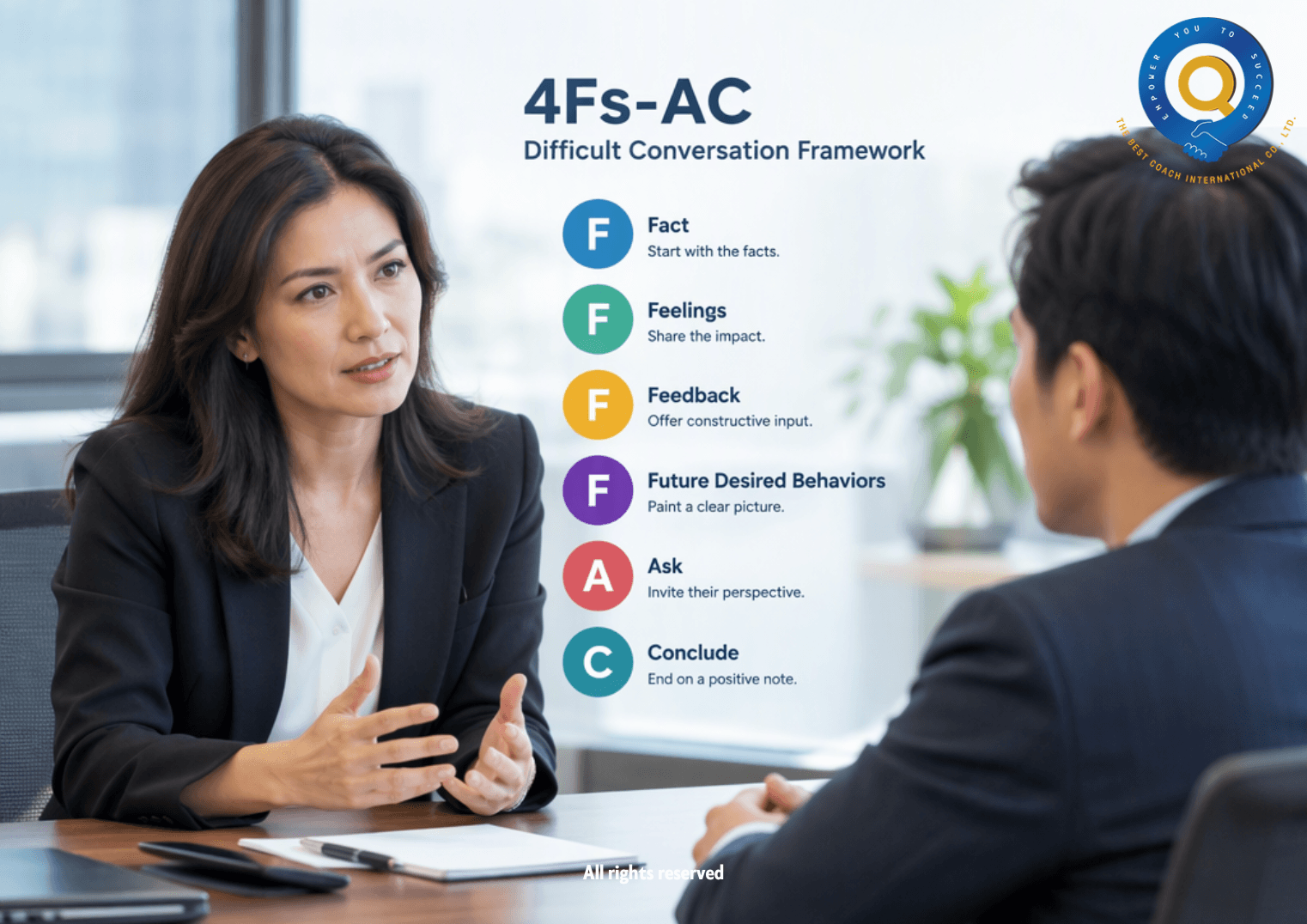
- The Conversation Tool: The 4Fs-AC Framework. When that reprimand is necessary, how you deliver it is everything. Mike and I designed a powerful script for a difficult conversation:
- Facts: “When you entered the lead for XYZ Corp, the contact information was inaccurate.”
- Feelings: “It concerns me because it undermines our team’s credibility.”
- Feedback: “Entering unverified data is a shortcut we can’t afford to take.”
- Future desired outcome: “Going forward, I need every lead to be fully verified before entry.”
- Ask: “Help me understand your process. Are there hurdles you’re facing?” This invites collaboration, not defensiveness.
- Conclude with positive notes: I look forward to your excellent and quality work. I trust that you can do as you’ve committed.
- The Master Blueprint: The EF-FIG Performance Management Framework. This is the mother framework, the system that ties it all together for sustainable change.
- Expectations: Set crystal-clear expectations from day one.
- Follow up & follow thru: Consistency is your credibility. You must follow up and follow thru with them.
- Feedback: Provide positive and constructive feedback, creating a corrective action plan if needed.
- Improvement Plan: If necessary, initiate a formal PIP, involving their direct manager and HR.
- Goodbye: Have the courage to make the final call if all else fails.
The Masterstroke: The 3-Way Conference
The most crucial insight for Mike was realizing he didn’t have to do this alone. The masterstroke was not a confrontation, but a collaboration. We designed a “3-Way Conference” — a meeting between Mike, The Shortcut, and his direct manager.
This wasn’t about going over anyone’s head. It was about creating a tripartite agreement. It brought the manager into the loop from the very beginning, turning him from a potential obstacle into a powerful witness and ally. The manager now knew Mike’s expectations, heard the commitments firsthand, and was invested in the outcome. The alignment was no longer just between Mike and The Shortcut; it was a pact solidified by the entire leadership chain.
The Transformation: From Relieved to Empowered
Mike left our session with a new sense of clarity and confidence.
By holding that 3-way alignment meeting, Mike transformed a potential conflict into a structured, collaborative process. He was no longer a frustrated peer trying to manage someone else’s employee; he was a strategic leader building a system of tripartite accountability.
He shared with me that he was relieved now. That’s the feeling of trading anxiety for a blueprint. It’s the confidence that comes from having a system to handle the inevitable human complexities of leadership.
This is the power of moving from a quick fix to a structured solution. It’s the shift from being a manager who reacts to a leader who architects success.
Are you facing a similar leadership paradox? Are you struggling to manage a critical resource, navigate a difficult conversation, or build a team that delivers results the right way? You don’t have to rely on your guesswork.
As a global executive and leadership coach, I help leaders like Mike replace their anxiety with effective frameworks and their uncertainty with concrete action. Let’s build the systems that will elevate your leadership and your team. Connect with me to learn more about my coaching programs and how I can help you to become the best leader.
About Atip Muangsuwan: Atip is an executive leadership coach who specializes in helping high-achieving leaders overcome internal barriers to unlock their full potential and drive organizational success. Through a blend of strategic frameworks and profound personal insights, he empowers leaders in transforming their mindsets, emotional states, and behaviors for lasting impact.
SHARE :
Facebook
LinkedIn
Twitter
RECOMMENDED ARTICLES :