

The Night My Client Realized He’d Been Innovating All Wrong
By Atip Muangsuwan
“Without curiosity, you don't look. Without observation, you don't see. Without connection, you don't innovate.”
Atip Muangsuwan
CEO Coach and Coach Supervisor
Matthew sat across from me, his coffee growing cold.
He’s a senior executive at a global technology company—the kind of place where “innovation” is printed on the walls, whispered in boardrooms, and demanded in every quarterly review. Yet here he was, admitting something most leaders never say out loud:
“I feel like I’ve hit a wall. The ideas just aren’t coming anymore.”
I leaned back and smiled. I’d been waiting for this moment.
The Paradox of the Saturated Mind
Here’s what fascinated me about Matthew’s confession: he works in an industry that invented the future. Yet somewhere between the KPIs and the meetings and the relentless pressure to disrupt, his creative well had run dry.
He didn’t need more brainstorming sessions. He didn’t need another innovation consultant. What he needed was to understand something fundamental—something most people get wrong about how breakthroughs actually happen.
So, I asked him a question that changed everything:
“Matthew, what if innovation isn’t about creating something from nothing? What if it’s simply about making connections no one else has made yet?”
The silence that followed was the sound of a paradigm shifting.
Creativity vs. Innovation: The Distinction That Changes Everything
Most leaders conflate these two concepts. I see it constantly in my executive coaching practice. So, let me draw the line clearly:
Creativity is making connections between existing ideas to generate something new. It’s intangible—a spark, an insight, a possibility.
Innovation is when you take that creative spark and transform it into a tangible product, service, or system that creates value.
Creativity is the thought. Innovation is the thing.
Matthew nodded slowly. He’d been chasing innovation while neglecting the creative connections that make it possible. That’s like trying to harvest a field you never planted.
The Framework That Reframed His Thinking
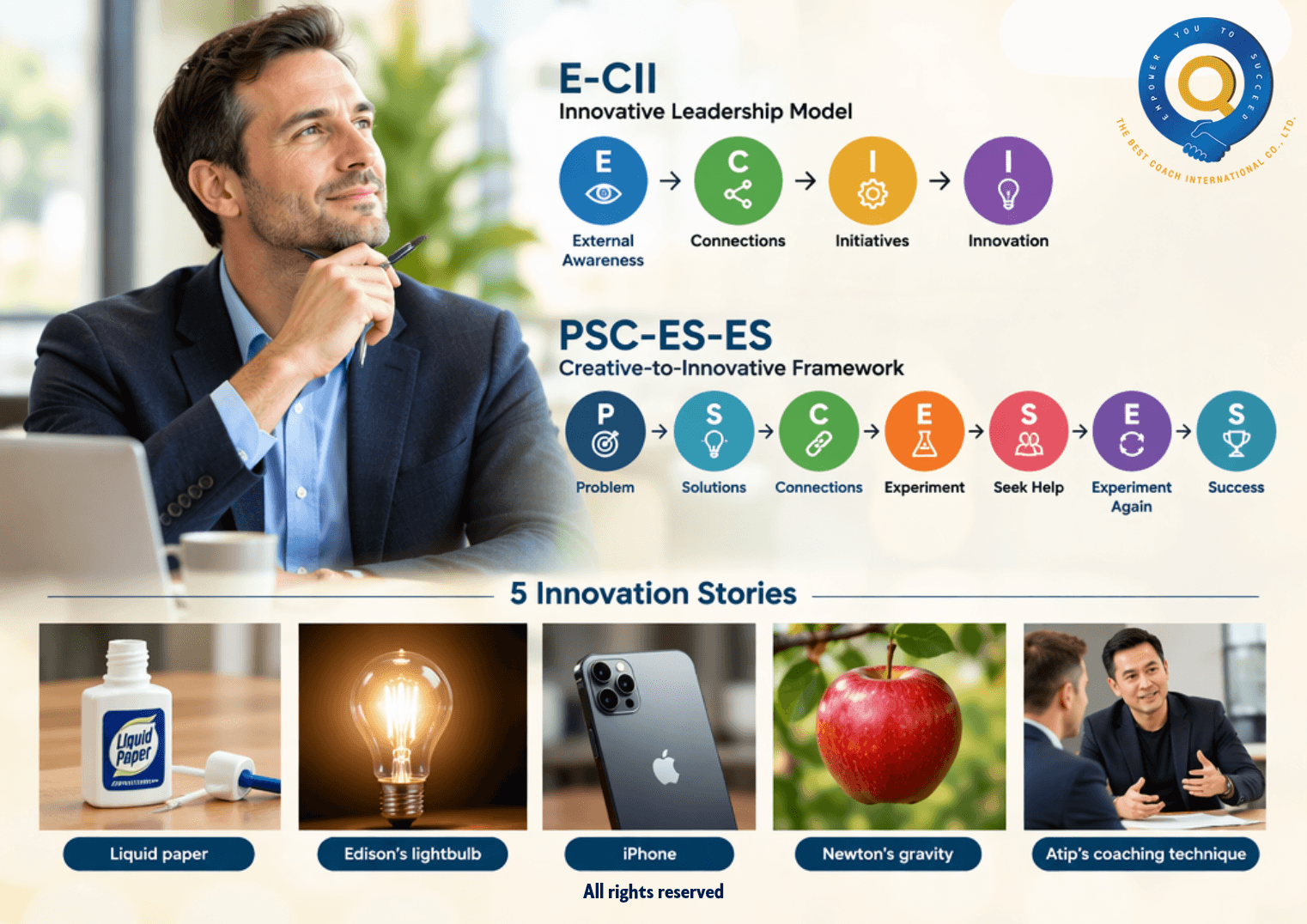
I introduced Matthew to my E-CII Innovative Leadership Model—a framework I’ve developed over years of coaching executives across continents.
Here’s how it works:
E — External Awareness
Beyond self-awareness lies the world. Global trends. Local disruptions. Future signals. I encouraged Matthew to consume news not as entertainment but as reconnaissance. Every headline is a data point. Every trend is a potential connection waiting to happen.
C — Connections
This is where the magic lives. Take what you’ve learned from the world and connect it to what you already know—your experience, your wisdom, your skills, your failures. New ideas emerge from this collision between external insight and internal knowledge.
I — Initiatives
Connections mean nothing without action. I challenged Matthew to set a goal: create and execute one initiative project per month. Small bets. Quick experiments. Momentum over perfection.
I — Innovation
From those monthly initiatives, patterns emerge. Certain projects grow legs. These become your major innovation bets—the ones worth significant resources. One breakthrough per year is enough to transform a career, a team, a company.
The PSC-ES-ES Framework: Innovation’s Hidden Architecture
But frameworks alone don’t create breakthroughs. Stories do.
Matthew needed to see innovation in action, so I shared the PSC-ES-ES Creative-to-Innovative Framework—my invention for making creativity tangible:
P — Problem: Start with a clearly defined pain point.
S — Solutions: Sketch a rough vision of what resolution looks like.
C — Connections: Link your existing knowledge to possible solutions.
E — Experiment: Test on your own.
S — Seek Help: When you hit a wall, find experts.
E — Experiment Again: Iterate with new knowledge.
S — Success: Repeat until breakthrough.
The Liquid Paper Story
Bette Nesmith Graham was a secretary in the 1950s who made countless typos on her typewriter. Each mistake meant retyping entire pages.
Problem: Typing errors waste time and energy.
Solution Vision: What if she could simply cover the mistake?
Connection: In painting class, she’d learned that you could paint over an old color with new paint.
Experiment: She tried applying white paint over her typos. It worked—but dried too slowly.
Seek Help: She approached a chemistry teacher at her son’s school.
Experiment Again: Together, they refined the formula.
Success: Liquid Paper was born—and eventually sold to Gillette for $47.5 million.
One woman. One problem. One connection between art class and office work. A revolution in workplace efficiency.
The Edison Mindset
When a journalist asked Thomas Edison how it felt to fail 1,000 times while inventing the lightbulb, he replied:
“I didn’t fail 1,000 times. The lightbulb was an invention with 1,000 steps.”
The iPhone Insight
Apple didn’t invent the smartphone. IBM created the first technical version years earlier. But Steve Jobs made a connection no one else had:
Conventional Phone + Computer = Smartphone
He didn’t create new technology. He connected existing technologies in a way that redefined how humanity communicates.
Newton’s Apple
Contrary to popular myth, an apple didn’t hit Isaac Newton on the head. In 1665, he simply observed an apple falling—and made a connection that others had overlooked for centuries.
Why do objects fall down rather than sideways or upward?
That single question, born from curiosity and connection, gave us the law of gravity.
The Hero of Innovation: Making Connections
By now, Matthew was leaning forward, his cold coffee forgotten.
“So, the key isn’t having better ideas,” he said slowly. “It’s making better connections.”
Exactly.
But here’s what I told him next—the part that most innovation literature skips:
You cannot make connections without curiosity. You cannot observe patterns without attention. The sequence matters:
Curiosity → Observation → Connection
Without curiosity, you don’t look. Without observation, you don’t see. Without connection, you don’t innovate.
And here’s the secret I shared as his executive coach: I apply this exact process in every coaching session. I make connections between my clients’ insights and my own—creating new frameworks, new strategies, new perspectives tailored to their unique challenges. That’s not just coaching. That’s creative innovation in real-time.
The Breakthrough
Matthew sat back, something shifting in his expression.
“I came here wanting examples of innovation,” he said. “But what I really needed was to understand how innovation actually works.”
He’d been trying to create from nothing. Now he understood that innovation is about connecting what already exists in ways that haven’t been tried.
His homework? Go back and define his real problem statements. Make internal and external connections. Set innovation KPIs that would transform him from an executive into a true innovative leader.
When I asked for a one-word summary of our session, Matthew didn’t hesitate:
“Connections.”
And his one-sentence takeaway?
“Apply the PSC-ES-ES Framework.”
My words for him? “Find your innovation role models and learn their strategies.”
What Matthew Taught Me
As I reflected on our session, I realized Matthew had articulated something profound:
“We all have solutions and capabilities. We just need to look and think deeper.”
That’s the essence of what I do as a global executive coach. I don’t hand clients answers—they already possess them. I help them see the connections they’ve been missing.
Whether you’re a technology executive stuck in creative drought or a leader seeking to unlock your team’s potential, the path forward is the same:
Get curious. Observe deeply. Connect boldly. Experiment relentlessly.
Your Next Step
If this story resonated—if you recognized yourself in Matthew’s creative exhaustion—perhaps it’s time for a conversation.
I work with executives globally, helping them transform saturated thinking into breakthrough innovation. Not through theory, but through frameworks tested in the real world, stories that illuminate, and connections that change everything.
Ready to find your connections? Let’s connect!
Your breakthrough might be one connection away.
About Atip Muangsuwan: Atip is an executive leadership coach who specializes in helping high-achieving leaders overcome internal barriers to unlock their full potential and drive organizational success. Through a blend of strategic frameworks and profound personal insights, he empowers leaders in transforming their mindsets, emotional states, and behaviors for lasting impact.
SHARE :
Facebook
LinkedIn
Twitter
RECOMMENDED ARTICLES :