

The $2 Trillion Question Every AI Leader Is Afraid to Ask
By Atip Muangsuwan
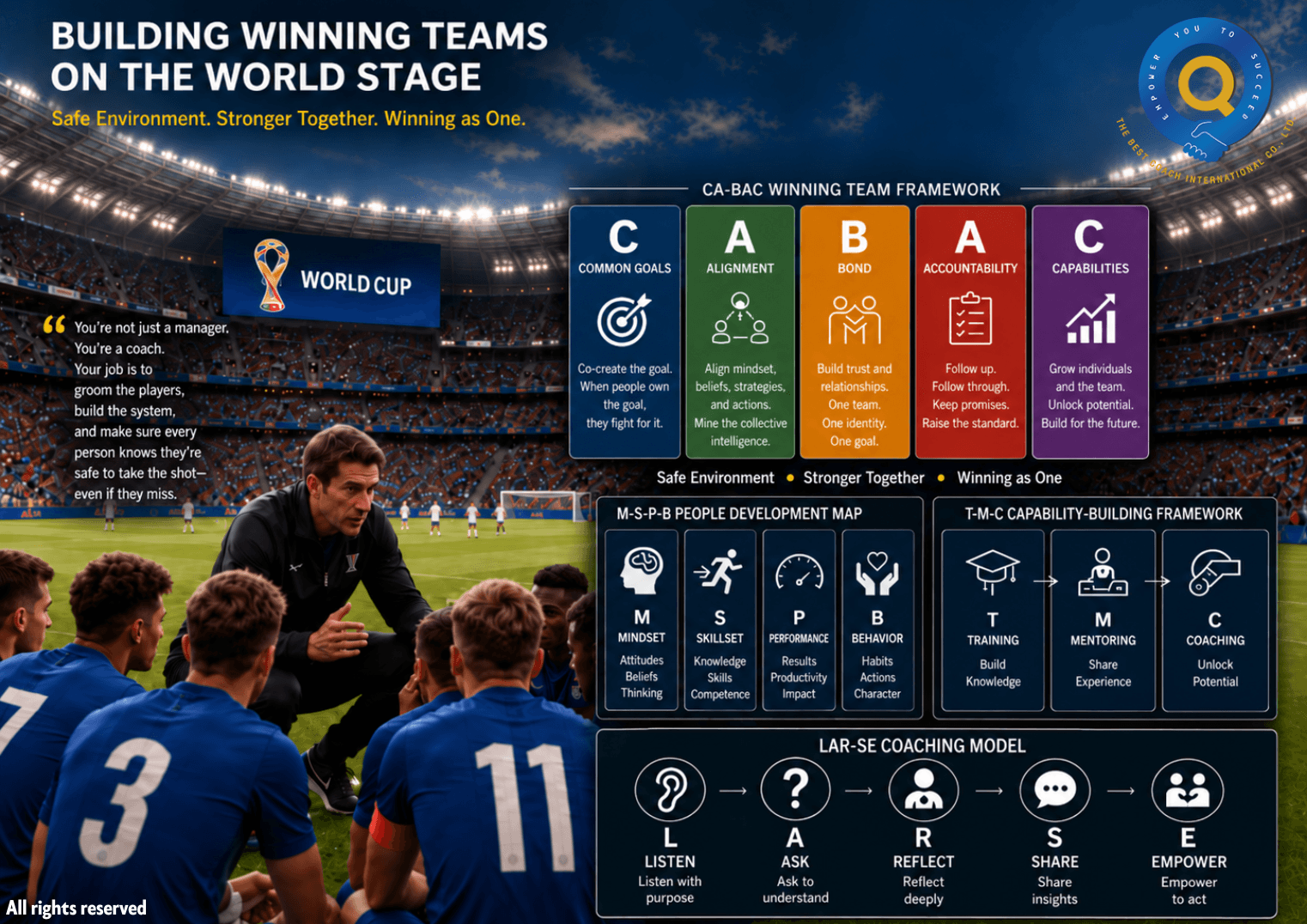
“You're not just a leader. You're a coach. Your job is to groom the players, build the system, and make sure every person knows they're safe to take the shot—even if they miss.”
Atip Muangsuwan
CEO Coach and Coach Supervisor
Robert stared at the ceiling of his corner office at 2:00 a.m., and the irony wasn't lost on him. He was building artificial intelligence for a living—systems that learned, adapted, and scaled at breathtaking speed. Yet the humans on his team were moving in the opposite direction. They were slowing down. Guarding their words. Sending carefully worded emails instead of walking down the hall to talk. The safer AI became, the less safe his people felt.
Robert wasn't failing because he lacked intelligence. He was failing because he had mastered managing the work and hadn't yet mastered managing the people.
Most leaders never say this out loud.
Robert did. And that is what saved his team.
The Confession That Changed Everything
When Robert first sat across from me, he didn't ask for a strategy deck or a roadmap. He asked for something far more difficult.
"I want to learn how to build a safe work environment where people feel like they're part of one team," he said. "And I want to create a winning team as a result of that."
He went on to describe what many executives quietly carry: a team that had been weakened by rounds of organizational change, replacements that were only partially done, and a fragile sense of trust hanging by a thread. His CEO and senior leaders trusted him. But he could feel the fractures beneath him.
Robert had been doing what most high-achievers do when they want to fix a team. He was listening. Asking questions. Empowering people.
All good things. But not enough.
"LAR-SE is a beautiful framework," I reflected back to him. "But for what you're trying to build, you need something more robust. You need the CA-BAC Winning Team Framework."
He leaned in. "What's CA-BAC?"
The Framework That Turns a Group into a Team
Here is the truth most executives discover too late: strategies and tactics are not the same thing, and you need both.
Robert had tactics. He listened. He asked questions. But he lacked a strategy—a blueprint that connected every action to a single outcome: a team that felt safe and won together.
That's what the CA-BAC Winning Team Framework provides.
C — Common Goals
Winning teams don't just share a purpose. They co-create it. Robert learned to conduct brainstorming sessions where his team defined the goals—not him. When people own the goal, they don't just execute. They fight for it.
A — Alignment
This is where most leaders stop and where Robert had to start. Alignment isn't agreement. It's the deliberate synchronization of mindset, beliefs, attitudes, strategies, approaches, actions, and behaviors toward a shared goal.
The tactic? Team coaching. Robert learned to step out of the executive's chair and into the coach's chair—facilitating conversations that mined the collective intelligence of the room. Because several heads are always better than one.
B — Bond
People don't go to war for a job description. They go to war for each other. Robert planned team outings—not as perks, but as strategic investments in the relational fabric of his team. Out of those shared experiences came shared identity: one team, one goal.
A — Accountability
This is the hardest one. Robert had to learn to follow up and follow through, not as a micromanager, but as a coach who refuses to let anyone settle for less than their best. Accountability isn't pressure. It's promise-keeping.
C — Capabilities
Finally, Robert had to ensure that each team member was growing—not just collectively, but individually. He used the M-S-P-B Map to assess each person across Mindset, Skillset, Performance, and Behavior. Then he delivered the right intervention through the T-M-C Approach: Training, Mentoring, and Coaching, tailored to the individual's actual state, not the leader's assumptions.
The Coach in the Locker Room
Robert had one more breakthrough during our session. It came in the form of a metaphor.
"You're not just a manager," I told him. "You're a sports coach. Your job isn't to play the game. It's to groom the players, build the system, and make sure every single person on that field knows they're safe to take the shot—even if they miss."
That shifted everything for Robert.
He stopped thinking about managing people. He started thinking about coaching them. And coaching, as he discovered, requires a different operating system entirely—one where the LAR-SE Framework (Listen, Ask, Reflect, Share, Empower) becomes the daily language of leadership.
Strategies are the insights. Tactics are the action steps. Robert needed both. CA-BAC gave him the strategy. The tactics—brainstorming, team coaching, outings, follow-up, and T-M-C—gave him the engine.
The Moment Robert Stopped Being the Smartest Person in the Room
When Robert shared his progress with me recently, he said something that has stayed with me:
"Safe work environment can happen when people feel they're part of the team even in the hard times and hardships."
That's the shift that changes everything. Not a new tool. Not a new incentive structure. A leader who understands that psychological safety isn't a perk—it's the platform on which high performance is built.
Robert is still building. His team is still evolving. But the ceiling is gone. The fractures are healing. And the team that once felt unsafe is beginning to believe that they aren't just surviving the change. They're winning because of it.
A Final Word for the Leader Who Feels Like Robert
If you are leading a team and you can sense the quiet distance—the silence in meetings, the hesitation before ideas, the exhaustion of being the person everyone waits for—I want you to know something.
You don't need to work harder. You need a framework that works smarter.
The CA-BAC Winning Team Framework, the M-S-P-B People Development Map, the T-M-C Capability-Building Framework, and the LAR-SE Coaching Model are not academic constructs. They are field-tested systems I have developed over years of coaching global executives across industries. They work because they honor a simple truth: leadership is not about commanding people. It's about creating the conditions where people choose to give their best.
If you're ready to stop managing the work and start coaching the people, I'd be honored to connect with you.
About Atip Muangsuwan: Atip is an executive leadership coach who specializes in helping high-achieving leaders overcome internal barriers to unlock their full potential and drive organizational success. Through a blend of strategic frameworks and profound personal insights, he empowers leaders in transforming their mindsets, emotional states, and behaviors for lasting impact.
SHARE :
Facebook
LinkedIn
Twitter
RECOMMENDED ARTICLES :