

Imagination-Led Business Acumen: How One Global Leader Learned to Conduct Business Creatively
By Atip Muangsuwan
“Imagination serves as a pathway to strengthen business acumen.”
Atip Muangsuwan
CEO Coach and Coach Supervisor
She had the title. The corner office. The global span of control. But like so many senior executives who reach the pinnacle of their careers, Lisa—a Senior Vice-President at a multinational company—found herself staring at a development gap she couldn’t quite name.
Her 360-degree feedback was clear: she needed to strengthen her business acumen and unlock her imagination. Two words that sounded straightforward but felt maddeningly abstract. How do you measure imagination? How do you strengthen business acumen when you’re already running a multi-billion-dollar operation?
Lisa came to me with that exact question. “I want to learn how to unlock my imagination to strengthen my business acumen,” she said. “But I don’t even know where to start.”
What unfolded over our coaching sessions became a masterclass in creative leadership—and a powerful reminder that sometimes the most transformative insights come from the simplest framework.
The Two Questions That Changed Everything
Most leaders believe business acumen is something you’re born with—an innate ability to “see the big picture” or “think commercially.” I shared with Lisa what I’ve come to believe after years of coaching executives: business acumen is a system, not a trait.
At its core, there are only two principles to create impact in any industry, any business, any company, any role:
- Add or create value.
- Reduce or cut costs.
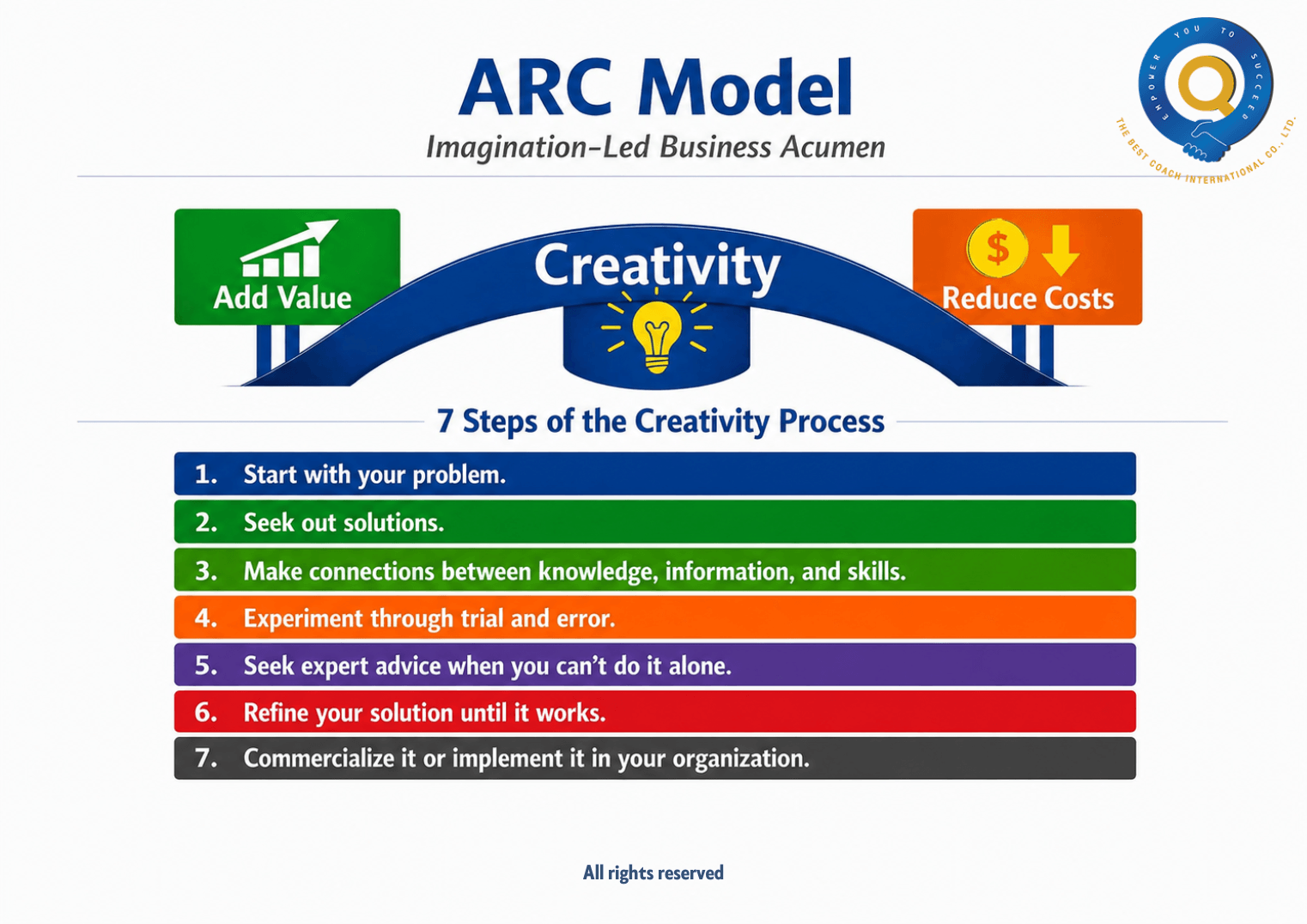
That’s it. Every successful business initiative, every profitable product, every operational efficiency—it all boils down to these two principles. I call it the ARC Model: Add Value, Reduce Costs, and use Creativity to do both.
Lisa’s eyes lit up. “So, business acumen isn’t that complicated?”
“It’s that simple,” I said. “But simple doesn’t mean easy. The real question is: Based on your current role and responsibilities, how can you add value and/or reduce costs for your organization?“
That question became her North Star. But we still had to tackle the second part of her development gap: imagination.
The Liquid Paper Lesson: Creativity Demystified
Lisa admitted something vulnerable in our coaching session. “In the past, I was never trained in fostering my imagination or how to think creatively,” she confessed. “I’ve been trained to execute, not to imagine.”
I shared with her a story that has become my favorite illustration of creativity in action—the story of Bette Nesmith, an ordinary secretary who invented Liquid Paper. Bette was frustrated by the messy, time-consuming process of correcting typing errors.
One day, she observed painters covering mistakes with white paint. She made a connection between that art technique and her typing problem, creating a correcting fluid using basic white tempera paint. She partnered with her son’s chemistry teacher to perfect the formula, and the rest is history.
The lesson? Creativity isn’t about inventing something from nothing. It’s about making connections between or among existing things to create something that has never existed before.
I walked Lisa through what I call the 7 Steps of the Creativity or Innovation Process:
- Start with your problem.
- Seek out solutions.
- Make connections between or among your existing knowledge, information, and skills.
- Experiment through trial and error.
- Seek expert advice when you can’t do it alone.
- Refine your solution until it works.
- Commercialize it or implement it in your organization.
“Imagination,” Lisa realized, “isn’t magic. It’s a process.”
Connecting the Dots
The breakthrough came when Lisa connected these two concepts. Creativity is about making connections. Business acumen is about adding value and/or reducing costs. Put them together, and you have a powerful formula for leadership and business impact:
Use your imagination to find creative ways to add value and/or reduce costs for your organization.
Lisa’s homework was deceptively simple: find a problem at work, apply the 7-step creativity process, and share back. But the transformation we witnessed was anything but simple.
She started seeing problems not as obstacles but as opportunities for creative problem-solving. She began asking better questions, making unexpected connections, and generating solutions that had never occurred to her before.
“What have I learned about myself?” she reflected at the end of our session. “That creativity is a skill I can develop. I just never knew how.”
Your Turn: The One Question That Unlocks Everything
If you’re a leader wondering how to strengthen your business acumen, I’ll leave you with the same question I left Lisa with:
Based on your current role and responsibilities, how can you add value and/or reduce costs for your organization—and what creative connections can you make to get there?
The answer might just transform how you lead.
To learn more about the ARC Model or to explore coaching opportunities, let’s connect.
About Atip Muangsuwan: Atip is an executive leadership coach who specializes in helping high-achieving leaders overcome internal barriers to unlock their full potential and drive organizational success. Through a blend of strategic frameworks and profound personal insights, he empowers leaders in transforming their mindsets, emotional states, and behaviors for lasting impact.
SHARE :
Facebook
LinkedIn
Twitter
RECOMMENDED ARTICLES :