

When Good Intentions Get Lost in Translation: A Leader’s Journey from Being Misunderstood to Truly Heard
By Atip Muangsuwan
“Approaching people with listening and asking questions—seeking first to understand, then to be understood—is the foundation of being understood yourself.”
Atip Muangsuwan
CEO Coach and Coach Supervisor
The best communicator is not the one who speaks the most eloquently, but the one who creates the clearest understanding between both parties.
I learned this truth anew the day I sat down with a senior leader I’ll call Josie.
She runs a significant division at one of the world’s most renowned entertainment companies. Her name is known in boardrooms across the globe. Her decisions shape content that reaches billions. And yet, on this particular morning, she wasn’t thinking about quarterly numbers or global strategy.
She was thinking about something far more human—and far more elusive.
“I want people to understand my real good intent,” she told me, her voice carrying the weight of someone who has been misunderstood too many times.
“I don’t want people to get me wrong. And I want to be approachable.”
The Paradox of the Direct Leader
Josie is a direct person. She always has been. In an industry where diplomacy often masks truth, she prides herself on saying what needs to be said. No sugar-coating. No dancing around hard truths.
But here’s the paradox: her directness—the very quality that makes her effective—sometimes wounds the very people she’s trying to lead.
“Sometimes I say things people don’t want to hear,” she admitted. “And sometimes, it hurts their feelings.”
She had become self-aware about this pattern. She knew it was happening. But awareness without a framework is like having a map without a compass—you know where you want to go, but you’re not sure how to get there.
Josie’s motivations were clear:
Relationship is paramount in her company’s culture. She wanted to be approachable—the kind of leader people sought out, not avoided. And she wanted her intent to be crystal clear so that even when she delivered difficult messages, people would know they came from a place of genuine care.
But how do you tell hard truths without creating hard feelings?
How do you stay authentic to your direct style while ensuring people feel valued, not bruised?
This is where our coaching journey began—and where two powerful frameworks would transform not just how Josie communicated, but how her entire team experienced her leadership.
The LAR-SE Framework: Seek First to Understand
I introduced Josie to a five-step model I’ve developed over the years of coaching leaders across industries—a simple framework that transforms ordinary conversations into breakthrough dialogues.
I call it the LAR-SE Model.
The LAR-SE Model is not about becoming a professional coach. It is about becoming a leader as coach—someone who leads through dialogue, curiosity, and empowerment rather than commands, control, and compliance.
Here’s how it works:
L — Listen Actively and Deeply
Most leaders listen just enough to formulate their response. That is not listening; that is waiting to speak.
The L in LAR-SE demands more. It means listening to understand the other person’s needs, expectations, motivations, pain points, concerns, worries, and fears.
When leaders practice active and deep listening with their teams, the shift is almost immediate. People feel seen.
A — Ask Powerful Questions
Questions are the engine of discovery. They uncover what lies beneath the surface. Powerful questions evoke self-awarenessin the other person. They don’t assume; they explore.
R — Reflect to Clarify
This is where you paraphrase what you’ve heard to confirm understanding and show you value their input. “So, if I’m hearing you correctly, your main concern is about the resources, not the goal itself.”
S — Share Your Side
Now—and only now—do you share your perspective, your real intent, your core message.
E — Empower or Encourage
Invite the other person to continue sharing. Keep the dialogue flowing.
Seek first to understand, then to be understood.
This principle, made famous by Stephen Covey, is the beating heart of LAR-SE. And for Josie, it was the key that unlocked everything.
The C-S-C Framework: The Compassionate Architecture
But understanding alone wasn’t enough. Josie needed a way to deliver her messages—her direct, honest, sometimes difficult messages—in a way that preserved trust and goodwill.
That’s where the C-S-C Framework came in.
The C-S-C Framework is a three-part structure that provides the compassionate architecture for your message, ensuring it’s framed within respect.
C — Care (Begin with Empathy & Recognition)
Start by genuinely acknowledging the other person’s value, efforts, or good intentions. This establishes psychological safety.
S — Share (Be Direct, Honest & Concise)
Clearly and respectfully state your feedback or boundary. Stick to facts, logic, and your own perspective.
C — Care (Reaffirm Respect & Shared Goals)
Close by reaffirming your respect and your commitment to the relationship and a positive outcome.
The Integration: Where LAR-SE Meets C-S-C
Here’s where the magic happens.
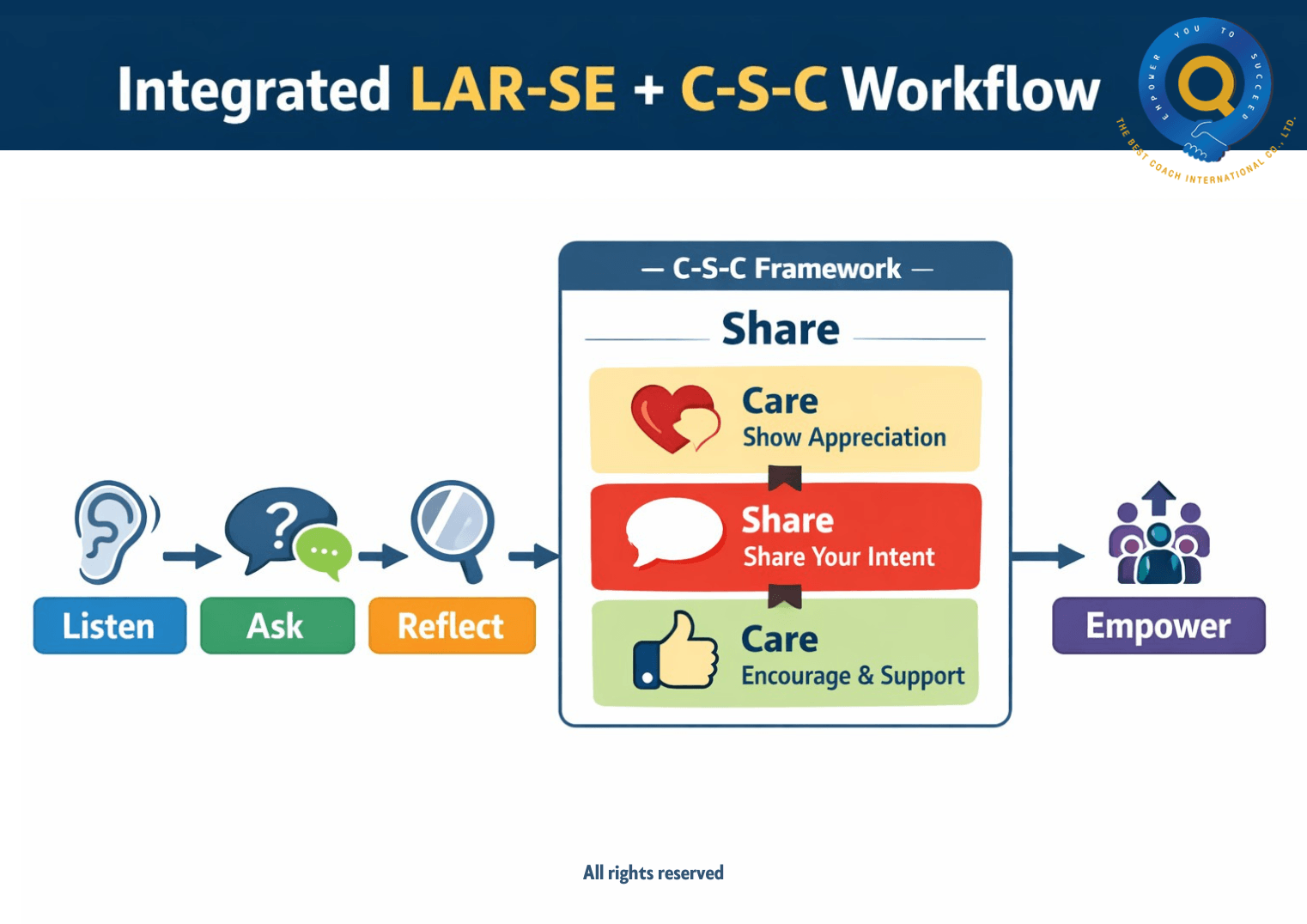
The C-S-C Framework provides the what (the caring structure), and the Coach Approach—embodied in LAR-SE—provides the how (the dialogic method).
Together, they ensure the other person feels heard, respected, and involved in finding a way forward.
But I want to focus on a specific integration that transformed Josie’s leadership: using the C-S-C Framework to expand the Share step of LAR-SE.
Think about it. The Share step in LAR-SE is where you finally share your perspective. But if you share it without the compassionate framing of C-S-C, you risk being heard as harsh, critical, or dismissive—exactly what Josie was experiencing.
By integrating C-S-C into the Share step, Josie learned to deliver her direct messages within a cocoon of genuine care.
Here’s how the integrated framework looks in practice:
Step 1: L — Listen Actively and Deeply
Before you share anything, listen. Really listen. Understand where the other person is coming from—their thoughts, feelings, expectations, motivations, fears, etc.
Step 2: A — Ask Powerful Questions
Draw them out. “What does success look like here? What’s the real challenge you’re facing? What options do you see?”
Step 3: R — Reflect to Clarify
“So, if I’m understanding correctly, you’re concerned about X because of Y. Is that right?”
Step 4: S — Share (Now integrated with C-S-C)
- C (Care): Begin by acknowledging their value. “I want you to know that I see how much effort you’ve put into this. Your dedication to this project hasn’t gone unnoticed.”
- S (Share): Now share your honest message. “Here’s my perspective on what I’m observing. I’m sharing this because I believe in your potential and I want to help you grow.”
- C (Care): Close with reaffirmation. “I’m committed to working through this with you. Your success matters to me, and I know we can find a way forward together.”
Step 5: E — Empower or Encourage
“What are your thoughts on what I’ve shared? I’d love to hear your perspective.”
The Human Urge to Be Important
There was one more piece of the puzzle—a profound insight from Dale Carnegie’s timeless book, How to Win Friends and Influence People.
Carnegie wrote that the deepest urge in human nature is the desire to be important.
People want to feel significant in other people’s eyes.
When Josie understood this, something clicked. Her directness, however well-intentioned, could sometimes make people feel insignificant. Not because she intended to diminish them—but because the delivery lacked the emotional framing that made people feel valued.
The solution wasn’t to stop being direct. It was to wrap her directness in genuine care and recognition.
Treat people like they’re your VIP. Then, they’ll treat you the same. (The law of reciprocity.)
Josie’s Transformation
When we met, Josie was frustrated. When we finished our session, she was empowered.
“I’ll start implementing the LAR-SE and C-S-C Frameworks with my subordinates, my manager, my peers, and colleagues right away,” she committed.
She had clarity. She had tools. And most importantly, she had a new understanding: approaching people with listening and asking questions—seeking first to understand, then to be understood—is the foundation of being understood yourself.
Caring and encouraging aren’t soft skills. They’re vital steps to reveal your good intent.
Your Invitation
Perhaps you see yourself in Josie’s story. Perhaps you’ve been misunderstood despite your best intentions. Perhaps you’ve struggled to balance directness with approachability.
The frameworks I’ve shared here are not theoretical—they’re proven, practical, and transform leaders every day.
The next time you face a difficult conversation, remember:
Listen first. Ask questions. Reflect to confirm understanding. Then share—with care, honesty, and care again.
And always remember: people don’t care how much you know until they know how much you care.
If you need help to transform your leadership skills like Josie did, let’s connect!
About Atip Muangsuwan: Atip Muangsuwan is a CEO Coach and Coach Supervisor, founder of The Best Coach International, and inventor of numerous frameworks that help leaders transform their communication, influence, and impact.
SHARE :
Facebook
LinkedIn
Twitter