


From Bottleneck to Breakthrough: A Leader’s Journey Through Crisis, Imagination, and the MR. SOC Framework
By Atip Muangsuwan
“Imagination is what transforms a crisis into an opportunity, a limitation into a launching pad, and a problem into a gift.”
Atip Muangsuwan
CEO Coach and Coach Supervisor
The Call That Changed Everything
The phone rang at 8:00 on a Monday morning.
On the other end was Patrick—a name I’ll use to protect the privacy of the global tech leader I had the privilege of coaching that day. But make no mistake: the man on that call was anything but anonymous in his industry. He ran operations for a multinational technology company with a reputation built over decades. His factories spanned continents. His products powered industries. His brand was synonymous with reliability.
And yet, on that Monday morning, Patrick’s voice carried something I’d rarely heard from him: uncertainty.
“Atip,” he said, skipping the pleasantries. “We have a problem. A big one.”
The problem was late delivery. Not just a few days late—weeks. Months, in some cases. Energy storages that were supposed to be in customers’ hands were still sitting in a factory that had run out of room, run out of time, and—if Patrick was being honest—run out of options.
“We have only one test room,” he explained. “One oven. A steel cutter that’s older than most of my engineers. And our factory? Ten thousand square meters. That’s it. Our other BUs have fifty thousand. A hundred thousand. We’re operating in a shoebox while trying to deliver products that require the space of a cathedral.”
The expansion project wouldn’t be completed until the middle of next year. Meanwhile, customers were waiting. Patience was wearing thin. And Patrick’s pride—the pride of a leader who had never failed to deliver—was on the line.
“I need to satisfy them,” he said. “I need to keep their confidence. I need to protect our brand.”
I leaned back in my chair and smiled. Not because the situation was easy—it wasn’t. But because I knew what was coming next. I knew that Patrick was about to discover something powerful about himself, about leadership, and about the nature of problems themselves.
“Patrick,” I said, “let me ask you something. What if I told you that every problem has a solution? Not some problems. Not most problems. Every problem.”
There was a pause on the other end of the line.
“That sounds… optimistic,” he said.
“It’s not optimism,” I replied. “It’s a mindset. And that mindset is the first step in what I call the MR. SOC framework.”
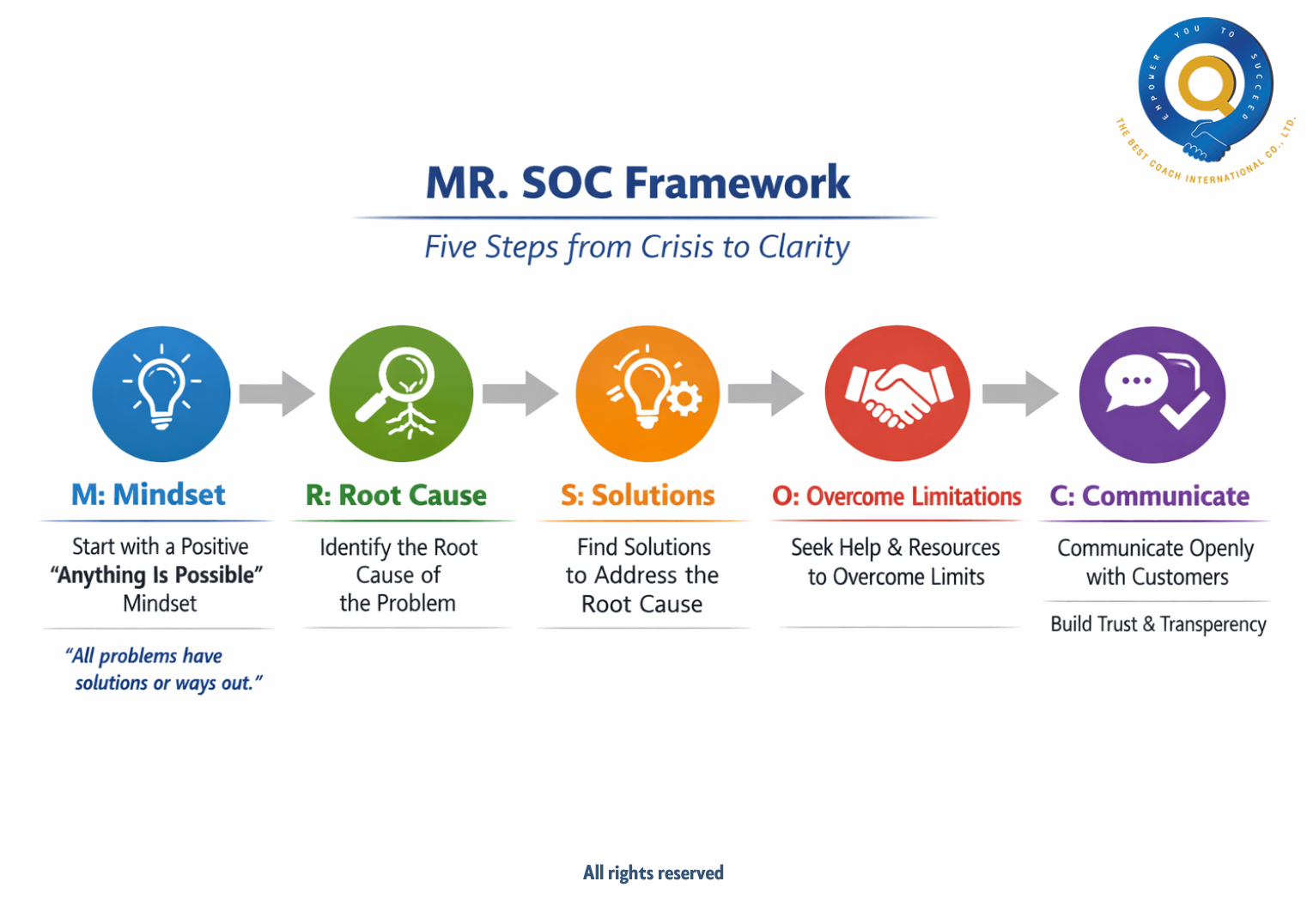
The MR. SOC Framework: Five Steps from Crisis to Clarity
Over the course of our coaching session, Patrick and I walked through a framework that would transform not just how he solved this problem, but how he approached challenges forever after. I call it the MR. SOC framework—and it’s built on a simple but profound truth:
All problems have solutions or ways out.
That’s the “M” in MR. SOC: Mindset.
M: Start with the Positive and ‘Anything Is Possible‘ Mindset
“All problems have the solutions or ways out.”
This isn’t wishful thinking. It’s a declaration of war against the paralysis that sets in when we feel trapped. Patrick was trapped—trapped by space constraints, by aging equipment, by a test room that could only handle so much. But the first step wasn’t to fix any of those things. The first step was to believe they could be fixed.
“I’m determined to overcome any obstacles,” Patrick said at one point during our session. And later, when we reflected on what he’d learned about himself: “I am open to any possibilities and options.”
That’s the mindset. That’s the foundation. Without it, nothing else works.
R: Identify the Root Cause(s)
Once Patrick had shifted his mindset, we got to work on the “R”: Root Cause Analysis.
The symptoms were clear: late deliveries, unhappy customers, a brand under pressure. But symptoms are never the real problem. They’re just the smoke. We needed to find the fire.
“What’s really causing the delays?” I asked.
Patrick didn’t hesitate. He’d already done the thinking:
- Only one small test room in the factory, creating a capacity bottleneck
- Quality issues with the product and partial discharge—poor quality leading directly to delays
- Insufficient factory space—10,000 square meters versus the 50,000 to 100,000 square meters of their other BUs.
These weren’t just problems. They were the root problems. And once you identify the root, you can start pulling it out.
S: Find the Solutions to the Root Cause(s)
This is where the real creativity begins. With the root causes identified, Patrick and I explored every possible solution we could imagine.
Brainstorming with stakeholders. Finding out who had solved this problem before and learning from their strategy. Studying case studies. Looking at what competitors were doing. Leaving no stone unturned.
“Creativity or innovation is about making connections of or among existing things to come up with the things which have never existed before!”
One connection that emerged was the China BU. Patrick’s company had operations there—and they had capacity. Why not manufacture twelve energy storages in China to relieve the pressure on the overloaded factory?
It wasn’t a perfect solution. But it was a solution. And in the world of problem-solving, momentum matters more than perfection.
O: Overcome Limitations by Seeking Help
This is the “O” in MR. SOC—and it might be the most underutilized step in all of problem-solving.
We human beings have a tendency to believe we have to solve everything ourselves. We think asking for help is a sign of weakness. Nothing could be further from the truth.
“Even innovators need guides,” I reminded Patrick.
I asked him a series of questions that opened up a world of possibilities:
- Can we rent factory space somewhere?
- Can we rent a test room?
- Can we rent an oven? A steel cutter?
- What about getting help from external specialists or experts?
- What about outsource and partnership options?
Patrick’s eyes widened. He’d been so focused on what his factory couldn’t do that he’d forgotten to ask what the world could do.
“We can outsource the packing,” he said, almost to himself. “We can outsource other processes, too. Why didn’t I think of that?”
Because we all have blind spots. That’s why we need other people like a personal coach to help us see.
C: Communicate with Customers
The final step—and perhaps the most counterintuitive—is to Communicate.
Most leaders hide their problems. They try to fix things quietly, hoping no one notices. But Patrick and I took a different approach.
“Be transparent,” I told him. “Be honest. Be frank.”
Share the root causes of the late delivery with your customers. Share your limitations. Share your constraints. And most importantly, share your action steps—what you’re doing right now to fix the problem.
When you do this, something remarkable happens: customers develop empathy. They understand. They trust you more, not less, because you’ve shown them that you’re human, that you’re working on it, and that you respect them enough to tell them the truth.
“Coordinate with the Key Account Managers,” Patrick noted. “Communicate the root causes, limitations, constraints, and action steps to the customers.”
It wasn’t about making excuses. It was about building trust.
The Out-of-the-Box Thinking That Changed Everything
Somewhere in the middle of our session, something clicked for Patrick.
We’d been talking about the constraints—the small test room, the old oven, the ancient steel cutter, the limited space. And then I asked him a question that changed everything:
“How could you turn this late-delivery problem into an advantage?”
Silence on the other end.
“How could you change this crisis into an opportunity?”
More silence.
Then: “I don’t know,” he said. “But I’m going to find out.”
That’s the power of imagination. As Albert Einstein once said, “Imagination is more important than knowledge. For knowledge is limited to all we now know and understand, while imagination embraces the entire world, and all there ever will be to know and understand.”
Because that’s what it really comes down to. Imagination is the engine of innovation. Imagination is what allows us to see solutions where others see dead ends. Imagination is what transforms a crisis into an opportunity, a limitation into a launching pad, and a problem into a gift.
Patrick started thinking differently. What if the delay wasn’t just a problem to be solved, but a chance to demonstrate their commitment to quality? What if the extra time allowed them to deliver an even better product? What if they could use this moment to deepen their relationships with customers?
“What’s possible?” I asked. “What’s an open door?”
He smiled. I could hear it in his voice.
“Everything,” he said. “Everything is possible.”
The Action Steps: From Insight to Impact
By the end of our session, Patrick had a clear plan. Not just vague intentions—specific, actionable steps:
- Create a recovery plan—a detailed roadmap for getting back on track.
- Organize brainstorming sessions with stakeholders—including frontline workers who might see solutions that executives miss.
- Work with the China BU to manufacture twelve energy storages, relieving capacity pressure.
- Outsource packing and other processes—anything that could be done externally. Only do what we do best, the rest we can outsource.
- Implement proactive quality control for the parts.
- Coordinate with Key Account Managers to communicate transparently with customers.
Each step was concrete. Each step was achievable. And each step moved Patrick closer to not just solving the problem, but transcending it.
What Patrick Learned About Himself
At the end of our session, I asked Patrick to reflect on what he’d discovered about himself.
Two things stood out:
First: “I am determined to overcome any obstacles, constraints and limitations.”
This wasn’t bravado. This was a man who had looked into the abyss of a crisis and decided he would not be defined by it. He would define it.
Second: “I am open to any possibilities and options.”
This is the hallmark of a truly innovative leader—the willingness to set aside ego, to ask for help, to consider ideas that seem crazy at first, and to trust that somewhere in the chaos lies an opportunity.
The Bottom Line
Patrick’s story isn’t unique. Every leader faces moments when the walls seem to be closing in. Every organization hits a point where the constraints feel insurmountable.
Every problem—no matter how complex—has a solution waiting to be discovered.
The question isn’t whether the solution exists. The question is whether you have the mindset to find it, the creativity to imagine it, and the courage to ask for help in bringing it to life.
If you need help transforming your crisis into opportunities, let’s connect soon!
About Atip Muangsuwan: Atip is a CEO Coach and Coach Supervisor at The Best Coach International. He works with leaders and executives navigating the complexities of the AI Era. He helps leaders and executives transform challenges into opportunities through innovative coaching frameworks and creative problem-solving.
SHARE :
Facebook
LinkedIn
Twitter
RECOMMENDED ARTICLES :