

The Unshakeable Executive: A Story of Resilience, Purpose, and Hope
By Atip Muangsuwan
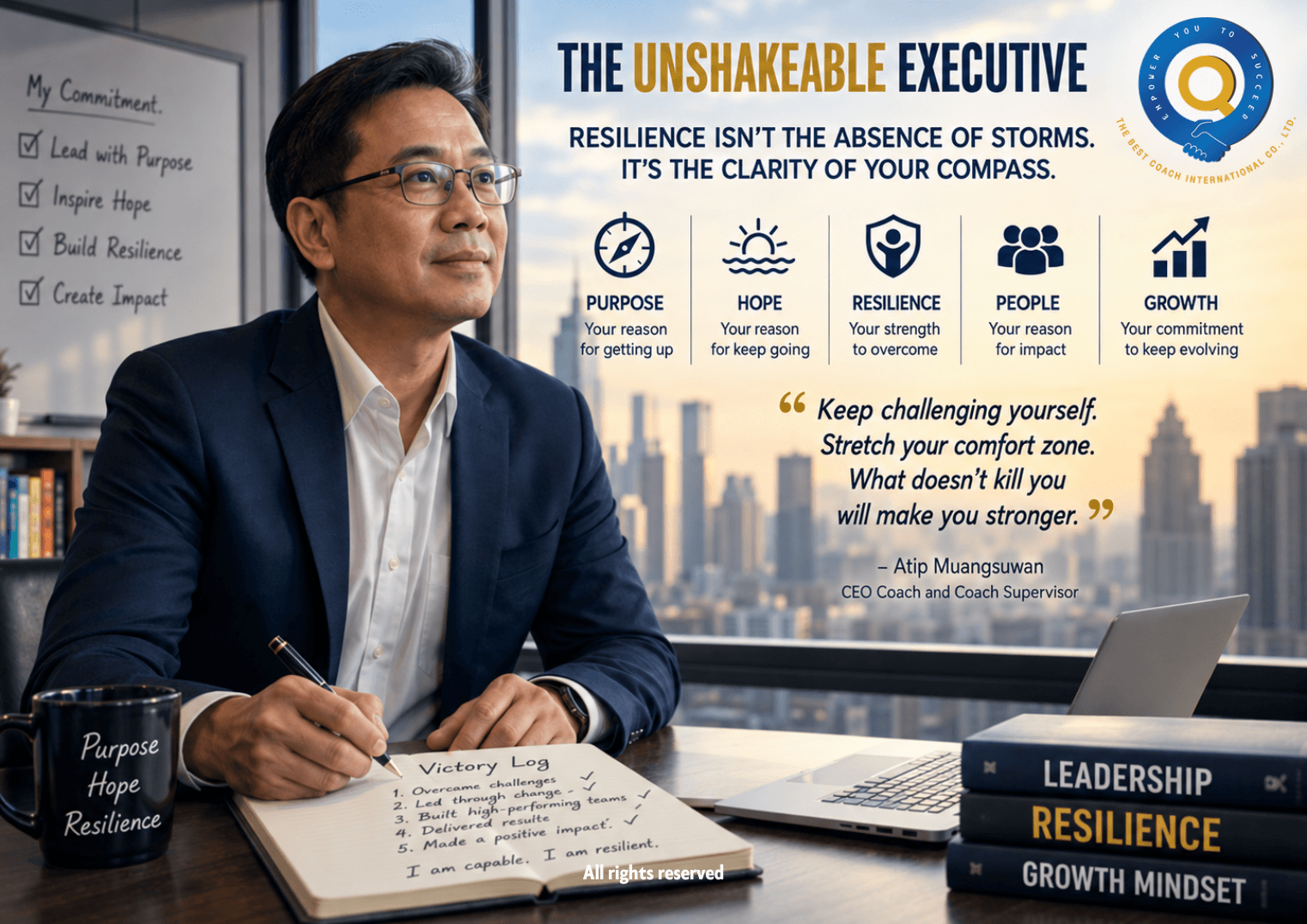
“Keep challenging yourself. Stretch your comfort zone. What doesn’t kill you will make you stronger.”
Atip Muangsuwan
CEO Coach and Coach Supervisor
The boardroom was silent, but Patrick’s mind was deafening.
As a high-ranking executive for a global conglomerate, Patrick had weathered storms that would sink most leaders. He had navigated market crashes, restructuring, and the relentless pressure of quarterly targets. Yet, sitting across from me in a recent coaching session, he admitted something profound: he was tired. Not the kind of tired that a vacation fixes, but a deep, existential fatigue that comes from constantly fighting to stay upright.
Patrick didn’t come to me because he was failing. He came to me because he was succeeding—but he knew that his current level of resilience wasn't sustainable. He scored his personal resilience a solid 7 out of 10. Most leaders would kill for a 7. But Patrick wanted a 10. More importantly, he wanted his organization, a sprawling global entity, to be a 10, too!
He asked, “How do I make resilience sustainable? For me, and for my people?”
What transpired in that session was not just a coaching conversation; it was a masterclass in the architecture of the human spirit. Here is the story of how Patrick moved from surviving to thriving.
The Misconception of Grit
Many leaders believe resilience is simply the ability to grind harder. To endure more pain. To have a thicker skin.
But as Patrick and I dug deep, we realized that resilience isn't about the thickness of your armor; it’s about the clarity of your compass. The first breakthrough came when we stopped looking at resilience as a tactic and started looking at it as a mindset.
Resilience is a belief system.
If you don't believe in yourself, your purpose, or your future, you will break. But if you are anchored by a strong sense of self and a compelling vision, you become unbreakable. This is where the concept of Hope and Optimism enters the room. It is not naive positivity; it is the strategic conviction that the future holds something better, and you have the agency to get there.
The Victory Log: Your Secret Weapon
I shared with Patrick a tool that I have used with leaders across the globe: The Victory Log.
In the chaos of leadership, we tend to focus on the gaps—what went wrong, what we missed, what we need to fix. We rarely pause to catalog our wins. I asked Patrick to start a log of his past successes and victories. I told him, “When you feel down, or when the weight of the world presses in, open this log. Review it. Remind yourself of who you are and what you have overcome.”
This is not an exercise in vanity; it is an exercise in empowerment. It builds the self-confidence and self-esteem that directly fuel resilience. When you have a written record of your survival and success, the current challenge loses its power to terrify you.
The Courage to Expand
I shared a few of my own stories with Patrick. I confessed that I once couldn't swim, yet I completed a SCUBA open-water diving course. I admitted that I have acrophobia (a fear of heights), yet I did a 70-meter waterfalls abseiling. As a university student, I had a terrible stage fright, yet I won my university’s English public speaking contest.
Why do I share this? Not to boast, but to illustrate a vital truth: Feel the fear and do it anyway.
Resilience grows at the edge of your comfort zone. If you only do what is easy, you atrophy. I shared with Patrick the story of my M.Sc. thesis. I was told to use Microsoft Excel—to play it safe. But I chose a new, complex geoscience software from the UK. Everyone said I would fail. But I held onto Hope. I held onto Optimism. I succeeded because I refused to give up.
Patrick realized that he had learned a love of learning, but he needed to stretch more. He needed to be willing to fail in order to grow.
The Organizational Ripple Effect
But how does this translate to a global conglomerate?
An organization is a mirror of its leader. If Patrick is anxious, the company is anxious. If Patrick is resilient, the company becomes resilient. To sustain organizational resilience, we identified that the company must be Purpose-Driven. It must have a culture where hope is currency. As we discussed the R&A (Recognition and Award) program he was running and the town halls he was leading, we realized these weren't just HR tasks—they were the pillars of a resilient culture.
The Takeaway
By the end of our session, the fatigue in Patrick’s eyes had been replaced by a spark. He felt hopeful. He felt confident.
He summarized his lesson in one word: Purpose.
I summarized mine in one word: Hope.
We realized that these two concepts are the twin engines of resilience. Purpose gives you the reason to get up, and Hope gives you the reason to keep going.
Patrick left with a clear action plan: He would share his Victory Log process, he would double down on recognizing his people, and he would ensure every town hall meeting painted a picture of a bright, promising future. He was no longer just managing a business; he was fostering a culture of unshakeable resilience.
Are you ready to build a legacy of resilience?
As a global executive and leadership coach, I have walked the path of high-stakes leadership. I don’t just coach resilience; I live it. Whether it is overcoming the fear of deep water or coaching executives through the turbulent waters of global commerce, my mission is to help leaders and organizations discover their true purpose and build the hope required to thrive.
If you are ready to move from a 7 to a 10—if you are ready to stretch your comfort zone and discover what doesn't kill you makes you stronger—let’s have that conversation.
Keep challenging yourself. What doesn’t kill you will make you stronger.
About Atip Muangsuwan: Atip is an executive leadership coach who specializes in helping high-achieving leaders overcome internal barriers to unlock their full potential and drive organizational success. Through a blend of strategic frameworks and profound personal insights, he empowers leaders in transforming their mindsets, emotional states, and behaviors for lasting impact.
SHARE :
Facebook
LinkedIn
Twitter
RECOMMENDED ARTICLES :