

The Space in Between: How a Tech Titan Found Freedom in a Single Pause
By Atip Muangsuwan
“Embrace yourself with mindfulness, and you will be set free. Firstly, you’ll be set free from chaotic and restless thoughts. Ultimately, you’ll be set free from craving and defilements. Only then can you have unshakeable peace.”
Atip Muangsuwan
CEO Coach and Coach Supervisor
Albert is a man who moves fast.
As a senior executive at a global technology giant, his world is measured in milliseconds. He leads teams across continents, manages multi-million-dollar risks, and makes decisions that ripple through the global economy. He is paid to be sharp, decisive, and always on.
But recently, Albert sat across from me, looking exhausted. “I feel like a pinball,” he admitted. “Every email, every comment in a meeting, every slight from a colleague—it hits me, and I bounce off the walls. I get angry, I get annoyed, I get frustrated. I react. And I’m tired of it.”
Albert had a specific goal for our session: He didn’t want to learn how to manage people better or how to optimize supply chains more effectively. He wanted to master the one thing that causes the most chaos in the corporate world—his own mind. He wanted to learn the art of Mindfulness.
The East Meets the West
In my work coaching leaders across the globe, I often find that the solution to modern stress lies at the intersection of ancient wisdom and Western psychology.
Albert came to me looking for a tool to control his emotional state. He found it in a conversation that bridged 2,500 years of Buddhist practice with the profound insights of Dr. Viktor Frankl, the Austrian psychiatrist and Holocaust survivor who wrote Man’s Search for Meaning.
Dr. Frankl famously wrote: “Between stimulus and response there is a space. In that space is our power to choose our response. In our response lies our growth and our freedom.”
This is the exact moment where Eastern Mindfulness meets Western Psychology.
In Buddhism, we practice being the observer of the mind in the present moment. We aim to be aware and awake. When we achieve this, we reach a state of “Empty Mind”—a state of bliss and peace.
Dr. Frankl called this same phenomenon the “Pause.”
The Anatomy of a Reaction
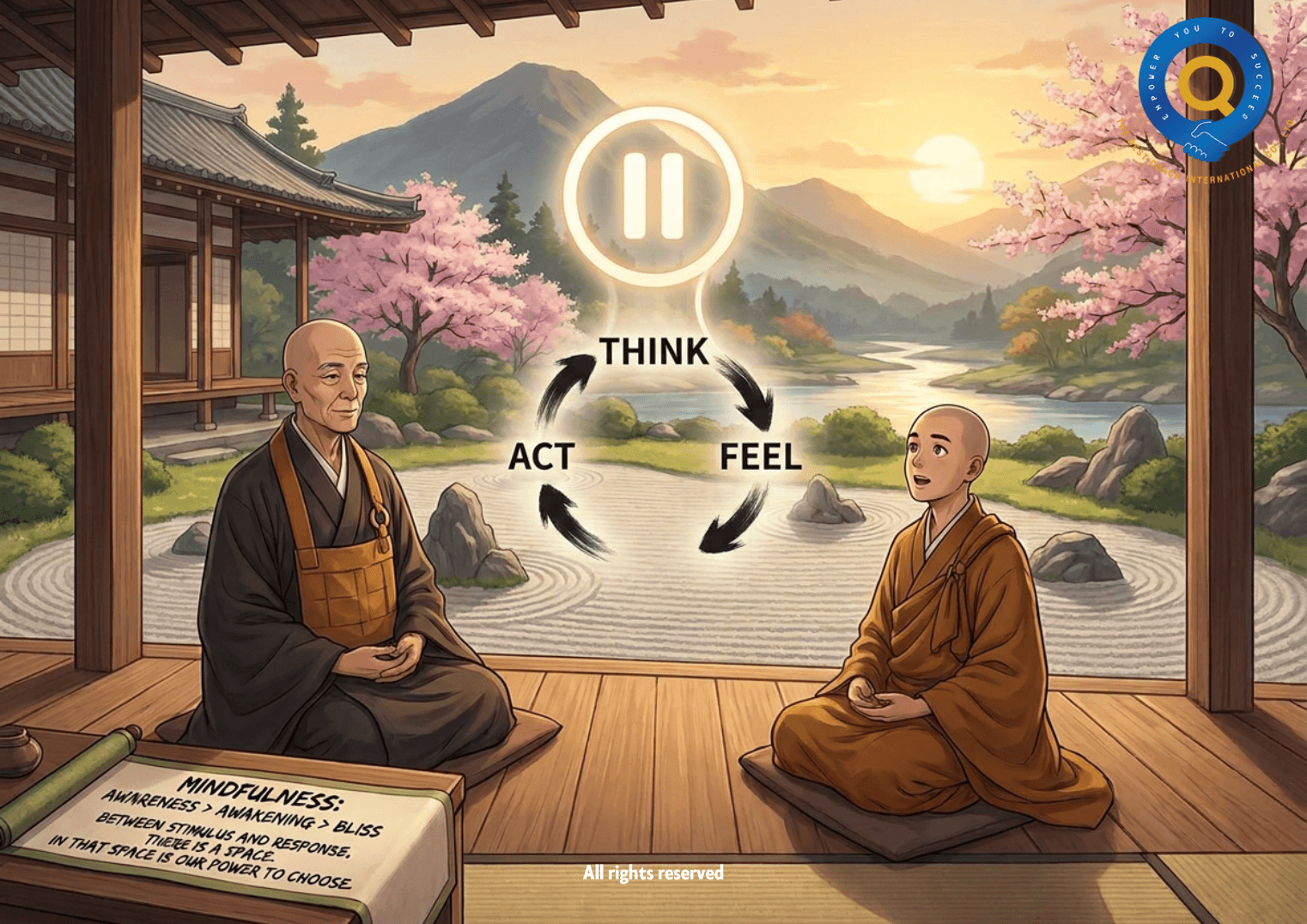
To help Albert visualize this, I walked him through the Think-Feel-Act Cycle.
This is basic human operating software:
- Upstream: Thinking (The Source)
- Mid-stream: Feeling (The Emotion)
- Downstream: Action (The Behavior)
If you don’t take care of the source (your thinking), the downstream (your action) becomes destructive. You lash out at a colleague. You send a passive-aggressive email. You spiral into anxiety.
Albert realized that he was living entirely downstream. He was reacting to the waves without ever looking at the source.
The secret, I told him, is to insert mindfulness into this cycle.
“When you become aware of your thought,” I explained, “that thought dies immediately. Before a new thought arises, you have a vacuum—an empty space.”
That empty space is your sacred space. It is where your freedom lies.
The Practice of the Pause
We live in a world that trains us to react instantly. But true leadership requires a pause.
Albert and I worked through a strategy to operationalize this:
- Awareness: Become aware of your thoughts, feelings and actions in the present moment throughout your day.
- The Pause: When something or someone triggers you, pause before responding to them.
- The Empty Mind: For a few seconds during the pause, you have an empty space. The old thought is gone; the new one hasn’t arrived. This is the moment your mind is empty from your thoughts.
- The Choice: In that empty mind, you’re free to choose your response.
This is the essence of emotional intelligence. It is not about suppressing your emotions; it is about creating your awareness by using the pause, having the empty mind, then having your choice and freedom to think, feel and act more intelligently.
“Take Control and Be Set Free”
By the end of our session, the shift in Albert’s energy was palpable. The anxiety in his shoulders had dropped.
“My one-word summary for this is ‘Pause,’ ” Albert told me. “I need to practice the pause more often. Not just as a concept, but in my daily practice.”
My one-word summary for him was “Observer.”
Being the observer of your mind in the present moment is the top secret. When you are the observer, you are no longer the victim. You are the executive of your own destiny.
Albert left with a clear action plan: to practice the pause, to choose positive thoughts after the vacuum state, and to report back on his progress.
His final words to me? “I’m really excited to practice this. I feel peaceful starting in this coaching session.”
The Leadership Imperative
As a global executive coach, I have had the privilege of coaching leaders from the boardroom to the meditation cushion. The challenges Albert faces are not unique to him. They are the challenges of every modern leader.
The higher you climb, the stronger the winds of chaos blow. But if you can cultivate that sacred space between stimulus and response, you become unshakeable.
You don’t have to be a Buddhist monk to benefit from mindfulness, and you don’t have to survive a Holocaust to understand the power of choice and freedom. You simply have to be willing to pause.
Embrace yourself with mindfulness, and you will be set free. Firstly, you’ll be set free from chaotic and restless thoughts. Ultimately, you’ll be set free from craving and defilements. Only then can you have unshakeable peace!
Are you ready to stop reacting and start responding with the space in between? If you are a leader looking to cultivate unshakeable emotional intelligence and lead with clarity and confidence, let’s connect. The space between where you are and where you want to be might just be one pause away.
About Atip Muangsuwan: Atip is an executive leadership coach who specializes in helping high-achieving leaders overcome internal barriers to unlock their full potential and drive organizational success. Through a blend of strategic frameworks and profound personal insights, he empowers leaders in transforming their mindsets, emotional states, and behaviors for lasting impact.
SHARE :
Facebook
LinkedIn
Twitter
RECOMMENDED ARTICLES :