


The Lightbulb in the Boardroom: How One Leader Moved from Fear to Faith.
By Atip Muangsuwan
“To move from fear to faith, you need to possess a winning mindset and a sense of certainty.”
Atip Muangsuwan
CEO Coach and Coach Supervisor
Julia had finally arrived. After years of dedication, she had been promoted to a top executive role at a global real estate firm. It was the opportunity of a lifetime. Yet, as she sat across from me, the shine of the promotion had faded, replaced by a quiet, creeping shadow.
“I feel like I’m waiting for the other shoe to drop,” she confessed, her voice laced with a fear she hadn’t shared with her new team or her boss. “What if I fail? What if I let everyone down?”
Julia wasn’t just worried about the usual challenges of a new job. She was staring into the abyss of a potential failure. She had never experienced a major professional setback before, and she felt utterly exposed, without an immune system to fight off the fallout. The thought was so daunting that she was already planning her retreat, her quiet withdrawal from the very position she had worked so hard to achieve.
Her goal for our session was clear: she wanted a framework to heal and recover, to build a fortress of self-confidence before the battle even began. She wanted to learn how to be okay with failing.
This is the silent struggle of so many high-achievers. We spend our lives building ladders to the top, but we never learn how to build a safety net beneath us. We are taught to succeed, but not how to survive a fall.
I told Julia that the first step isn’t about avoiding the fall, but changing our relationship with it. To do that, I shared a story about one of history’s greatest innovators, Thomas Edison.
In the 1920s, a journalist asked Edison how it felt to fail 1,000 times in his quest to invent the incandescent lightbulb. Edison, with the clarity of a true master, replied, “I didn’t fail 1,000 times. The lightbulb was an invention with 1,000 steps.”
There are no failures. Only experiments.
This is the cornerstone of resilience. It’s the mindset that transforms a setback from a verdict on your worth into a data point on your journey. It’s the difference between saying “I am a failure” and “This attempt didn’t work.”
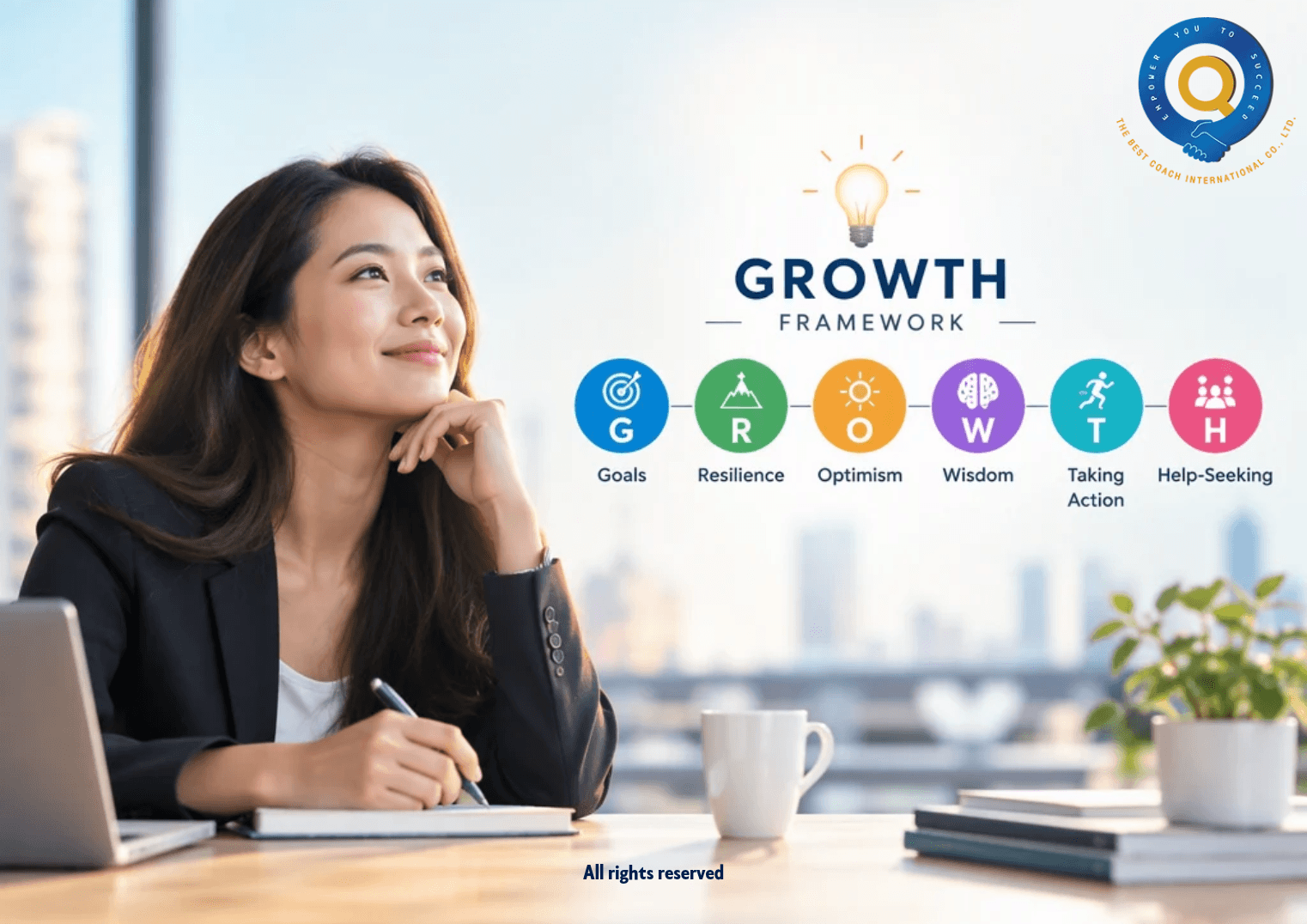
To help Julia operationalize this mindset, I introduced her to my GROWTH Framework, a tool designed not just for success, but for survival and evolution.
- G – Goals: You must set clear, compelling goals for what you want to achieve. A ship without a destination is just a boat adrift.
- R – Resilience: This is the commitment to never, ever give up until you’ve achieved your set goals. It’s the muscle you build in the gym of adversity.
- O – Optimism: Be hopeful. Resilience and optimism are two sides of the same coin. When you have hope, your spirit naturally becomes buoyant.
- W – Wisdom: Use your inner strengths and hard-won lessons to overcome challenges. You are not starting from zero; you are starting from experience.
- T – Taking Action: Action is the bridge between the intangible world of ideas and the tangible world of results. It’s where hope becomes reality.
- H – Help-Seeking: When you can’t solve a problem on your own, seek support. Asking for help isn’t a sign of weakness; it’s a strategic move.
To prove that this framework isn’t just theory, I shared a story from my own life. At 22, I was sent to Brunei for a Master’s degree, a program that compressed 12 months of intense UK curriculum into a single year. For my thesis, I had to learn a complex new geoscience software in just under three months. I had a difficult dataset and, in that pre-Zoom era, my only support was a software expert in the UK, communicating via delayed emails across time zones.
The pressure was immense. My classmates, fearing for my deadline, urged me to abandon the software and use a simpler tool like Microsoft Excel. They were begging me to take a Plan B.
But I refused. I didn’t give up. I pushed, I struggled, and I emailed. I ultimately mastered the software, defended my thesis, and earned my degree. My classmates’ suggestion of Excel was a Plan B I never even considered.
The lesson? Never surrender. Believe in yourself. And when your support system is an ocean away, you learn that resilience and optimism are mindsets you must cultivate within yourself. I used Edison as my role model, and I tell you now, “Who said I couldn’t make it? I did it.”
I shared this with Julia not to boast, but to show her what’s possible when you build a fortress around your own belief. Through our work, she learned to apply her own top strengths—her natural ‘Ideation’ and ‘Strategic’ thinking—not as tools to guarantee success, but as tools to conduct experiments. She saw that her self-confidence wasn’t something she needed to find; it was something she needed to build through action. By instilling in her a sense of certainty and faith in her own ability to grow, her perspective shifted entirely.
“I wanted to retreat,” she told me at the end of our session. “But now I can feel the positivity and see the possibilities. I’m feeling more confident to move ahead.”
Her final takeaway, her one-sentence summary for the future, was this: “I’ll have faith in my GROWTH.”
Are you a leader who feels the immense weight of a new role, the quiet fear of failure holding you back? Do you have the tools to turn that fear into a series of powerful experiments?
If Julia’s story resonates, it might be time to build your own safety net. My work as a global executive and leadership coach is dedicated to helping leaders like you move from fear to faith, from uncertainty to action. You don’t have to wait for the first fall to learn how to fly. Let’s start building your GROWTH today. Let’s connect!
About Atip Muangsuwan: Atip is an executive leadership coach who specializes in helping high-achieving leaders overcome internal barriers to unlock their full potential and drive organizational success. Through a blend of strategic frameworks and profound personal insights, he empowers leaders in transforming their mindsets, emotional states, and behaviors for lasting impact.
SHARE :
Facebook
LinkedIn
Twitter