


The Leadership Breakthrough No One Sees Coming
By Atip Muangsuwan
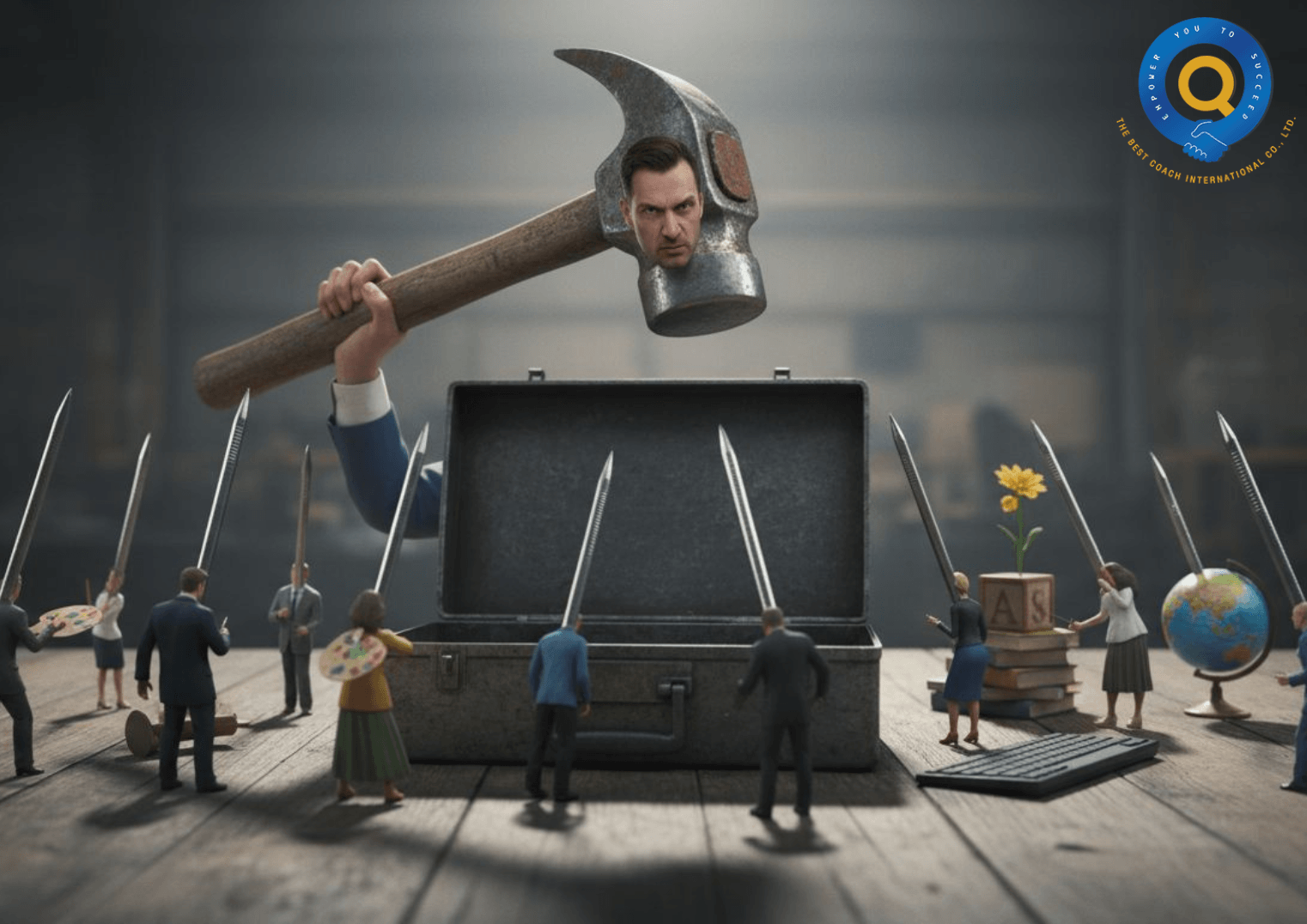
“If a leader has a hammer as the only tool in his toolbox, everything and everyone he encounters might look just like a nail to him!”
Atip Muangsuwan
CEO Coach and Coach Supervisor
There is a moment in every great leader’s career where they hit a wall. Not the wall of burnout or the wall of failure, but a subtler, more deceptive barrier: the belief that to lead well, you must project a certain kind of leadership.
I recently sat down with a leader we’ll call Thomas. On paper, Thomas has already won. He runs a global company, navigating supply chains, boardroom politics, and market volatility with a steady hand. But inside, he felt a familiar gnawing doubt. He looked at his role and saw a gap between who he was and who he needed to become.
“I want to learn how to become an assertive leader,” Thomas told me at the start of our coaching session.
When I pressed him on what that meant, his eyes lit up with clarity. He pointed to two icons: former President Barack Obama and Microsoft CEO, Satya Nadella. To Thomas, these men represented the pinnacle of calm, confident authority. They speak softly, yet the world listens. They never posture, yet they command every room.
Thomas’s career goal wasn’t selfish. He wasn’t looking for a quick promotion or a corner office with a better view. He was playing the long game. He wanted to build a legacy of leadership that his global team could actually believe in.
The Common Trap
We began our exploration the way most high-performers do: by looking for a formula. Thomas wanted the how-to. He wanted strategies, techniques, and measurable outcomes. He assumed that assertiveness was a specific volume—a precise decibel level of voice and decisiveness that sat somewhere between passive and aggressive.
So, we mapped it out. We looked at the two major poles of leadership:
- Authoritative-Based Leadership: The dominators. The commanders. Think the commanding general or the old-school dictator. It’s one-way communication. “Because I said so.”
- Relationship-Based Leadership: The servant leaders. The empathetic connectors. Leaders like Obama, Nadella, and Mandela. Two-way communication. “How can I help?”
Thomas was terrified of the first bucket and enamored with the second. But he was still stuck. He believed that “assertive” meant leaning a little more toward the authoritative side. He thought he needed to be tougher, more direct, less flexible.
After exploring halfway through our session, an aha moment happened! That’s where the turning point happened.
The Turning Point: Why Water Always Wins
About halfway through our session, I stopped Thomas with a powerful question. I asked him to forget Obama for a moment. I asked him to imagine a different kind of power entirely.
“What if the best leader isn’t the one who stands firm like a rock,” I said, “but the one who flows like a river?”
This is where Thomas’s entire framework shattered—in the best possible way.
We introduced the concept of Water-Like Leadership.
Water is soft. It yields. It pours itself into a teacup and becomes the teacup. It pours itself into a cracked pavement and becomes the puddle. It seems passive. And yet, over time, water wears down mountains. It carves canyons. It cannot be destroyed.
Thomas realized that the leaders he admires—Obama, Nadella—aren’t actually “assertive” in the aggressive sense. They are situationally fluid. They can be authoritative in a crisis, empathetic in a healing session, and democratic when brainstorming. They don’t have one style. They have all the styles.
The best kind of leaders, Thomas learned, doesn’t dominate or merely relate. They adapt. They strike a sweet spot between confidence and humility, between decisive action and deep respect for their people.
The Core Insight
The ground shifted beneath Thomas’s feet. He walked in wanting to be a specific type of leader (assertive). He walked out realizing he needed to become a system of leadership (fluid).
He summarized the entire session in a single, brilliant sentence:
“The best leadership style is fluid.”
I added gently. “Be water-like.”
Because here is the secret that Thomas unlocked that day: The root of all great leadership isn’t power or even empathy. It is genuine care for people. When you genuinely care, you stop trying to force the world to fit your style, and you start adapting your style to fit the world.
Your Action Plan (Thomas’s Homework)
If you, like Thomas, are ready to stop chasing assertiveness and start cultivating fluidity, here is your first step:
- Find Your Role Models. Not just the famous ones. Find leaders who can switch gears—calm in a storm, fierce in a fight, gentle in a celebration.
- Mimic the Move, Not the Man. Watch how they handle their emotions. Study how they treat the janitor versus the investor. Steal their techniques.
- Ask for Feedback. The water-like leader is humble. Go to your team and ask, “When did my style help? When did it hurt? Where do I need to bend?”
- Develop Your Own Styles. Eventually, you stop mimicking. You become the source.
The Final Word
Thomas left our session not as a man who had learned to be “more assertive.” He left as a man who had learned to be less rigid and more flexible.
The best kind of leadership is like a toolbox which contains many different tools in it.
The best leaders possess many different leadership styles in their toolbox and can pick and choose the style that best fits the relevant context, situation and people.
They’re able to shift from one style to another very flexibly just like water.
If a leader has a hammer as the only tool in his toolbox, everything and everyone he encounters might look just like a nail to him.
Are you looking to develop your leadership skills? If you are, then let’s talk soon!
About Atip Muangsuwan: Atip is an executive leadership coach who specializes in helping high-achieving leaders overcome internal barriers to unlock their full potential and drive organizational success. Through a blend of strategic frameworks and profound personal insights, he empowers leaders in transforming their mindsets, emotional states, and behaviors for lasting impact.
SHARE :
Facebook
LinkedIn
Twitter