



The Executive’s Paradox: Why Having No Time is Costing You Your Future
By Atip Muangsuwan
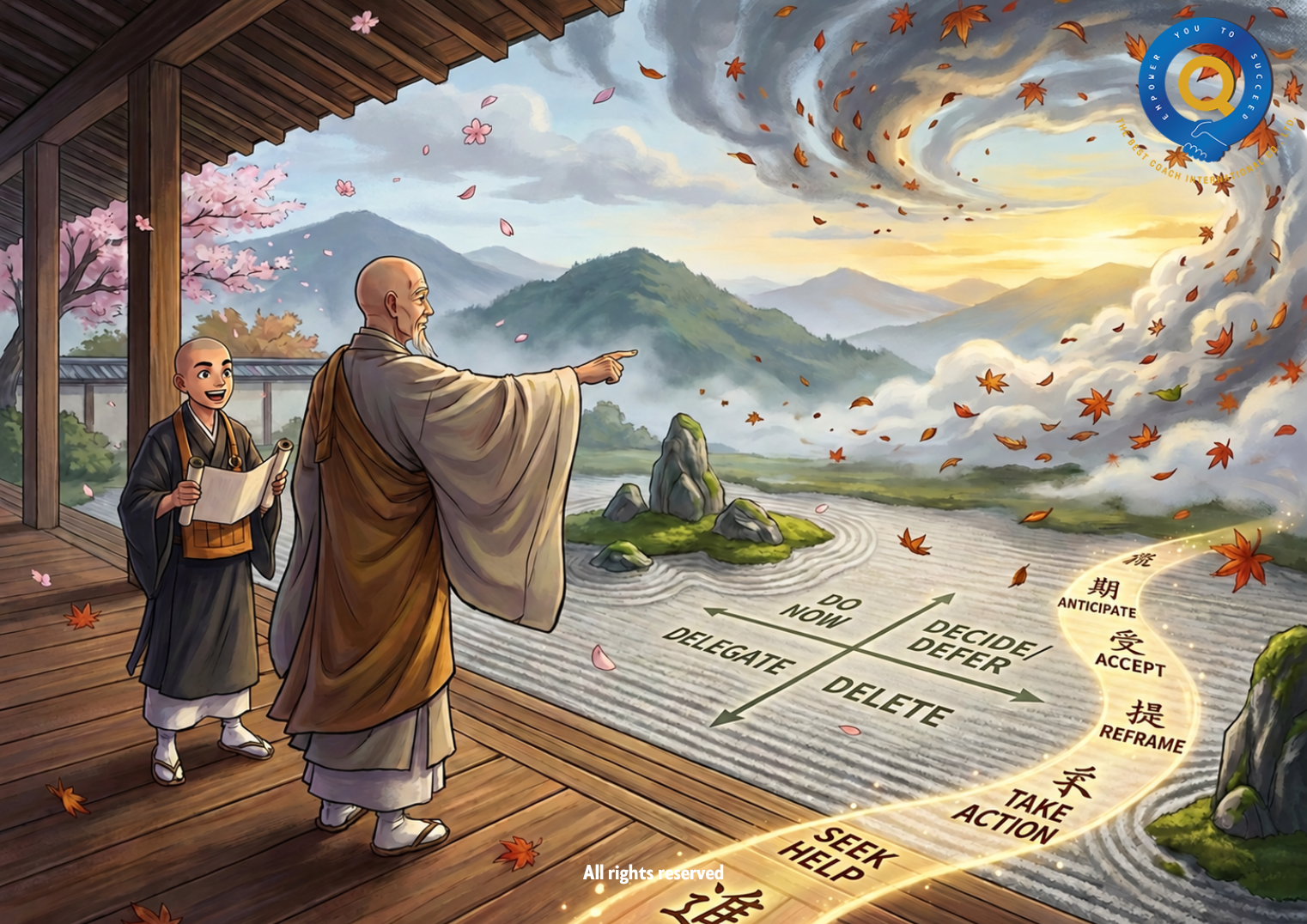
“Time Management is the prerequisite for Change Management.”
Atip Muangsuwan
CEO Coach and Coach Supervisor
It was 8:00 PM on a Friday when I met Liz, though for her, the day was far from over.
Liz is a high-ranking executive at a sprawling, global entertainment conglomerate. To the outside world, she is the picture of composure—commanding rooms, greenlighting projects, and navigating the cutthroat currents of the industry. But as we sat down for our session, the mask slipped. Liz wasn’t just tired; she was besieged.
Her world, like the industry she leads, is chaotic. The ground is constantly shifting beneath her feet. With rapid organizational restructuring and a workload that would make most people weep, Liz’s days had become a blur of ad-hoc fires, sudden assignments, and relentless interruptions. She came to me with a desperate goal: “I want to be able to manage my time and manage the changes coming right at me more effectively than at present.”
It is a plea I hear often from leaders at the pinnacle of their careers. They mistakenly believe that to handle chaos, they must simply move faster. They try to outrun the storm. But as Liz and I discovered, you cannot outrun a storm if you are too exhausted to see the shelter.
The Illusion of the Urgent
Liz’s first struggle was a lack of oxygen. She felt suffocated by tasks. We started our exploration with a hard truth: To manage time better, you must manage your priorities better.
We introduced the 4D Eisenhower Matrix, a tool that ruthlessly categorizes the noise:
- Do Now: Important and Urgent. (The crisis.)
- Decide/Defer: Important but Not Urgent. (The strategy.)
- Delegate: Not Important but Urgent. (The distraction.)
- Delete: Not Important and Not Urgent. (The waste.)
For Liz, the revelation wasn’t about the tasks she was doing; it was about the tasks she was afraid to let go of. This is a common trap for high-performers. They confuse activity with productivity. But as Liz realized, her “courage gap” was in the fourth D: Delete. She needed the courage to stop doing things that didn’t matter so she could focus on what did.
The Prerequisite for Survival
However, time management alone wasn’t enough. Liz was facing a tsunami of change. To handle this, we shifted from organization to adaptability. This is where the distinction between Time Management and Change Management becomes critical. Most leaders treat them as separate skills. They are not.
Time Management is the prerequisite for Change Management.
You cannot anticipate the future if you are drowning in the present. You cannot reframe a crisis as an opportunity if you are too exhausted to think. When you have more time and space in your life, you can deploy the A-ART-S Framework to navigate the shifts around you:
- A – Anticipate: Look to the future and do the pre-work. (This requires time).
- A – Accept: Embrace the changes coming right at you. (This requires mental space).
- R – Reframe: Turn the crisis into an opportunity to learn and grow.
- T – Take Action: Solve problems and find solutions.
- S – Seek help: Ask for help and support when the weight is too heavy to carry alone.
The “Liz” Moment
As we integrated these two tools—the 4D Eisenhower Matrix to carve out the space, and the A-ART-S framework to fill it with agility—something shifted in Liz. The panic in her eyes softened into focus.
She realized that her development gaps weren’t just about skill; they were about mindset. She identified that she needed to be comfortable with feeling uncomfortable. She had to embrace the chaos of the ad-hoc tasks, not by fighting them, but by creating a system that allowed her to process them more effectively.
“I feel confident and happy,” Liz told me at the end of our session. “Because I have direction now.”
She realized that better prioritization doesn’t just clear your calendar; it clears your mind.
The Global Executive’s Edge
In my years coaching global executives and leaders, I have seen this pattern repeatedly. The most successful leaders are not those who work the longest hours. They are the ones who master the art of integration. They know that to lead through the storm, you must first anchor yourself.
If you are reading this and feeling the familiar pang of overwhelm—if you are a leader feeling buried by the rapid pace of change—know that you are not alone, and you are not doomed to burnout.
You simply need a strategy that honors both your time and your capacity to change.
As Liz succinctly put it at the end of our session: “Better prioritization and time management lead to better results and faster growth.”
My insight for you is the same as it was for Liz: Integrate the 4D matrix with the A-ART-S framework. Maximize your impact by mastering your time, so you can master the change.
If you are a global executive or leader looking to reclaim your time and turn chaotic change into your greatest opportunity, let’s connect. Your breakthrough is closer than you think.
About Atip Muangsuwan: Atip is an executive leadership coach who specializes in helping high-achieving leaders overcome internal barriers to unlock their full potential and drive organizational success. Through a blend of strategic frameworks and profound personal insights, he empowers leaders in transforming their mindsets, emotional states, and behaviors for lasting impact.
SHARE :
Facebook
LinkedIn
Twitter
RECOMMENDED ARTICLES :