


The Corner Office Dilemma: How to Make the Toughest Call in Business
By Atip Muangsuwan
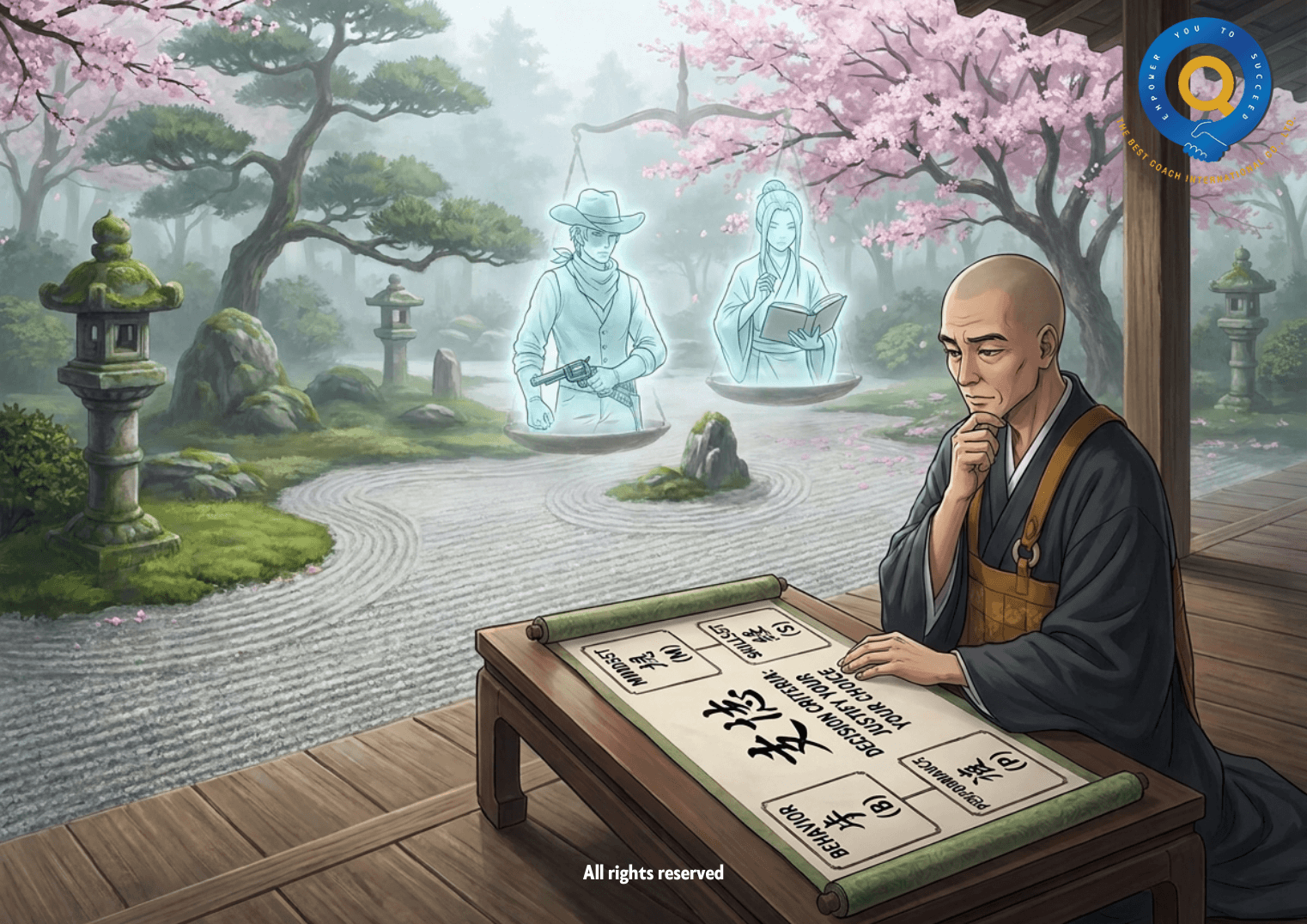
“The hardest part of leadership is not strategy. It is the people. But when you have the right criteria, the heavy lifting becomes lighter.”
Atip Muangsuwan
CEO Coach and Coach Supervisor
It is the quietest room in the world—the corner office. But for executives, the silence is often deafening, filled with the weight of decisions that dictate the livelihoods and morale of others.
I once sat across from an executive—let’s call him Mike—who was wrestling with a ghost that haunts every leader at some point in their career. Mike is a high-level executive at a global conglomerate, a man used to navigating complex markets and quarterly targets. But he sat before me paralyzed by a binary choice involving two of his direct reports.
He had to keep one manager and let the other go.
On one hand, Mike had “The Cowboy.” The Cowboy was a rainmaker. His skillset was sharp (8/10), and his performance was the engine of the team (8/10). But he was a lone wolf. He ignored rules, bristled at instruction, and his ego was a fortress. He didn’t listen; he dictated.
On the other hand, there was “The Soft.” This manager was mediocre on paper. His skillset was a work in progress (5/10), and his performance needed crutches (5/10). He required hand-holding. But he possessed a golden trait: he was open-minded. He followed the rules, respected the chain of command, and was hungry to learn.
Mike looked at me, exasperation etched on his face. “The Cowboy gets results. But he’s toxic. The Soft is safe, but he’s slow. If I make the wrong choice, I damage the team.”
This is the moment where most leaders rely on “instinct.” They go with their gut. But instinct is often just bias in a suit. As a global executive coach, I’ve learned that the worst decisions are made in a vacuum of criteria.
“Mike,” I asked, “what if we stopped looking at this as a choice between two people, and started looking at it as a math problem?”
We needed a framework. We needed to move beyond the anxiety of the decision and into the architecture of it.
I introduced Mike to the M-S-P-B Employee Assessment Framework. It is a tool I developed to strip away the emotion from talent decisions and reveal the structural truth of a human being. It stands for Mindset, Skillset, Performance, and Behavior.
I asked Mike to score both managers on a scale of 1 to 10 in each category.
The Cowboy:
Mindset: 2/10 (Fixed, ego-driven)
Skillset: 8/10
Performance: 8/10
Behavior: 2/10 (Toxic, insubordinate)
The Soft:
Mindset: 8/10 (Growth-oriented)
Skillset: 5/10
Performance: 5/10
Behavior: 8/10 (Obedient, collaborative)
The numbers were stark, but Mike hesitated. “The Cowboy has higher Skillset and Performance scores. Doesn’t that count for more?”
This is the critical error most leaders make. They treat all four pillars as equal. They shouldn’t.
I shared my philosophy with Mike: Mindset and Behavior are the heaviest weights.
Skillset and Performance are important, yes. But they are also transient. You can train a skillset. You can coach for performance. You can send an employee to a training class to learn a new software or a sales technique.
But you cannot easily fix a fixed mindset. You cannot train away a toxic ego. You cannot coach a grown adult into being a decent human being if they’re close-minded. Mindset and Behavior are rooted in character.
If you keep “The Cowboy,” you are renting short-term performance at the cost of long-term cultural decay. You are telling your team that results excuse abuse. You are allowing a virus into the host.
If you keep “The Soft,” you are investing in potential. You are betting on the fact that a willing student will eventually beat a stubborn master.
Mike looked at his scores again. The realization hit him. He had been blinded by the Cowboy’s revenue and ignored the bankruptcy of his character.
“I can’t keep The Cowboy,” Mike said, the clarity settling in. “He’s a threat to the morale of the entire team. With The Soft, I can cover his gaps. I can coach him. I can help him hit the numbers for the next quarter. If he doesn’t improve in three months, then I recruit, but I can’t keep the toxicity.”
Mike didn’t just make a decision that day; he adopted a strategy. He realized that leadership isn’t about intuition; it’s about justification. When he faces his manager to explain his choice, he won’t say, “I had a feeling.” He will say, “I analyzed Mindset, Skillset, Performance, and Behavior. The data led me here.”
The Leader as Coach
In my work coaching executives across the globe—from the boardrooms of New York to the tech hubs of Singapore—I often see brilliant leaders paralyzed by the “human” side of the business. They can read a P&L sheet in seconds, but they struggle to read the room.
My role is not to give them the answers, but to give them the frameworks to find the answers themselves. Whether we are utilizing the LAR-SE Coaching Framework (Listen, Ask, Reflect, Share, Empower) to build trust, or the M-S-P-B Framework to make the tough calls, the goal is the same: empowering leaders to act with clarity, confidence and conviction.
Mike later told me, “I usually use my intuition, but now I’ve learned that intuition without criteria is just a guess.”
The hardest part of leadership is not strategy. It is the people. But when you have the right criteria, the heavy lifting becomes lighter.
The M-S-P-B Takeaway:
When you are stuck in the corner office, staring at the two resumes, stop asking “Who is better?” and start asking “Who is built to last?”
If you are a leader facing your own “Cowboy vs. Soft” dilemma, or if you are looking to build a culture of high performance without the toxicity, let’s connect. The best decisions are made with the best frameworks.
About Atip Muangsuwan: Atip is an executive leadership coach who specializes in helping high-achieving leaders overcome internal barriers to unlock their full potential and drive organizational success. Through a blend of strategic frameworks and profound personal insights, he empowers leaders in transforming their mindsets, emotional states, and behaviors for lasting impact.
SHARE :
Facebook
LinkedIn
Twitter
RECOMMENDED ARTICLES :