


The Executive and AI: A Story of Clarity in the Age of AI
By Atip Muangsuwan
“The most important conversation wasn't about what AI can do. It was about what we must do to thrive alongside it.”
Atip Muangsuwan
CEO Coach and Coach Supervisor
Susan, a high-powered executive at a global transportation company, was feeling a familiar, modern ache. It wasn’t the pressure of quarterly targets or the complexity of global logistics. It was the nagging suspicion that she was running at full speed on a treadmill that was slowly speeding up. She was busy, but was she truly productive? She was working, but was she truly leading?
She had already dipped a toe into the AI waters, using tools like Microsoft Co-Pilot to draft emails and crunch numbers. It felt like a small victory, a bit of time saved. But she knew, with the certainty of a seasoned leader, that she was only scratching the surface. She wasn’t looking for a new gadget; she was looking for a new way of thinking.
That’s when she found herself in a coaching session with me. Her goal was clear: she wanted to learn how to apply digital transformation and AI to her work, not as a novelty, but as a fundamental part of her leadership toolkit.
Like many brilliant leaders, Susan initially framed the problem as a technical one. But I knew the real challenge lay elsewhere. As we explored her motivations—to eliminate repetitive work, to boost efficiency and productivity—a deeper truth emerged.
The Magic Isn’t in the Machine. It’s in the Mind.
“You can use AI as your ‘Thinking Partner,’” I told her. “But you must remember the heart and soul of AI usage is the prompt. It must be specific, precise, and goal-oriented. You must be crystal clear about the result you want.”
This is the point where most people get it wrong. They treat AI like a magic 8-ball, asking vague questions and hoping for a profound answer. The real power comes from treating AI as a brilliant, lightning-fast, but utterly literal assistant. You wouldn’t ask a new intern to "just handle everything." You’d give them clear instructions.
This is where I shared some crucial cautions with Susan, the guardrails of this new world: Never delegate 100% of your thinking. Always verify and audit the information. And above all, protect your integrity by never sharing confidential data or personal information.
But the most important conversation wasn't about what AI can do. It was about what we must do to thrive alongside it. We discussed the future human skills that are becoming more critical, not less: self-awareness, critical thinking, creative problem-solving, strategic thinking, and the deeply human capacity for connection.
That’s when the pieces began to click for Susan. She realized that using AI wasn’t about becoming a programmer. It was about becoming a better architect of her own success.
The Simple Framework for a Complex World
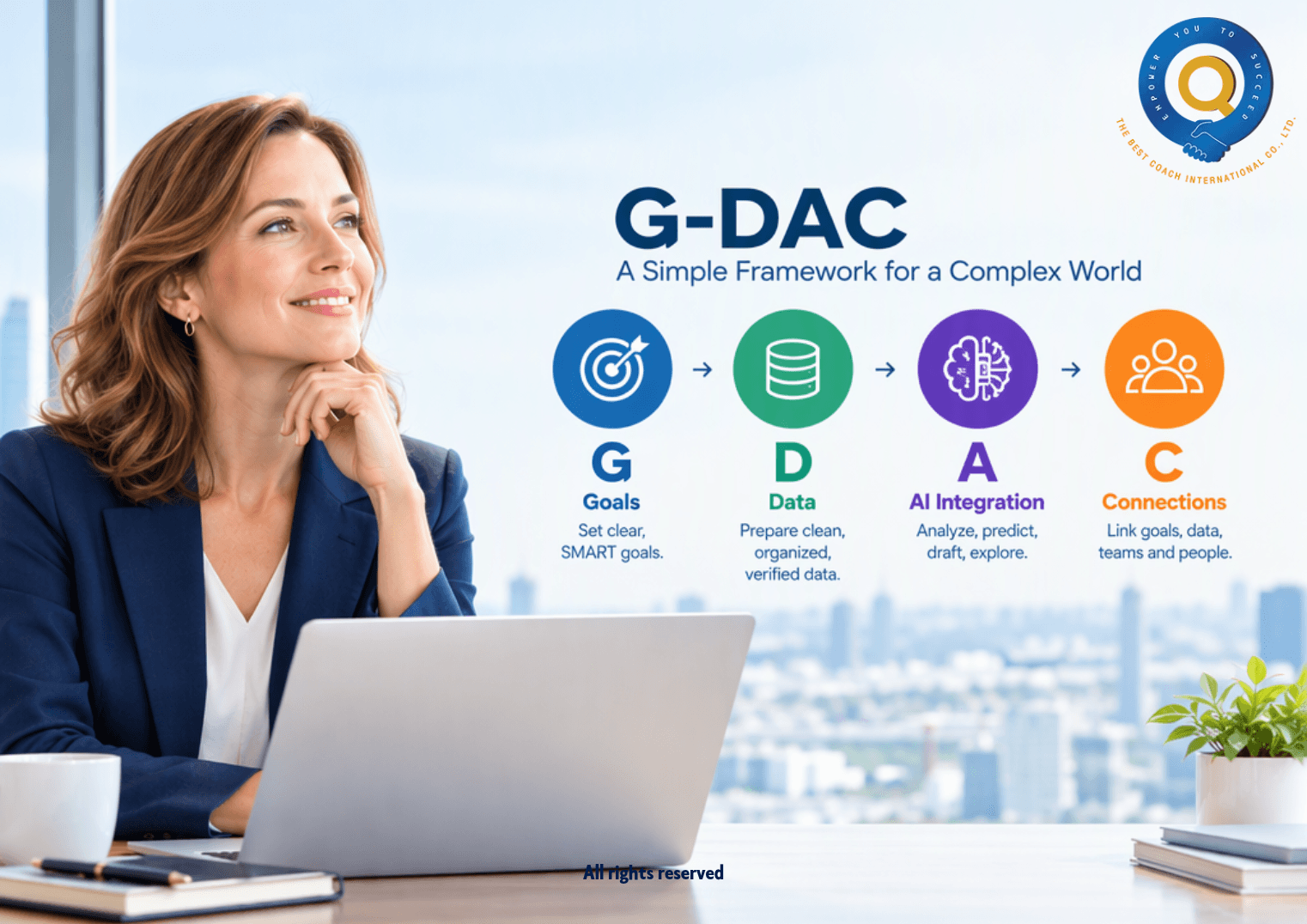
To help her move from insight to action, I introduced her to a simple, powerful framework I’ve developed for leaders navigating this landscape: G-DAC.
It’s not just an acronym; it’s a roadmap. It stands for:
- (G) Goals: You need crystal-clear, 'SMART' goals. What problem are you really trying to solve? What does a successful outcome look like? Without this, you’re just wandering in a digital desert.
- (D) Data: This is your fuel. You need your (big) data to be ready—formatted, organized, standardized, and verified. AI is a powerful engine, but it’s useless without clean fuel.
- (A) AI Integration: Once you have the goals and the data, you integrate the AI. You use it to analyze, to predict, to draft, to explore—turning your raw data into actionable insight.
- (C) Connections: This is the secret sauce. It’s not enough for an executive to have a clever AI model. You must make connections. Connect your goals to your data teams, your sales teams, your operations teams, and the frontline workers who see the reality of your operations every day.
The moment the concept of (C) Connections landed, I saw a shift in Susan. Her posture changed. Her eyes lit up. She had been trying to solve a systemic problem with a siloed solution. The framework gave her permission to think like a holistic leader again.
From Overwhelmed to Empowered
At the end of our session, I asked Susan for a one-word summary of her feeling.
She didn’t hesitate. “Confident.”
She had come in seeking technical skills and left with a strategic framework. She learned that the most important process in creativity and innovation is making connections—between goals, data, technology, and, most importantly, people.
Susan’s story isn’t unique. It’s the story of every leader in this era—brilliant, capable, and yet searching for a way to harness a technological tidal wave without losing the human touch. The secret, as she discovered, isn't in mastering the algorithm. It’s in mastering a new level of clarity.
Is Your Business Running You?
Are you, like Susan, feeling the friction between the demands of today and the promises of tomorrow? Do you see the potential of AI but feel unsure of the first step?
This is precisely what I do. As a global executive and leadership coach, I help executives and leaders build the mindset, the strategy, and the simple, powerful frameworks like G-DAC to lead with confidence and create real, lasting value.
Let's connect and explore how a deep, strategic conversation can turn your AI anxiety into your company's greatest advantage. Connect with me here to learn more.
About Atip Muangsuwan: Atip is an executive leadership coach who specializes in helping high-achieving leaders overcome internal barriers to unlock their full potential and drive organizational success. Through a blend of strategic frameworks and profound personal insights, he empowers leaders in transforming their mindsets, emotional states, and behaviors for lasting impact.
SHARE :
Facebook
LinkedIn
Twitter
RECOMMENDED ARTICLES :