

10 Ancient Lenses, 1 Modern Framework: A Leader’s Guide to Thinking That Scales
By Atip Muangsuwan
“Even a framework about frameworks requires a framework.”
Atip Muangsuwan
CEO Coach and Coach Supervisor
The Day Mike Stopped Thinking in Circles (And Started Building Frameworks)
Mike’s corner office overlooked a skyline that most people would kill for. But the view wasn’t the problem. The problem was the silence between him and his boss after the 360-degree feedback landed. “Technically brilliant,” the report said. “But needs to develop more systematic thinking.”
Mike — a brilliant executive at a global conglomerate you’ve definitely heard of — stared at those words. He’d built a career on gut instinct, rapid decisions, and firefighting. Now, that very style was starting to cost him. His manager wanted structure. Predictability. Repeatable success, not heroic one-offs.
When Mike walked into our coaching session, he didn’t want theory. He wanted a system for systematic thinking. And he wanted it fast.
The trap most high-achievers fall into
Here’s what I’ve learned after coaching hundreds of leaders across continents: telling a smart, driven executive to “be more systematic” is like telling a fish to be wetter. They drown in a sea of bullet points, flowcharts, and methodologies that feel like straitjackets.
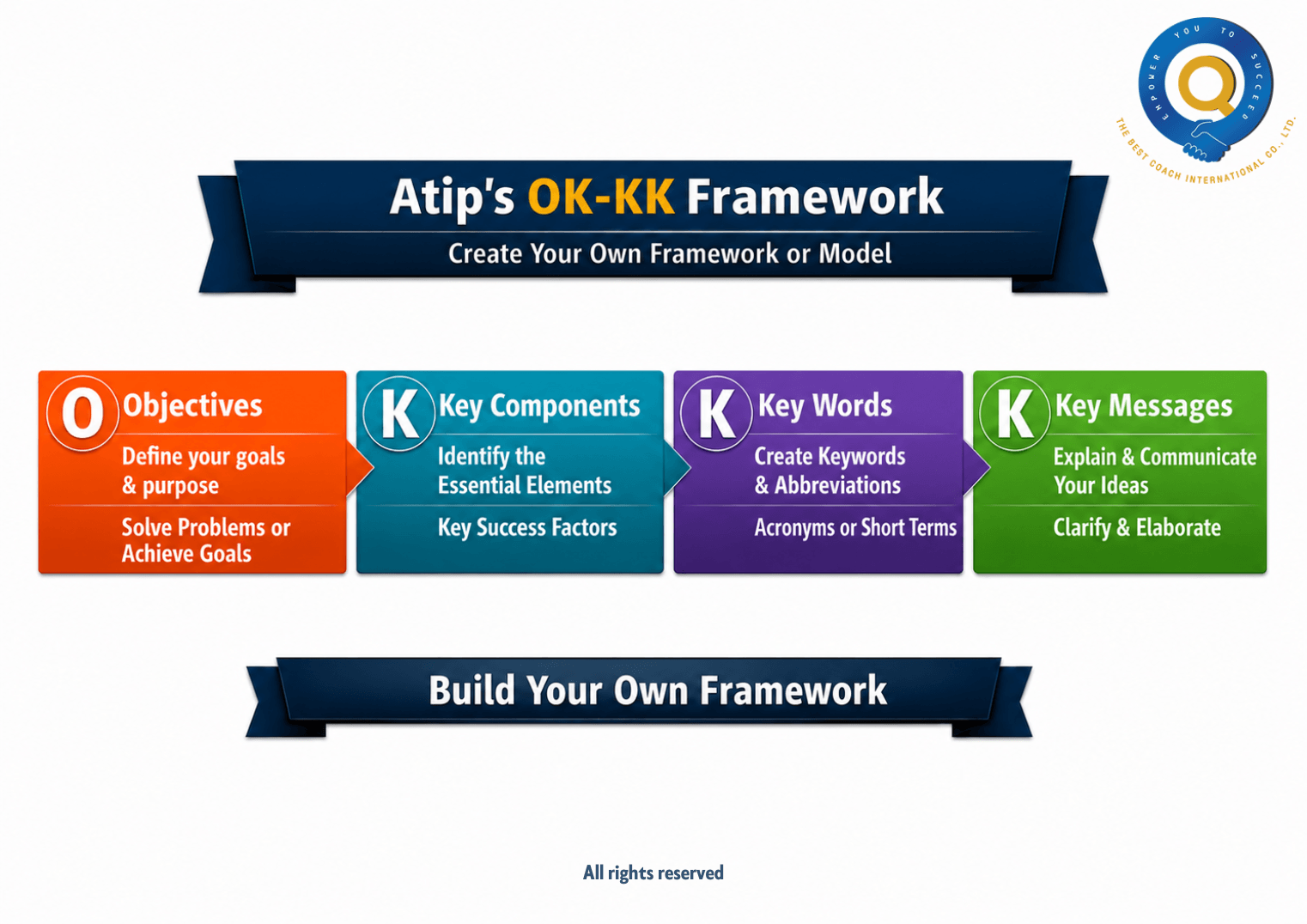
Mike needed something different. He needed a way to build his own framework, not just borrow someone else’s. So, I shared something I’d developed over years of executive coaching — a simple, four-step engine for turning messy human thinking into crystal-clear frameworks. I call it the OK-KK Framework (pronounced, OK-double K)
The OK-KK Framework: A skeleton key for the mind
“Mike,” I said, leaning forward, “every great framework starts with a single question: What’s the objective?”
That’s the first O: Objectives. Are you solving a problem? Chasing a goal? If you don’t anchor your thinking to a sharp objective, you’ll drift.
Mike’s face relaxed. “My objective,” he said, “is to make our regional expansion strategy systematic — so my team can execute without me constantly in the room.”
Boom. We had our north star.
Next came the first K: Key Components. “If you want that objective to succeed,” I asked, “what are the non-negotiable pillars?” He thought for a moment, then listed: market analysis, partner selection, regulatory readiness, team capability, and launch rhythm.
Those five pillars became the bones of his framework.
Then, the second K: Key Words. I told Mike, “Turn those components into sticky, memorable words. Even better — create an acronym or abbreviation your people can instantly recall.”
After a few playful attempts, Mike crafted the acronym C.L.E.A.R. — Compliance, Logistics, Ecosystem (for partners), Ability (of the team), and Rhythm. Suddenly, his expansion strategy wasn’t a chaotic to-do list. It was a branded, portable mental model.
Finally, the third K: Key Messages. “Now,” I said, “for each letter, write one crisp message that explains what it means and why it matters — so anyone in your organization can pick it up and run with it.”
Mike scribbled notes furiously. C: We never enter a country without mapping regulatory risk. L: Operations must be live within 90 days of signing. And so on. In under an hour, he’d built a framework that could be taught, tested, and repeated.
That’s the power of OK-KK: Objectives → Key Components → Key Words → Key Messages. It doesn’t just make you think clearly. It makes your thinking transferable. Repeatable. Scalable.
The ten ancient lenses that make frameworks foolproof
But a framework, I told Mike, is only as strong as the thinking that fills it. Executives often fail not because they lack structure, but because their minds get hijacked by cognitive ruts — bias, panic, overconfidence. That’s where something ancient can help.
“I want to offer you a bonus,” I said. “Ten mental models from Buddhist psychology. Think of them as lenses you can slip on whenever you’re populating any part of your OK-KK framework — especially when crafting key messages or testing your logic. They’ll make your systematic thinking not just sharp, but wise.”
Here are the Ten Ways of Thinking I walked Mike through. I list them not as philosophy, but as a practical toolkit.
- Thinking by Causal Relations
Trace every action back to its cause and forward to its effect. Before you add a component to your framework, ask: What triggers this? What will it trigger? - Thinking by Analytical Decomposition
Break the whole into parts. A murky objective becomes clear when you dismantle it into sub-components — just as Mike did with his expansion challenge. - Thinking in Terms of the Three Common Characteristics
Remember that all plans, no matter how brilliant, are impermanent, can bring dissatisfaction, and are not fully controllable. This keeps your framework humble and adaptable. - Thinking in Accordance with the Four Noble Truths
This is a ready-made problem-solving frame: identify the problem, pinpoint its cause, envision the goal, and map the path. It dovetails perfectly with the OK-KK sequence. - Thinking by Linking Principles with Objectives
Connect every key message back to the original objective and the core values of your organization. No orphan ideas allowed. - Thinking in Terms of Advantages, Disadvantages, and an Escape
For every key component, weigh the pros and cons. Then, define the exit strategy or mitigation plan — what Buddhists call “the escape.” - Thinking in Terms of True and Artificial Values
Distinguish what’s essential from what’s merely shiny. In framework-building, this prevents you from chasing vanity metrics or buzzwords. - Thinking that Cultivates Wholesome Qualities
Deliberately steer your thoughts toward kindness, collaboration, and positive impact. Your framework should uplift people, not just optimize them. - Thinking in the Present Moment
When executing, anchor yourself in the now. Systematic thinking collapses if you’re paralyzed by past failures or future anxieties. - Thinking by Comprehensive Analysis
Before finalizing your framework, examine it from every angle — your team’s perspective, the customer’s perspective, the competitor’s perspective. Let no blind spot remain.
Mike didn’t just nod. He began annotating his C.L.E.A.R. framework with notes like “use #6 to build risk scenario for each component” and “apply #5 to align market analysis with corporate values.” The ancient lenses made his modern framework feel alive, ethical, and resilient.
Why frameworks are the new leadership currency
Since that day, Mike has deployed his C.L.E.A.R. framework across his business unit. Early feedback? His manager used the word “transformed.” More importantly, Mike’s team now moves with a rhythm that doesn’t depend on his physical presence. They have a shared language. A shared system. A shared path to results — tested by causal logic and tempered by the wisdom of the ten mental lenses.
As a global executive and leadership coach, I see this pattern everywhere. The leaders who thrive in complexity aren’t necessarily the most experienced or the most charismatic. They’re the ones who know how to build frameworks that make brilliant thinking systematic — and who fill those frameworks with thinking that’s both sharp and deep.
The OK-KK Framework, paired with these ten ways of thinking, is my contribution to that journey. (A flow diagram accompanies this article; it maps the entire sequence visually — because even a framework about frameworks deserves a framework.)
Your move
Mike’s story doesn’t end with a certificate or a smile. It ends with a question for you: What’s the one challenge in your leadership right now that needs a framework?
Maybe it’s decision-making. Maybe it’s innovation. Maybe it’s scaling culture across borders. Whatever it is, remember: objectives first, then key components, then key words, then key messages. And then filter it all through those ten ancient lenses — they’ll catch what your ambition might miss.
If you’d like a thinking partner to help you craft your own framework — or to close a development gap the way Mike did — I’d be happy to talk. The view from your office might be impressive. But the view from a mind that finally thinks in systems, and does so with wisdom? That’s unbeatable.
About Atip Muangsuwan: Atip is an executive leadership coach who specializes in helping high-achieving leaders overcome internal barriers to unlock their full potential and drive organizational success. Through a blend of strategic frameworks and profound personal insights, he empowers leaders in transforming their mindsets, emotional states, and behaviors for lasting impact.
SHARE :
Facebook
LinkedIn
Twitter
RECOMMENDED ARTICLES :