

The Big Flood That Taught Bangkok What Sun Tzu Knew 2,500 Years Ago
By Atip Muangsuwan
“I’ve spent my career helping global executives and leaders become the architects of their own futures. Not reacting to the storm, but anticipating it. Not fighting fires, but building fireproof systems.”
Atip Muangsuwan
CEO Coach and Coach Supervisor
Bangkok is drowning.
It’s September 26, 2026. In just 48 hours, nearly 300 millimeters of rain have hammered the capital — the heaviest deluge in 15 years. All 50 districts have been declared disaster zones. Roads are submerged. Cars float like toys. Residents wade through waist-deep water, clutching plastic bags of belongings above their heads.
The Chao Phraya River — the artery that has sustained Thailand for centuries — is now the enemy. Its canals are overflowing. Its dams are releasing nearly 2,000 cubic meters of water per second.
And somewhere in the chaos, a question echoes: Could this have been prevented?
I’ve spent years coaching global executives on strategic leadership. I’ve studied Sun Tzu’s Art of War the way others study scripture. And as I watched the floodwaters rise in my homeland, I couldn’t help but think: this isn’t just a natural disaster. It’s a leadership lesson written in water.
The General Who Saw the Storm Coming
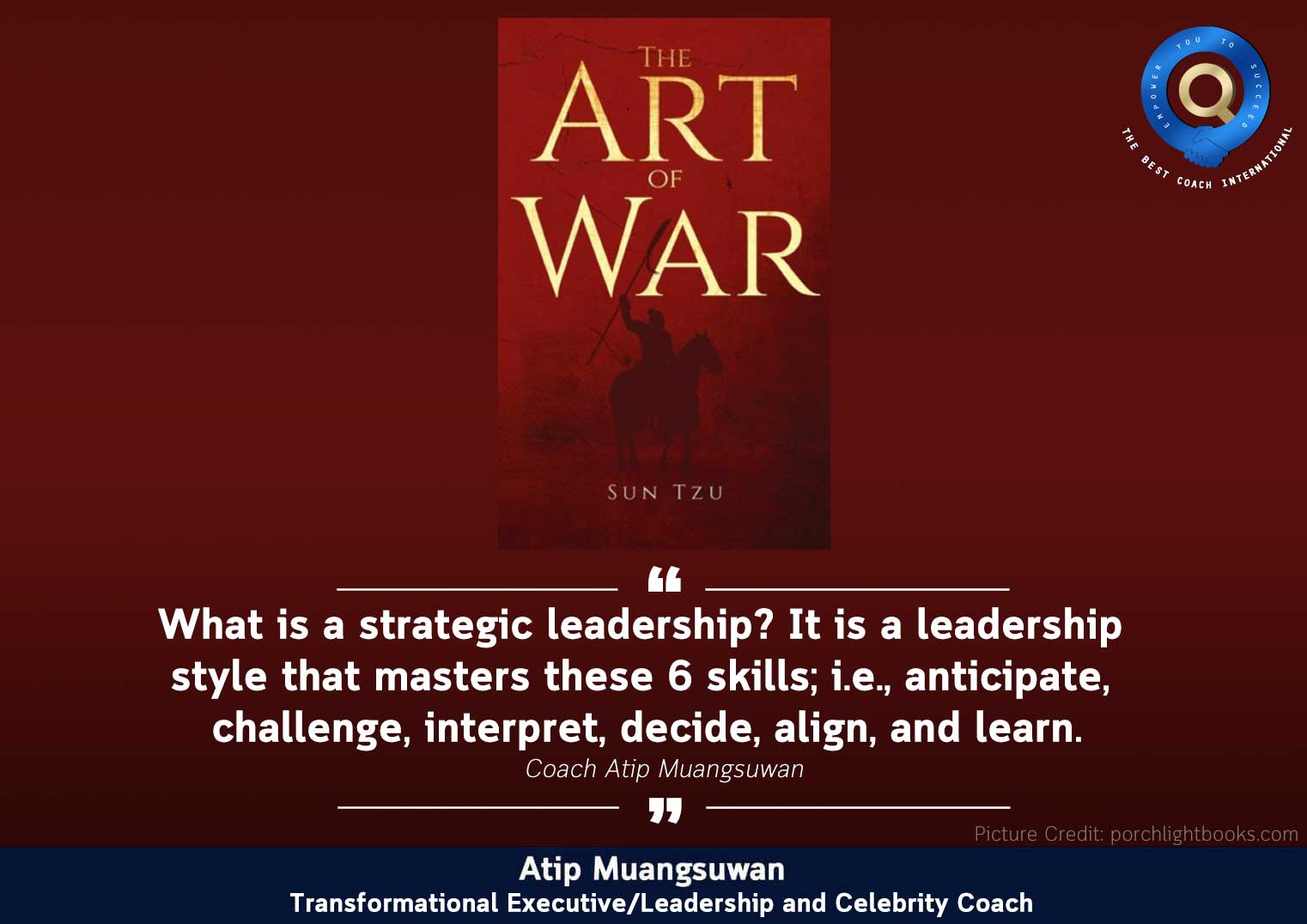
Sun Tzu wrote: “Victorious warriors win first and then go to war, while defeated warriors go to war first and then seek to win.”
The victory Sun Tzu speaks of isn’t won in the flood. It’s won in the calm before — in the meetings, the forecasts, the preparations that most people never see. Or never make.
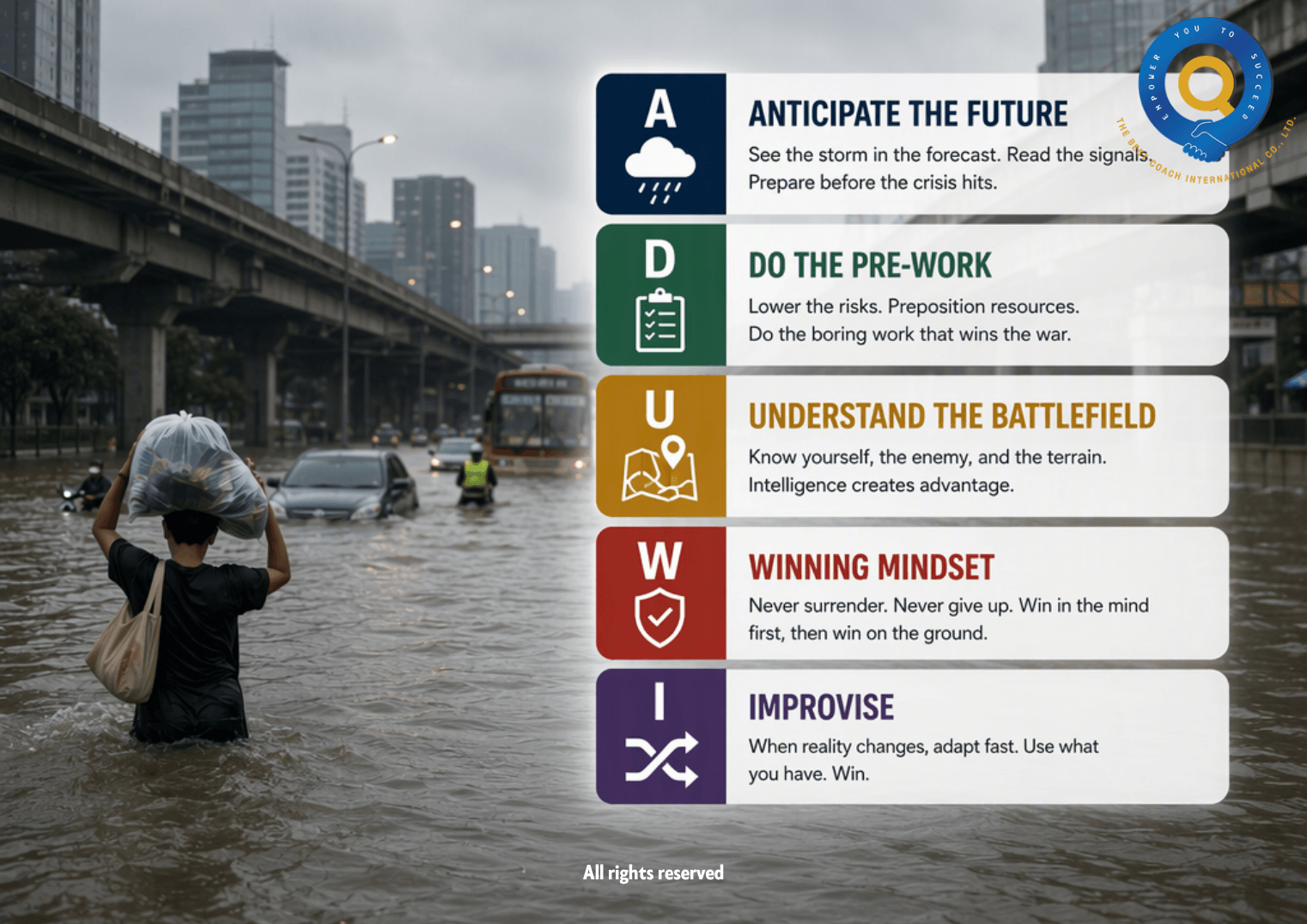
Let me walk you through what that looks like in practice. I call it the ADU-WI Leader as Strategist Framework — a discipline I’ve refined over years of coaching leaders across the globe, built from Sun Tzu’s timeless principles and sharpened by real-world crises like the one unfolding in Bangkok right now.
A — Anticipate the Future
Before the first raindrop fell, the warning signs were there. The Smart Water Operation Centre had confirmed rising water flows from the north on September 18. The Royal Irrigation Department issued flood alerts for 11 provinces. The data was clear: a swirling low-pressure system was combining with the southwest monsoon. The forecasters knew.
Anticipation isn’t fortune-telling. It’s the discipline of reading the signals everyone else ignores.
The leaders who win are the ones who see the flood in the forecast — not in the floodwaters.
D — Do the Pre-Work
Here’s where strategy becomes action.
If the authorities had acted on those forecasts, they could have lowered water levels in Bangkok’s main canals before the rains arrived. They could have prepositioned pumps, evacuated vulnerable areas, stockpiled supplies.
The Prime Minister did order agencies to prepare aid from London — food, water, shelters, equipment — but only as the crisis was already unfolding.
Victory is secured in peacetime. The pre-work is unglamorous. It’s the boring meetings, the dry runs, the checklists no one reads until it’s too late. But it’s the difference between a city that bends and a city that breaks.
U — Understand Yourself, Your Enemy, and the Battlefield
Sun Tzu said: “If you know the enemy and know yourself, you need not fear the result of a hundred battles. If you know Heaven and know Earth, you may make your victory complete.”
In Bangkok’s case, the “enemy” was the rain — over 300 millimeters in 48 hours, a volume that overwhelmed a drainage system built for a different era. The “battlefield” was the terrain itself — the canals, the low-lying districts, the river that carries water from the north to the sea. And the “self” was the manpower, the pumps, the resources available to fight back.
Understanding isn’t a one-time assessment. It’s a living, breathing intelligence that updates with every changing condition.
The leaders who win are the ones who know the terrain so well that they can predict where the water will flow before it flows there.
W — Winning Mindset
Now the crisis is here. The water is rising. What separates the leaders who rise to the occasion from those who crumble?
A winning mindset.
This isn’t blind optimism. It’s the absolute conviction that you will win — not hope to win, not try to win. Win. Never surrender. Never give up. Not when the first district floods. Not when the 50th is submerged.
Sun Tzu’s wisdom isn’t about avoiding battle. It’s about knowing which battles you can win — and then committing everything to winning them.
The flood is a war. And like any war, it’s won first in the mind, then on the ground.
I — Improvise
This is the piece most leaders miss.
You can anticipate. You can prepare. You can understand. And then reality hands you something you never saw coming.
Bangkok’s drainage infrastructure wasn’t built for 300 millimeters in 48 hours. The pumps — working at full capacity, draining 1,200 cubic meters per second — still couldn’t keep up. The dams had to release more water to prevent upstream collapse.
So, what do you do?
You improvise. You use what you have — the manpower, the equipment, the geography itself. You drain the canals into the Chao Phraya, and the Chao Phraya into the sea. You deploy the military. You mobilize volunteers. You MacGyver your way through the crisis with duct tape and determination.
A plan is a starting point. Not a script.
Sun Tzu planned meticulously. He also won battles by adapting on the ground. That’s the paradox of strategy: prepare like a chess grandmaster, then improvise like a jazz musician.
The Real Lesson
Bangkok’s flood will recede. The waters will return to the canals, the canals to the river, the river to the sea. The city will dry out. The headlines will move on.
But the question will remain: Will we learn?
Because here’s the truth I want you to sit with: most leaders are firefighters. They wait for the blaze, then run toward it with a hose. They’re heroic. They’re exhausted. And they’re replaceable.
Strategists are architects. They see the fire before it starts — and often, they make sure it never starts at all.
And when it does start anyway? They improvise. They adapt. They win.
The ADU-WI Leader as Strategist Framework isn’t theory. It’s a discipline. And like any discipline, it’s built one deliberate rep at a time — sometimes with a coach who’s walked the path before.
I’ve spent my career helping global executives become the architects of their own futures. Not reacting to the storm, but anticipating it. Not fighting fires, but building fireproof systems.
If you’re ready to make that shift — from firefighter to architect — I’d be honored to walk that path with you. Let’s connect!
Because the flood is coming. The only question is: will you be ready?
About Atip Muangsuwan: Atip is an executive leadership coach who specializes in helping high-achieving leaders overcome internal barriers to unlock their full potential and drive organizational success. Through a blend of strategic frameworks and profound personal insights, he empowers leaders in transforming their mindsets, emotional states, and behaviors for lasting impact.
SHARE :
Facebook
LinkedIn
Twitter