


The Leader as Coach: How One Global Executive Transformed His Leadership with the LAR-SE Model
By Atip Muangsuwan
“The best communicator is not the one who speaks the most eloquently, but the one who creates the clearest understanding between both parties.”
Atip Muangsuwan
CEO Coach and Coach Supervisor
A Masterclass in Listening, Asking, Reflecting, Sharing, and Empowering
Let me share a story about a leader I’ll call Charlie.
Charlie runs engineering for a global company. Overseeing dozens of critical projects, he spends his days in back-to-back meetings, firefighting technical crises, and making high-stakes decisions that impact teams across continents.
From the outside, he looked like he had it all figured out.
Inside? He felt like a bottleneck.
Every morning, his direct reports lined up outside his virtual door, seeking his approval on decisions they could—and should—be making themselves. The weight of it all was exhausting. His calendar was bursting. His team was capable but cautious. And somewhere along the way, Charlie had stopped leading. He had become a traffic cop for decisions rather than a coach who unlocks potential.
When I met Charlie, he told me something that stopped me cold: “I don’t want to be the smartest person in the room anymore. I want the room to get smarter without me.”
That, right there, is the heart of the leader as coach philosophy.
The Moment Everything Changed
Charlie had just completed a Coaching Academy course on the fundamentals of coaching. He understood the theory. What he needed was the practice—real-time, real-stakes, real-conversation practice. So, we designed a unique learning methodology: I would coach Charlie on his professional goals, and in the process, he would observe how a coach operates.
Two birds, one stone.
- First, Charlie would achieve meaningful personal and professional outcomes by being coached.
- Second, Charlie would learn the coaching approach firsthand by experiencing it as a coachee.
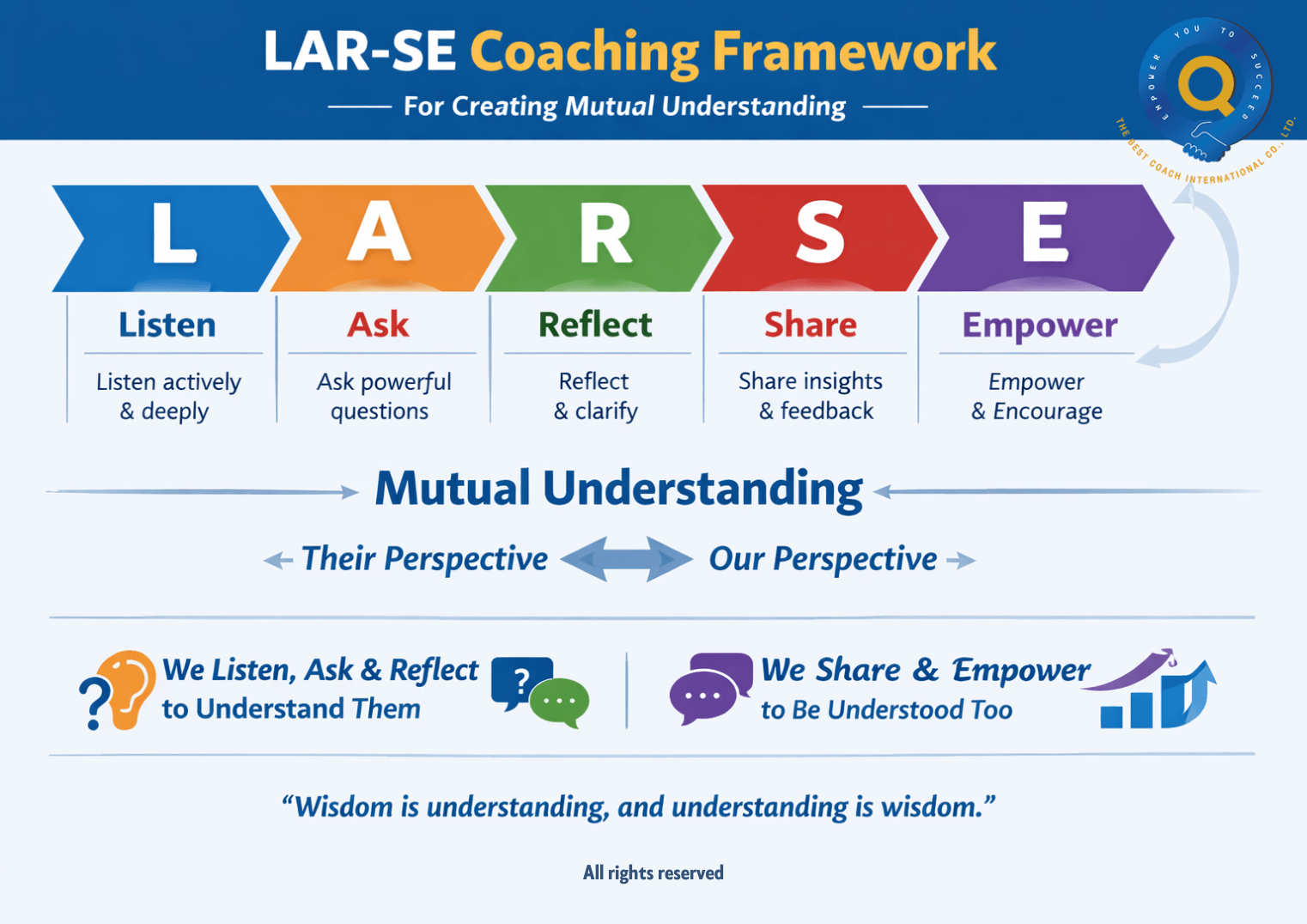
And that’s when I introduced him to a framework I have developed over years of coaching leaders across industries. A simple, five-step model that transforms ordinary conversations into breakthrough dialogues.
I call it the LAR-SE Model.
LAR-SE: The Coach Approach for Effective Leaders
The LAR-SE Model is not about becoming a professional coach. It is about becoming a leader as coach—someone who leads through dialogue, curiosity, and empowerment rather than commands, control, and compliance.
Here is how it works.
L — Listen Actively and Deeply
Most leaders listen just enough to formulate their response. That is not listening; that is waiting. The L in LAR-SE demands more. It means listening to understand the other person’s needs, expectations, motivations, pain points, concerns, worries, and fears.
According to the World Economic Forum’s Future of Jobs Report 2025, active listening is a critical skill for career success, particularly for leaders. Yet the majority of leaders listen only to respond, not to understand.
When Charlie began practicing active listening with his team, he stopped finishing their sentences and started finishing their thoughts. The shift was almost immediate. People felt seen.
As one leadership expert puts it, when employees feel genuinely heard, they move from guarded performance to authentic contribution.
A — Ask Powerful Questions
Questions are the engine of discovery. They uncover what lies beneath the surface. Powerful questions evoke self-awareness in the other person. They don’t assume; they explore.
In leadership coaching, keeping a short list of powerful questions handy and internalize them can transform any conversation: What does success look like here? What is the real problem to solve? What options do you see? What is the next step?
Charlie learned to replace his default question— “What do you need from me?” —with a far more potent one: “What do you think we should do?”
The difference was electric.
R — Reflect Back What You Hear
Reflection is the bridge that turns listening into understanding. When you reflect back what you hear, you clarify issues, problems, dilemmas, needs, and expectations. You create mutual alignment.
This is not parroting. It is synthesis. As one Forbes Coaches Council member notes, a simple discipline can be transformative: “What I’m hearing is … Did I capture that correctly?” This practice demonstrates respect, reduces reactivity, and signals that the conversation has value.
Charlie began summarizing his team members’ perspectives before offering any input of his own. The result? Fewer misunderstandings. Faster alignment. Deeper trust.
S — Share from Your Side
This is where LAR-SE breaks from traditional coaching models. Traditional coaching often keeps the coach’s perspective in the background. But when you are a leader as coach, you are not a neutral third party. You have skin in the game.
The S in LAR-SE invites you to share your information, data, facts, feedback, thoughts, views, perceptions, stories, feelings, needs, expectations, motivations, pain points, concerns, worries, and fears with the other person sitting across you.
This is the vulnerability move. This is where you show your humanity.
Charlie used to keep his cards close to his chest. He believed that leadership meant projecting certainty at all times. But when he started sharing his own challenges and uncertainties with his team—calibrated, of course—something remarkable happened. His team started sharing theirs. The walls came down. The psychological safety took place.
E — Empower or Encourage
The final step depends on who you are speaking with.
- When coaching your team or subordinates: Empower. Give them the autonomy, resources, and confidence to act.
- When speaking with peers, people above you, or colleagues from different Business Units: Encourage. Invite them to talk more while you listen more.
Because listening more is understanding more.
Charlie used to dominate team conversations. Now he leads them with silence. He waits. He encourages. He empowers. And his team has never been more engaged.
“The best communicator is not the one who speaks the most eloquently, but the one who creates the clearest understanding between both parties.”
That is the purpose of LAR-SE. A dialogue that creates mutual understanding between two parties.
Why the Leader as Coach Matters More Than Ever
The business case for coaching is overwhelming.
A landmark Metrix Global study found that executive coaching delivers a 788 percent return on investment when increased productivity and employee retention are considered. The International Coaching Federation reports that 86 percent of companies see a positive return on investment from leadership coaching programs. Research also shows that organizations with strong coaching cultures see 32 percent higher employee engagement and 32 percent higher employee retention rates.
Charlie’s engineering context made the case even more urgent. A 2025 global workforce survey found that about 74 percent of employers worldwide struggle to fill skilled roles, with engineering among the most difficult capabilities to recruit. Over the next twelve months, engineering leaders expect a shift from manual coding to AI oversight and governance, with new skills like prompt engineering and AI-agent management emerging.
In this environment, engineering leaders face a pivotal choice: evolve into strategic value creators or risk being sidelined as cost centers.
Charlie chose to evolve.
Putting LAR-SE into Action: Charlie’s Homework
After our session, Charlie left with a clear action plan:
- Practice the LAR-SE Model by coaching the two of his direct reports as they’re identified in his successor list. So, start from these two first.
- Require recommendations. He told his subordinates that whenever they wanted his decisions or solutions, they needed to come see him with their own proposed options and recommendations. This is to maximize his people’s potential.
- Share results. When we meet in the next session, Charlie will walk me through what worked, what didn’t, and where LAR-SE created breakthrough moments.
Charlie summarized our session into a single sentence: “Let’s do LAR-SE.”
Wisdom Is Understanding
“Wisdom is understanding, and understanding is wisdom.”
Leaders who understand their people unlock potential. Leaders who are understood by their people earn trust. LAR-SE creates the conditions for both.
Charlie is not a professional coach. He is a top leader of a global organization. He has now been a leader who listens, asks, reflects, shares, and empowers. A leader who has discovered that the best way to lead is to coach.
And you can do the same!
Your Next Step
Start small. In your next one-on-one conversation, try just one or two elements of LAR-SE like asking a powerful question and reflecting back what you hear. Then, sit in the silence and listen.
The transformation will not happen overnight. But it will happen.
Let’s do LAR-SE! If you want to learn more about coaching, let’s connect.
About Atip Muangsuwan: Atip is an executive leadership coach who specializes in helping high-achieving leaders overcome internal barriers to unlock their full potential and drive organizational success. Through a blend of strategic frameworks and profound personal insights, he empowers leaders in transforming their mindsets, emotional states, and behaviors for lasting impact.
SHARE :
Facebook
LinkedIn
Twitter