


Against All Odds: The Four-Hour Swim That Defined True Resilient Leadership
By Atip Muangsuwan
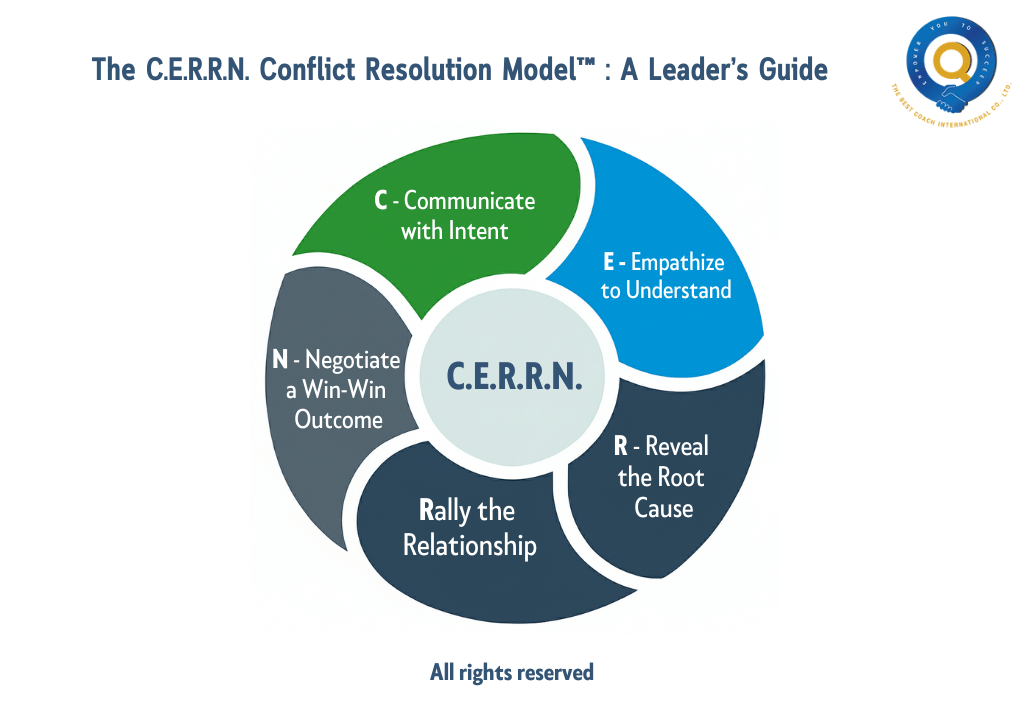
Transform your workplace in 4 clear steps – proven by real results.
“Austin Appelbee’s story transcends mere survival—it offers a masterclass in resilient leadership under extreme duress. His actions demonstrate that true leadership isn’t about position or age, but about character in crisis.”
Atip Muangsuwan
CEO Coach and Coach Supervisor
The Decision That Changed Everything
The Indian Ocean off Quindalup was turning hostile. What began as a calm morning paddle had become a fight for survival for the Appelbee family. With their kayak swamped, the shore a distant memory, and the sun beginning its descent, Joanne Appelbee faced an impossible choice. Her eyes met those of her eldest, 13-year-old Austin. The words that followed would set in motion one of the most remarkable tales of resilience ever recorded.
“Try to get to shore and get some help,” she told him, her voice steady despite the churning fear. “This could get really serious really quickly.”
Austin nodded, the weight of his family’s lives settling on his young shoulders. He was the strongest swimmer. He had to go. With a final look at his mother, 12-year-old brother Beau, and 8-year-old sister Grace, he turned toward a shore he could no longer see and began what rescuers would later call a “superhuman” journey.
The Long Swim Home
Hour One: Abandoned Equipment
Austin initially tried to paddle the failing kayak, fighting waves that seemed determined to push him further out. The kayak was taking on water, becoming an anchor rather than a vessel. In a critical moment of decision-making under pressure, Austin made his first strategic choice—he abandoned the kayak. With his life jacket still on, he began to swim, each stroke a battle against the relentless sea.
Hour Two: A Risky Gamble
Fatigue set in deep. The life jacket that promised safety now hindered his progress, fighting against his strokes. In shark-inhabited waters, under fading light, Austin made another fearless decision. He ditched the life jacket. “The brave fella thought he’s not going to make it with a life jacket on, so he ditched it,” recounted Paul Bresland of Naturaliste Volunteer Marine Rescue. For the next two hours, he would swim without it—a calculated risk that showcased extraordinary judgment for someone his age.
The Mental Marathon
As his body screamed in protest, Austin deployed mental strategies that would challenge most adults. “I was trying to get the happiest things in my head,” he recalled. “And at this time, you know, the waves are massive, and I have no life jacket on … I just kept thinking ‘just keep swimming, just keep swimming.'”
He turned to prayer and Christian songs, making promises in his desperation. “Throughout the next two hours, it was prayer, Christian songs and happy thoughts which kept me going,” he told the BBC. His focus never wavered from the singular goal: reach shore, get help, save his family.
Meanwhile, A Mother’s Vigil
As Austin fought his way toward shore, Joanne Appelbee faced her own trial. Tethered together on paddleboards with her younger children, she maintained a façade of calm. “We kept positive, we were singing, and we were joking,” she said, treating it as a game for the children’s sake.
But as darkness enveloped them, reality set in. “As the sun went down, I thought something’s gone terribly wrong here and my fear was that Austin didn’t make it.” When Beau lost feeling in his legs from the cold, Joanne began preparing for the end. “It was the end, it was definitely the end,” she remembered thinking, looking skyward to send a final message to her mother in Ireland.
The Final Push and Collapse
After four hours of continuous swimming through rough seas, Austin felt sand beneath his feet. He had covered approximately four kilometers. “I finally made it to shore, and I hit the bottom of the beach, and I just collapsed.”
But his mission was only half complete. After resting briefly, he ran two kilometers back to their accommodation, found his mother’s phone, and made the call that would save his family. “I said, ‘I need helicopters, I need planes, I need boats, my family’s out at sea.’ I was very calm about it,” Austin recalled with a maturity far beyond his years.
His detailed description of their kayak and paddleboards gave rescuers the critical information they needed. A multi-agency rescue team was immediately deployed.
Rescue in Darkness
At approximately 8:30 PM, nearly ten hours after their ordeal began, the rescue helicopter spotted Joanne, Beau, and Grace about 14 kilometers offshore. In a final cruel twist, a large wave had separated the children from their mother just minutes before rescue. Joanne could hear Grace screaming but couldn’t hear Beau.
“When the boat came and picked me up, and I screamed at them that there were two kids [still] in the water … I called for Grace, and I could hear her, and I still couldn’t hear Beau,” Joanne recounted, the terror still fresh in her memory. “I called out to kill the engine, and all of a sudden, I heard this little voice … and we picked them up, and it was the best feeling in the world.”
The Aftermath and Awakening
Austin had passed out on the beach after making the call, exhausted beyond comprehension. He awoke in Busselton Health Campus, consumed by guilt. “I realised they were gone, I thought they were dead,” he said. “I had a lot of guilt in my heart. I thought, ‘Oh man, I wasn’t fast enough.'”
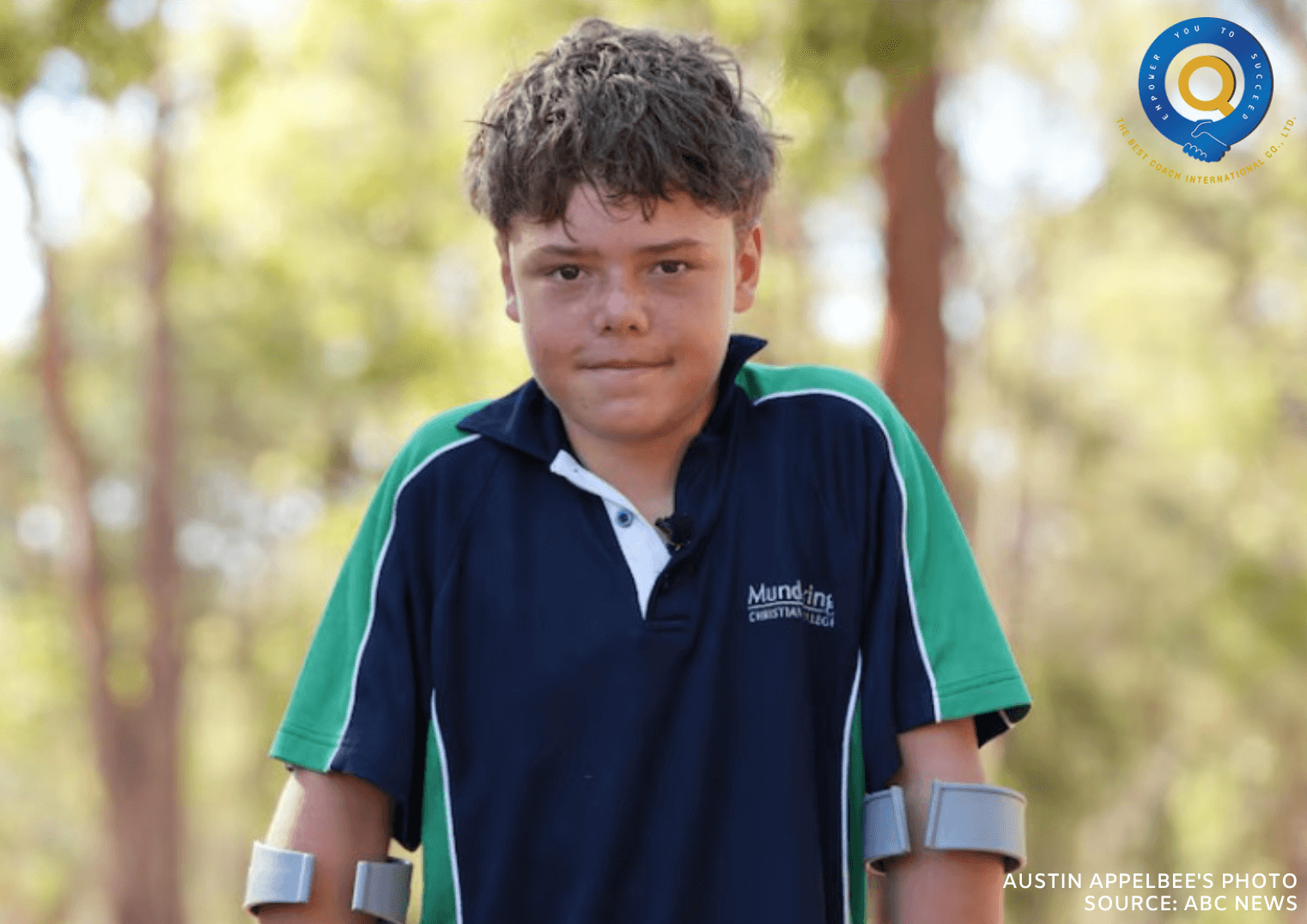
When news arrived that his family had been rescued, the relief was overwhelming. The physical toll was substantial—Austin needed crutches to walk, having endured physical exertion equivalent to running two marathons. His family suffered swollen legs, blisters, and bruises, but they were alive.
Resilient Leadership: Lessons from Austin’s Story
Austin Appelbee’s story transcends mere survival—it offers a masterclass in resilient leadership under extreme duress. His actions demonstrate that true leadership isn’t about position or age, but about character in crisis:
- Decisive Action in Critical Moments: Austin made multiple strategic decisions when it mattered most—abandoning failing equipment, modifying his approach, and maintaining his objective despite overwhelming obstacles.
- Mental Fortitude Over Physical Strength: Though a capable swimmer, Austin had previously found it “quite tiring” to swim 350 meters without a break. His four-kilometer swim was powered not by superior physique but by unwavering mental resilience. He created and deployed coping strategies (happy thoughts, prayer, songs) to overcome physical exhaustion.
- Clarity of Purpose: Throughout his ordeal, Austin never lost sight of his mission: get help for his family. This singular focus allowed him to make difficult decisions and persevere when his body begged him to stop.
- Effective Communication Under Stress: Upon reaching shore, Austin provided precise, actionable information to emergency services that directly contributed to the successful rescue.
- Sacrificial Responsibility: Austin accepted the enormous burden his mother placed on him without hesitation, understanding that his family’s survival depended on his actions.
Western Australia Premier Roger Cook captured the essence of this leadership when he declared: “Austin’s bravery is beyond his years, showing remarkable courage, resilience and determination in the face of real danger.”
The Unbreakable Human Spirit
In a world often captivated by fictional heroes, Austin Appelbee’s true story reminds us that extraordinary courage exists in ordinary people. His journey through dark waters reflects our capacity to find strength we never knew we possessed when those we love are at stake.
The Appelbee family now faces recovery, particularly from what Joanne calls “the mental scarring.” But as she powerfully stated: “We made it, we’re alive, and that’s the most important thing. I have three babies. All three of them made it. That was all that mattered.”
Austin’s four-hour swim through rough, open ocean teaches us that resilience isn’t the absence of fear or fatigue—it’s the decision to continue despite them. It’s the embodiment of the phrase he repeated like a mantra: “Just keep swimming.” In those three words, we find a blueprint not just for survival, but for leadership in our darkest hours.
(This article is based on firsthand accounts from the Appelbee family and rescue officials as reported by ABC News and BeachGrit in February 2026. Austin Appelbee was 13 years old at the time of the incident.)
Ready to become a resilient leader in the AI Era? This is the core of the work I do with leaders. Book your discovery session with me now to transform how you lead in the AI Era.
About Atip Muangsuwan: Atip is an executive leadership coach who specializes in helping high-achieving leaders overcome internal barriers to unlock their full potential and drive organizational success. Through a blend of strategic frameworks and profound personal insights, he empowers leaders in transforming their mindsets, emotional states, and behaviors for lasting impact.
SHARE :
Facebook
LinkedIn
Twitter