



The Art of Connections: A Leader’s Journey to Mastering Effective Presentations, Communications and Public Speaking
By Atip Muangsuwan
“Effective communications can be measured by the understanding of our audience.”
Atip Muangsuwan
CEO Coach and Coach Supervisor
He stood at the edge of the stage, palms slightly damp, running through his slides for the hundredth time. In just twenty minutes, he would deliver what he believed was a make-or-break presentation to his global leadership team.
But something felt off.
Ben—a Business Unit Leader for a multinational corporation, a respected voice in his religion community, and a devoted father—had always been a competent communicator. Yet competence, he was discovering, rarely equals effectiveness. His presentations were thorough, data-rich, and logically sound. But were they landing? Were they moving people? Were they creating the impact he desperately wanted?
That question—the gap between delivering information and creating genuine connection—is what brought him to our coaching session.
The Moment of Truth
“Atip,” he confessed as we began, “I can feel when I’ve lost a room. It’s like watching them mentally check out, one by one. The same thing happens when I’m trying to explain something to my children or when I’m speaking at my community events. I’m saying the right words… but nobody’s truly listening.”
I recognized that frustration. It’s the unspoken crisis of modern leadership. We’ve been trained to communicate at people, not with them.
Ben was ready for something different.
The AM-DQ Framework: Where Connection Begins
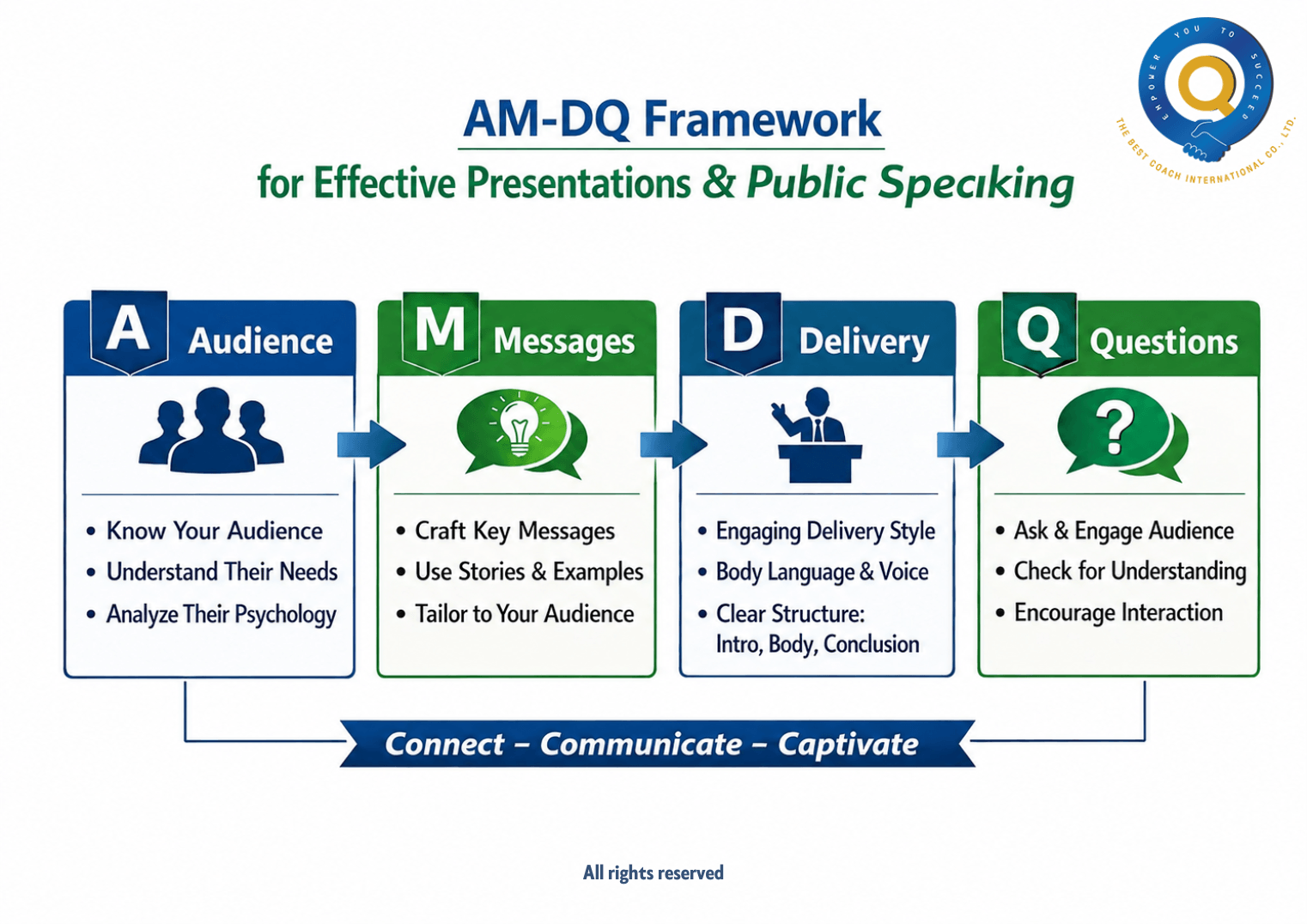
What emerged from our session wasn’t just another presentation template. It was a complete reimagining of what effective communication truly means—a framework we distilled into four simple letters: AM-DQ.
Audience, Messages, Delivery, Questions.
It sounds simple. But as Ben discovered, simplicity is often the most profound complexity.
- Audience: The Heart and Soul of Everything
“Let’s talk about your next big presentation,” I suggested. “Who’s in the room?”
Ben listed off titles and roles—VPs, regional directors, cross-functional partners. But I pressed deeper.
“What do they need? What keeps them up at night? What are they worried about right now that your presentation could actually address?”
The shift in Ben’s expression was immediate. He’d been preparing content based on what he wanted to say. He hadn’t been thinking about what they needed to hear.
“This is the critical pre-work,” I explained. “Most leaders spend 90% of their time crafting their message and 10% understanding their audience. We need to flip that ratio.”
For Ben, this insight unlocked something powerful. He began applying it everywhere—studying his executive audience’s quarterly concerns, understanding what his religion community elders were wrestling with in their roles, even paying closer attention to what his teenage children were truly communicating beneath their surface words.
- Messages: Start with the Why
“When you open your laptop to create a presentation, what’s your first move?” I asked.
“Graphics. Charts. The data story.”
“Try this instead,” I suggested. “Start with your key messages—three to five words or phrases that capture everything you need to communicate. Build everything around those.”
Ben was skeptical. He’d always believed that more information equaled more influence. But when he stripped his next presentation down to its essential core messages, something surprising happened.
“It created space,” he later told me. “Space for stories, for metaphors, for examples that actually made things click for people. I wasn’t overwhelming them anymore. I was guiding them.”
His new approach? The key messages became the anchor. Everything else—graphs, case studies, data points—existed to illuminate those anchors, not overwhelm them.
And the most important shift? “I realized I needed to tailor everything to my specific audience, not just deliver a generic message I’d used before.”
- Delivery: Your Physical Presence as a Tool
Ben had always viewed his body, voice, and presence as secondary to his content. We explored the opposite perspective.
“Your delivery isn’t the wrapping paper—it’s part of the gift,” I told him.
We worked on the architecture: how a powerful introduction hooks attention, how a well-structured body builds understanding, how a closing creates lasting impact. But more importantly, we explored the feeling he brought to each moment.
“Your tone conveys more than your words,” I observed during a practice session. “Pause deliberately. Let your audience absorb what you’ve said. Use silence as emphasis.”
Ben began to see his own body as a communication instrument. Eye contact became a connector rather than a checklist. Vocal variety became a way to keep energy alive. Gestures became extensions of his message rather than nervous habits.
- Questions: From Monologue to Dialogue
This is where Ben experienced his biggest breakthrough.
“Your audience’s attention is a limited resource,” I explained. “If you talk for twenty minutes straight, their minds will wander by minute seven. They can’t help it—it’s basic human physiology.”
The solution? Questions. Not just at the end. Throughout the entire presentation.
Ben started embedding questions that required engagement. Some were rhetorical, creating internal dialogue. Others invited actual participation. Every three to four minutes, he’d pause and ask something that pulled attention back to the present.
“It completely changed the energy in the room,” he reported after his first practice session with his team. “People weren’t just receiving information—they were participating. Thinking. Owning the discussion.”
The Three Arenas of Application
What made Ben’s transformation remarkable was his determination to apply the AM-DQ framework to every part of his life.
At Work
He delivered presentations to his subordinates using the framework, testing and refining his approach. The feedback was immediate and positive. “They actually understood what I was trying to achieve, not just what I was saying.”
In His Community
When speaking at his religion community gatherings, he began with a simple question: “What’s the challenge you’re dealing with that’s not being discussed?” The vulnerability created connection. The framework helped him tailor ancient wisdom to contemporary concerns in ways that truly resonated.
At Home
Perhaps most importantly, Ben applied these principles with his children. Instead of delivering “advice,” he started asking questions that encouraged them to think. He considered their needs before formulating his messages. He realized that effective communication with his family wasn’t about being heard—it was about being understood.
The Measure of True Effectiveness
As our session drew to a close, Ben shared his key-message summary: “To test whether our presentation is effective, check with our audience.”
I shared mine: “Effective presentations can be measured by the understanding of our audience.”
It’s that simple, and that difficult. Communication isn’t about what you say—it’s about what they hear, what they understand, and what they feel.
Your Invitation
Ben’s journey represents what’s possible when leaders shift from broadcasting to connecting. The AM-DQ framework isn’t a technique—it’s a mindset that transforms how we show up in every interaction.
As an executive leadership coach, I’ve seen this work across industries, cultures, and contexts. The principles are universal because the human beings we’re communicating with are universal.
Whether you’re preparing for your next board presentation, speaking to your community, or simply trying to connect more deeply with your family, I invite you to consider: Who is your audience? What do they truly need? How can you make your communication a genuine conversation rather than a performance?
The results might surprise you as they already surprised Ben.
To learn more about the AM-DQ framework or to explore coaching opportunities, let’s connect.
About Atip Muangsuwan: Atip is an executive leadership coach who specializes in helping high-achieving leaders overcome internal barriers to unlock their full potential and drive organizational success. Through a blend of strategic frameworks and profound personal insights, he empowers leaders in transforming their mindsets, emotional states, and behaviors for lasting impact.
SHARE :
Facebook
LinkedIn
Twitter
RECOMMENDED ARTICLES :