

Effective Negotiation Skills: How Most Executives Get Negotiation Wrong
By Atip Muangsuwan
“The best kind of negotiations can be measured by asking a simple question: Is everyone going home happy?”
Atip Muangsuwan
CEO Coach and Coach Supervisor
Chris sat across from me, the weight of a multi-million-dollar global contract visibly pressing on his shoulders. As a high-level executive for a worldwide engineering firm, he had mastered the art of data. He walked into negotiations armed with spreadsheets, market analysis, and a confidence that bordered on rigidity.
Yet, he was exhausted.
“I win the deals,” he told me, “But I feel like I’m leaving a piece of myself—and my company’s soul—at the table every time. It’s a battle. I prepare for war, and I walk away with a treaty, but the relationship feels… bruised.”
Chris had fallen into the most common trap in the executive world: believing that negotiation is a game of chess where one must conquer the other. He was playing to win, but he was playing the wrong game.
I’ve spent several years coaching leaders across the globe, from Fortune 500 boardrooms to high-stakes engineering floors. I’ve seen the “Win-Lose” mentality drain the life out of brilliant careers. I told Chris what I tell all my clients: If you are negotiating, you are doing it wrong. You should be collaborating.
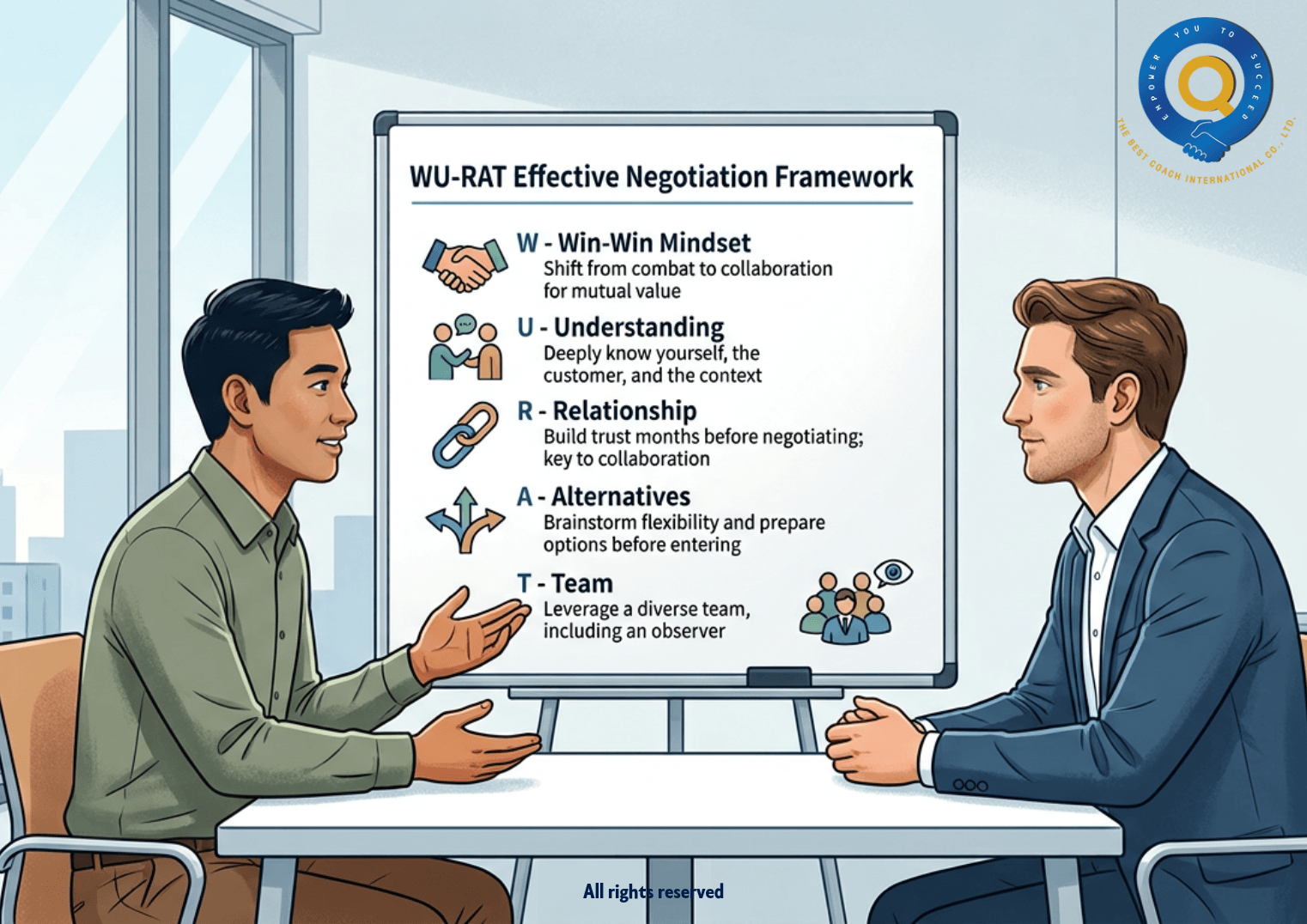
To transform Chris from a stressed-out dealmaker into a master of influence, we didn’t just practice tactics. We rewired his approach using a framework I developed called WU-RAT. It is a methodology that turns adversaries into partners and contracts into covenants.
Here is how we unlocked it.
The Shift: From Battlefield to Blueprint
Chris’s preparation was impeccable. He had the data and the internal team meetings. But he was missing the human element. He was focused on protecting his company’s interests rather than expanding them.
I introduced him to the WU-RAT Effective Negotiation Framework. It is an acronym that serves as a mental checklist for every high-stakes interaction.
1. W – The Win-Win Mindset
This is the foundation. Chris had to stop viewing the customer as an opponent. We shifted his goal from “getting what we want” to “extracting the best value for both parties.” When you aim for a win-win, you move from combat to collaboration. You stop trying to slice a pie and start trying to bake a bigger one.
2. U – Understanding
This is where most leaders fail. They understand their own needs but forget to understand the other party’s needs also.
“We must understand ourselves,” I told Chris. “Our needs, pain points, our fears, our strengths, our psychology. We must equally understand the customer’s needs, concerns, worries, their psychology. In addition, we must understand the context of our negotiation.” When Chris began to view the negotiation through the customer’s lens, the tension in the room dissipated. He wasn’t fighting a client; he was solving a problem for a partner.
3. R – Relationship
I often say that good relationship is the key to collaborative negotiation. You cannot build trust in the five minutes before you sit at the table; you build it months in advance. For Chris, this meant leveraging his natural ability to connect. For new clients, it meant creating a first impression that spoke of reliability, not just sales quotas.
4. A – Alternatives
This is the safety net. Before entering the room, we brainstormed alternatives. What if the client can’t meet the primary requirement? What can we offer instead? Having these ready doesn’t show weakness; it shows flexibility and saves hours of exhausting back-and-forth. It keeps the momentum moving forward when roadblocks appear.
5. T – Team
The lone wolf negotiator is a myth. For global engineering projects, Chris needed a team. But not just any team—a diverse one. We discussed the strategy of bringing different experts into the room and, crucially, designating one person purely to observe.
“You need someone to read the room,” I added. “Someone to watch the atmosphere. If the energy drops, your observer signals you to adjust the tone. You work as a unit before, during, and after.”
The Three Phases of Mastery
We didn’t stop at the acronym. We applied it to the timeline of the deal.
- Before: Apply the WU-RAT framework thoroughly.
- During: Keep the vibes positive, observe, and adjust.
- After: Follow up to ensure the deal is closed and the relationship is intact.
The Breakthrough
By the end of our session, the change in Chris was palpable. The tension had left his shoulders. He realized that his greatest asset wasn’t his engineering knowledge or his data—it was his humanity.
“I’ve learned that I can make use of my good relationship-building trait,” Chris reflected. “Effective negotiation is about building trust and creating win-win solutions.”
The Leader’s Takeaway
As executives, we are constantly negotiating—with clients, with boards, with our own teams. If you treat every interaction as a zero-sum game, you will eventually run out of opponents. But if you treat it as a collaboration, you build an empire of allies.
Chris walked away with a framework, but more importantly, he walked away with a peace of mind. He stopped fighting the current and started directing it.
Are you ready to master the art of the Win-Win negotiation?
If you find yourself exhausted by the “battle” of business, or if you want to elevate your leadership from managing tasks to inspiring collaboration, you don’t have to do it alone. As a global executive coach, I help leaders like you turn complex negotiations into seamless partnerships.
Stop negotiating. Start collaborating.
Discover how to lead with impact, let’s connect soon!
About Atip Muangsuwan: Atip is an executive leadership coach who specializes in helping high-achieving leaders overcome internal barriers to unlock their full potential and drive organizational success. Through a blend of strategic frameworks and profound personal insights, he empowers leaders in transforming their mindsets, emotional states, and behaviors for lasting impact.
SHARE :
Facebook
LinkedIn
Twitter
RECOMMENDED ARTICLES :