


The Mistake That Kept Happening (And the Framework That Finally Stopped It)
By Atip Muangsuwan
“Building a winning team starts with your leadership. As a leader, you need to act as a team coach for your team.”
Atip Muangsuwan
CEO Coach and Coach Supervisor
Peter had a problem.
Not the kind of problem that shows up on a quarterly report. Not the kind you can fix with a new process or a stern memo. Peter's problem was the kind that keeps executives awake at 3 a.m. — the kind that whispers, "This is never going to change."
He was the head of a global technology company. His teams were smart. His resources were ample. His strategy was sound. And yet, the same mistakes kept happening. Over and over. Human errors that delayed product deliveries. Mistakes his people had made before. Mistakes they knew they shouldn't make again.
Peter had tried everything.
He set up processes to control people. He rolled out KPIs to drive performance. He sent his teams to training workshops. He created a Continuous Improvement Team to drive change. He developed a Master Plan. Nothing worked. The mistakes kept coming. The delays kept piling up. And Peter kept asking himself the same question:
What am I missing?
The Moment Everything Changed
When Peter walked into our coaching session, he was frustrated but not defeated. He was a leader who had built his career on solving hard problems — and this was the hardest one yet.
"I've tried every tool in the book," he told me. "Processes, metrics, training, plans. Why can't I stop these mistakes?"
I listened. And then I asked him a question that changed everything:
"Peter, have you been building a system — or have you been building a team?"
He paused. The silence in the room said more than any answer could.
You see, Peter had been doing what so many brilliant executives do. He had been treating his people like variables in an equation. Fix the process, fix the problem. Improve the training, improve the results. But human beings are not variables. They are not cogs in a machine. They are people — with hopes, fears, relationships, and a deep need to belong to something bigger than themselves.
The mistakes weren't happening because his people lacked training or because his processes were flawed. The mistakes were happening because his teams weren't truly teams. They were collections of individuals operating in silos, without the one thing that makes a group of people unstoppable:
A winning team culture.
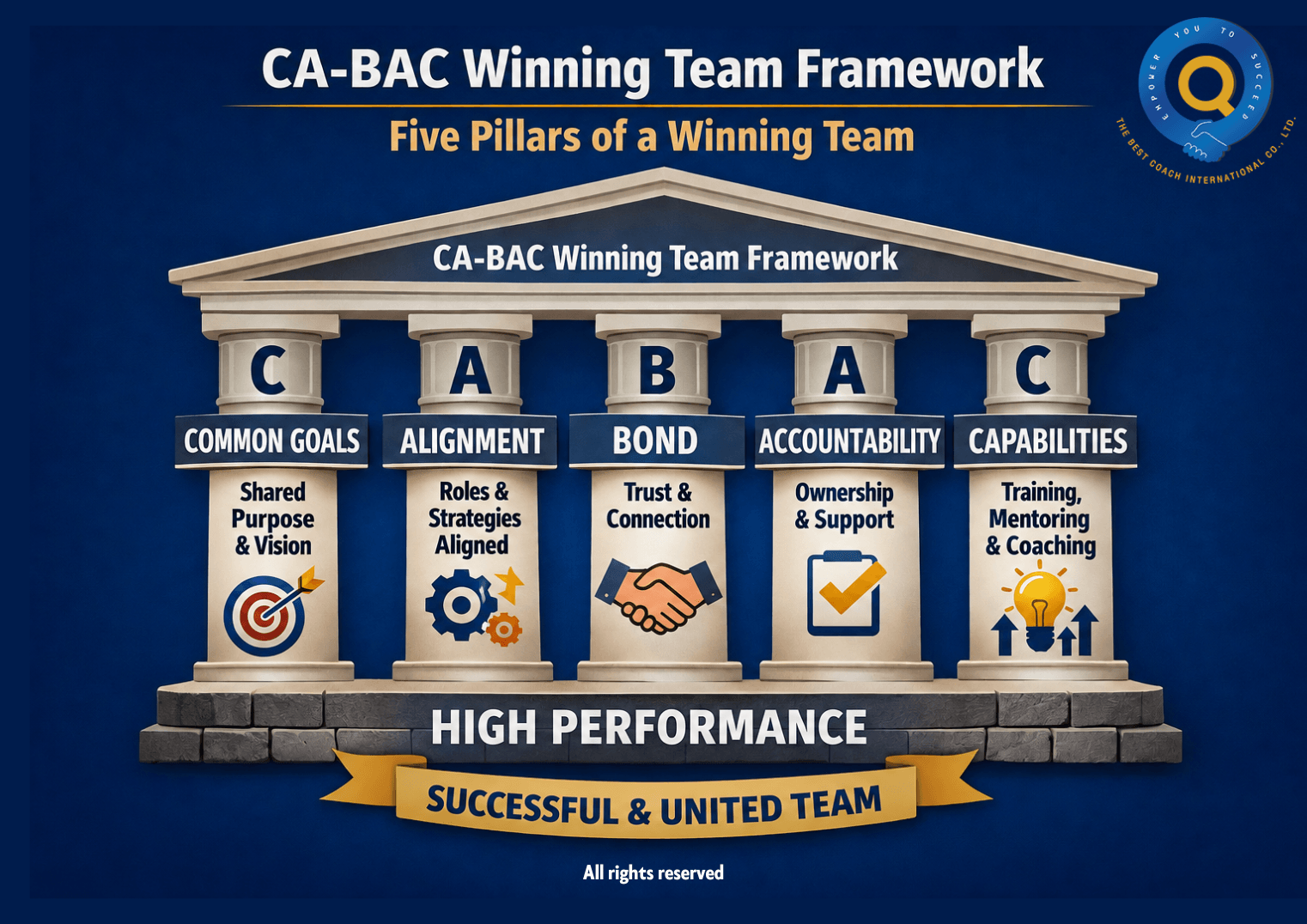
The CA-BAC Framework: Five Pillars of a Winning Team
This is where the real transformation began. I shared with Peter a framework I've developed over years of coaching global executives — the CA-BAC Team Winning Framework. It's simple. It's practical. And it works.
Here's what it looks like:
C – Common Goals
Winning teams share a common purpose. Not just a mission statement on a wall. Not just quarterly targets. A genuine, shared understanding of why they exist and what they're trying to achieve together. When team members are rowing in the same direction, the boat moves faster.
A – Alignment
Common goals aren't enough. Teams need alignment on how to achieve those goals. This means every member understands not just the destination, but the path to get there. It means clarity on roles, responsibilities, and the ways of working that will get them where they need to go.
B – Bond
This is the secret sauce. The bond between team members — the trust, the connection, the genuine care for one another — is what transforms a group into a team. When people feel psychologically safe with each other, when they know they can be vulnerable without judgment, they stop covering up mistakes and start solving them together.
A – Accountability
Winning teams have both individual accountability and collective accountability. Each person owns their piece. But they also own the team's success. When one person stumbles, the team catches them. When the team wins, everyone celebrates.
C – Capabilities
Finally, winning teams invest in capabilities — not just through training, but through a blend of Training, Mentoring, and Coaching (what I call the T-M-C approach). Because when individual capabilities multiply, team capabilities explode.
From Framework to Transformation
Peter left that session with a newfound clarity. The problem wasn't his people. The problem wasn't his processes. The problem was that he had been building a machine when he should have been building a team.
His action plan was simple but powerful:
First, he would apply the CA-BAC framework to his direct team — his inner circle of leaders.
Second, he would share the framework with his direct reports, teaching them the same principles he had just learned.
Third, he would take the framework to the production team — the very team where those repeated mistakes kept causing delays.
Fourth, he would deploy the framework across the entire organization, team by team.
And finally, he would share the success stories. Because nothing inspires change like proven results.
The Leadership Lesson Peter Learned
Here's what Peter discovered — and what I want you to take away from his story:
Building a winning team starts with your leadership.
Not with a new process. Not with a better KPI. Not with another training workshop. It starts with you — with your willingness to see your people not as resources to be managed, but as human beings to be led.
When Peter made that shift, everything changed. His teams started owning their mistakes instead of hiding them. They started solving problems together instead of pointing fingers. They started holding each other accountable — not because they had to, but because they wanted to.
And those repeated mistakes? They started to disappear. Not because the processes got better. Because the people got better. Together.
Your Turn
If you're reading this and recognizing your own story in Peter's, I want you to know something: You are not alone. Every great leader faces this moment. The moment when they realize that the systems and processes they've built aren't enough. That what their teams truly need is something deeper.
Something like a winning team culture.
Over the years, I've had the privilege of coaching CEOs, C-suite executives, and leaders across the globe — helping them transform not just their organizations, but their approach to leadership itself. I've seen what happens when leaders shift from managing people to leading them. I've seen the mistakes stop. I've seen the delays disappear. I've seen teams become unstoppable.
And I've seen leaders like Peter walk away from our sessions with something priceless: confidence. Confidence that they can build the teams they've always dreamed of. Confidence that they can create organizations that don't just perform — they win.
The One-Sentence Summary That Says It All
Peter summed up his transformation in just seven words:
"Build strong and winning team with CA-BAC."
And I added my own:
"The winning team starts with your leadership."
Your Next Step
The question isn't whether you can build a winning team. The question is: Are you ready to start?
Because the mistakes you're trying to prevent? The delays you're trying to stop? The performance gap you're trying to close?
They're not going to fix themselves.
But with the right framework — and the right leadership — they can be fixed. For good.
If Peter’s story resonates with you, I invite you to explore your story with me. Who knows, your leadership and your team culture might just be transformed, too.
About Atip Muangsuwan: Atip is an executive leadership coach who specializes in helping high-achieving leaders overcome internal barriers to unlock their full potential and drive organizational success. Through a blend of strategic frameworks and profound personal insights, he empowers leaders in transforming their mindsets, emotional states, and behaviors for lasting impact.
SHARE :
Facebook
LinkedIn
Twitter