


How One Executive Turned a Forced Career Pivot into His Greatest Opportunity with a help of the A-ART-S Framework
By Atip Muangsuwan
“The secret of coping with any change: Anticipate the changes, do the pre-work, accept the changes, turn them into your own advantages, take action, and ask for help and support.”
Atip Muangsuwan
CEO Coach and Coach Supervisor
There’s a moment in every leader’s career when the rug gets pulled out from under them. The phone call. The unexpected email. The tap on the shoulder from a manager with a look that says, “We need to talk.”
For Jason, that moment came on an otherwise unremarkable Tuesday afternoon.
After twenty-six years of mastering his craft—twenty-six years of accumulating knowledge, sharpening skills, and delivering excellence in a role he genuinely loved—Jason’s manager delivered a gut punch: effective immediately, he was being re-assigned to a new role with entirely new responsibilities.
No negotiation. No “Would you consider…” Just, “This is your new role. Deliver the results.”
Jason couldn’t say no. But inside? He was reeling.
That’s when he found his way to me—and to the A-ART-S Change-Coping Framework that would transform his forced pivot into a platform for breakthrough.
The Problem with Loving Your Job Too Much
Here’s what you need to understand about Jason: he wasn’t just good at his old role. He was exceptional. For over two decades, he had built his professional identity around expertise that few could match. His knowledge wasn’t just deep—it was earned, layer by layer, through years of dedicated execution.
And now, that identity was being stripped away.
“It’s not fair,” he told me during our coaching session. The frustration radiated off him like heat from asphalt. “I’ve given this company my best work for twenty-six years. And this is how they reward me?”
I listened. I validated. And then I asked him a question that stopped him cold:
“Jason, what if this change isn’t a punishment—but a promotion you haven’t yet claimed?”
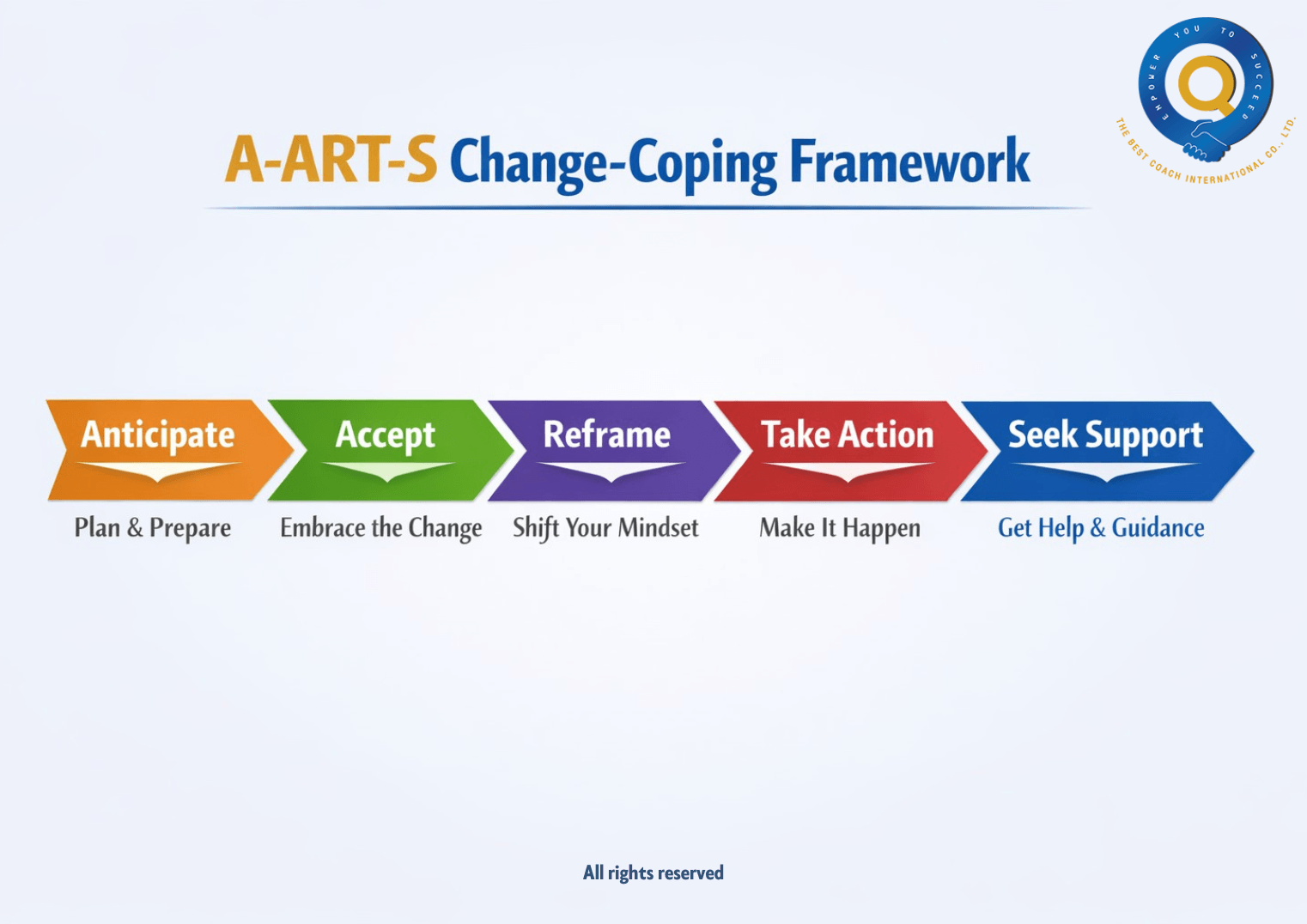
The A-ART-S Framework: Your Blueprint for Any Change
Before I share how Jason turned his crisis into a career-defining opportunity, let me walk you through the five pillars of the framework that made it possible.
A: Anticipate the Changes & Do the Pre-Work
Sun Tzu’s key principle in The Art of War is deceptively simple: anticipate the future and prepare for it before the battle arrives. The same principle applies to organizational change.
Most executives live reactively. They wait for the change to hit, then scramble to respond. But the leaders who thrive? They’re the ones who’ve already done the mental and strategic pre-work. They’ve asked themselves: What changes could be coming? What new skills might I need? What relationships should I be building right now?
Jason hadn’t done this work. Neither had most of his peers. That’s about to change for you.
A: Accept & Embrace the Changes
When change actually arrives—when it’s standing in your doorway, impossible to ignore—your first instinct will be to deny, escape, or run.
Don’t.
Acceptance isn’t surrender. It’s clarity. When you stop wasting energy fighting reality, you free that energy for something far more useful: strategic action. Embrace the change peacefully, not because you love it, but because resistance is the only thing standing between you and your next breakthrough.
R: Reframe Your Mindset
This is the secret weapon of the entire framework. Reframing changes your relationship with the change itself.
Instead of asking, “What am I losing?” you ask, “What am I gaining access to?”
Instead of seeing a problem, you see an emerging opportunity.
Jason’s reframe took him from victim to victor in a single coaching conversation. You’ll see exactly how in a moment.
T: Take Action on the Changes
Positive thoughts without action are just daydreams. Once you’ve reframed your mindset, you must move. Action is where transformation actually happens—where abstract possibility becomes tangible results.
S: Seek Help and Support
This is where even brilliant leaders stumble. They try to go it alone. They treat asking for help as a sign of weakness.
It’s not. It’s the smartest move you can make.
When you’re handling change alone, you’re operating with one brain, one network, one set of skills. When you seek help, you multiply your capacity exponentially.
The Shift: How Jason Applied A-ART-S
Let me show you exactly how this played out for Jason—because his story could be yours.
A (Anticipate): We started by acknowledging what he couldn’t change. The new role was happening. That ship had sailed. But we also looked forward: What future changes could he anticipate? What pre-work could he do now to protect himself next time?
Jason committed to a quarterly “change audit”—a simple thirty-minute review where he’d ask: What shifts are happening in my industry? In my company? What skills should I be building proactively?
A (Accept): This was the hardest step. For three weeks, Jason wrestled with acceptance. He wanted to fight. He wanted to appeal. He wanted to prove how unfair this was.
Then he made a choice. He stopped resisting and started accepting—not because he agreed with the decision, but because he recognized that resistance was consuming energy he needed for something better: winning in his new role.
R (Reframe): Here’s where the magic happened.
I asked Jason: “What do you actually want that you haven’t gotten yet?”
His answer came quickly: “A promotion. I’ve been waiting for years. My boss keeps saying ‘next review cycle’ and then nothing changes.”
“And what if,” I said, “this new role is your leverage to finally get that promotion?”
Silence. Then: “I never thought of it that way.”
The reframe was complete. Jason stopped seeing his new assignment as a demotion and started seeing it as negotiating power. He wasn’t being pushed aside—he was being handed the keys to a conversation he’d been too afraid to have for years.
T (Take Action): Jason didn’t wait. Within a week, he scheduled a meeting with his boss. His message was clear, confident, and reframed:
“I’ll deliver exceptional results in this new role. Here’s what I’m asking for in return: your commitment to promote me when I meet or exceed expectations.”
For the first time in years, Jason wasn’t waiting passively. He was acting strategically.
S (Seek Help): Jason also stopped trying to be a hero. He identified two subject-matter experts who could accelerate his learning curve in the new role and asked for their support. He built a small advisory team. He stopped pretending he had all the answers and started leveraging people who did.
The Aladdin Factor: If you want to get, you have to ask!
There’s a principle I’ve shared with the executives and leaders who work with me, drawn from one of the most powerful books on my recommended reading list: The Aladdin Factor by Jack Canfield and Mark Victor Hansen.
The principle is embarrassingly simple, yet almost no one actually follows it:
If you want something, you have to ask for it.
Not hint. Not hope. Not work harder and wait to be noticed.
Ask.
Jason asked for his promotion. He asked for help and support. He asked for resources he needed to succeed in his new role. And you know what? Most of what he asked for, he received—not because he was lucky, but because he finally stopped assuming people could read his mind.
The Results: What Happened Next
Within ninety days of applying the A-ART-S framework, Jason had transformed his entire trajectory.
His boss didn’t just give him a verbal commitment about the promotion—he put it in writing. Jason’s performance in the new role exceeded expectations precisely because he had asked for and received the support he needed. And for the first time in years, Jason wasn’t dreading Monday mornings.
He had turned a change he never wanted into a gold mine—and he was digging out the gold every single day.
Your Turn: Three Actions You Can Take Today
You don’t have to wait for a surprise re-assignment to apply these principles. Here’s what you can do right now:
- Anticipate & do your pre-work.What changes are likely coming in your industry or organization over the next three or six months? What skills, relationships, or resources would you need to thrive through those changes? Start building now.
- Reframe one thing today.Pick a change you’ve been resisting—a new process, a team restructuring, even a personal transition. Ask yourself: What opportunity might this be creating that I haven’t seen yet?
- Ask for something you want.Not next week. Today. One simple, direct request. Whether it’s resources for a project, a development opportunity, or honest feedback—practice the Aladdin Factor until asking becomes instinct.
One Insight to Remember
Jason’s takeaway from our work together was simple and powerful: “Ask for what you want.”
My takeaway for you is this: Anticipate the changes, do the pre-work, accept the changes, turn them into your own advantages, take action, and ask for help and support.
Do that, and you won’t just cope with change.
You’ll lead through it.
Ready to apply the A-ART-S framework to your own leadership challenges? Let’s talk.
About Atip Muangsuwan: Atip is an executive leadership coach who specializes in helping high-achieving leaders overcome internal barriers to unlock their full potential and drive organizational success. Through a blend of strategic frameworks and profound personal insights, he empowers leaders in transforming their mindsets, emotional states, and behaviors for lasting impact.
SHARE :
Facebook
LinkedIn
Twitter
RECOMMENDED ARTICLES :